Square Toe Flip Flops Catch the Front Edge on Stairs
The squared sole looks polished on level ground. On stairs, its projection, flex, and toe-post position decide whether it clears the step or folds underneath you.
Women's · November 14, 2026 · 7 min read
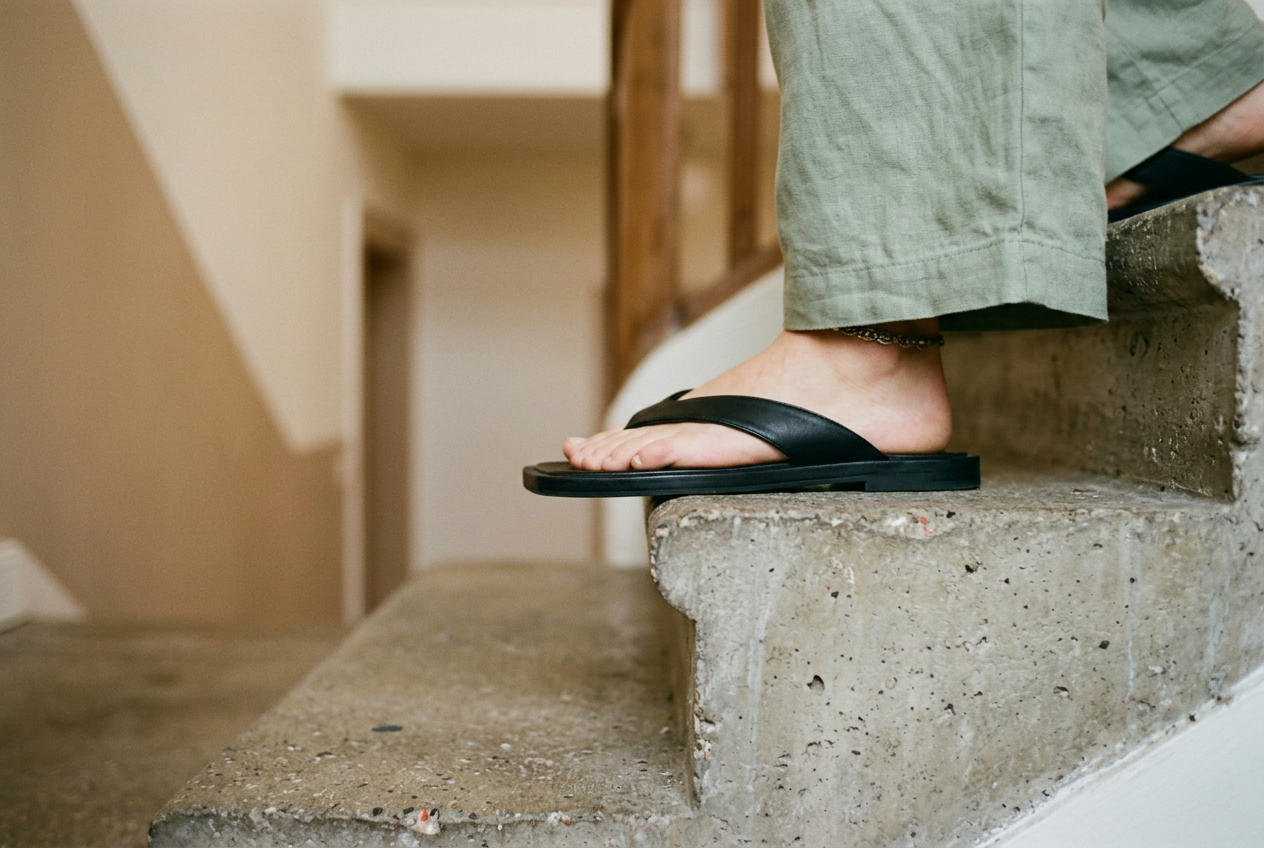
Square toe flip flops have been judged mostly from above, where the flat front line makes a basic thong sandal look sharper and gives wide-leg pants a tidy stopping point. The less flattering view is from the side, halfway up a staircase, as that extra corner meets the vertical face of the next step.
For this walking test, I wore one black women’s pair over a week on indoor stairs, outdoor concrete steps, ordinary curbs, and an escalator. The sandal had a molded EVA sole, meaning the lightweight foam base and footbed were formed as one piece, with narrow synthetic straps and a central toe post. Its squared front extended visibly beyond my longest toes, while the sole stayed nearly flat rather than curling upward.
That combination looked clean. It also produced a repeatable catch at the front edge whenever I climbed without lifting my foot quite high enough. This is women’s footwear coverage, and the sizing advice refers to women’s sandals, though the underlying mechanics apply to any square-toe thong construction.
The problem is the unused sole in front of the foot
Sole projection is the amount of outsole extending past the foot. Some projection protects toes from pavement and gives the square shape room to register, but once the edge sits well ahead of the longest toe, the sandal has to clear each step before the foot does.
On the test pair, my foot appeared to fit properly from above. The heel sat inside the back edge, the straps did not pull, and my toes stayed on the footbed. Yet the front still behaved as if I had chosen a longer size because the design placed much of its visual square beyond the usable toe area.
The corners caused more trouble than the center. A rounded flip flop can glance off a step when the foot approaches slightly crooked; a broad square front presents a flatter edge, and either corner can make contact first. The result was rarely dramatic. Most catches were small interruptions, just enough to fold the front down, make the heel slap, and remind me that elegance had requested closer supervision.
A stiff sole magnifies this. When the front catches, flexible EVA can bend and release as the foot continues upward, while a rigid platform or dense rubber unit resists the step and sends more of the interruption back through the toe post. Thin does not guarantee flexible, either. Some slim fashion soles bend at one abrupt line or barely bend at all.
Stairs expose the fit mistake first
The test pair behaved acceptably while descending because the heel led and the squared front remained behind the edge of each tread. Climbing was different. On a standard enclosed staircase, where every step has a vertical riser, the projecting front made contact whenever I placed only the ball of my foot on the tread and began lifting before the sandal had settled.
The catch happened more often at normal commuting speed than during deliberate testing. Once I watched every step, I lifted higher and cleared it. That is useful evidence, but hardly a comfort feature. Shoes that work only while receiving active instructions from the wearer are demanding shoes.
Toe-post placement mattered as much as sole length. A toe post is the piece anchored between the first and second toes that holds a thong sandal on the foot. On this pair, it sat slightly behind the point where my toes naturally wanted to rest, so my foot drifted backward while walking. That movement increased the empty sole in front and brought the edge closer to the stair riser.
Sizing down would have reduced the projection, but it was not a clean fix. The straps became tighter across the forefoot, and the heel moved too close to the back edge. With thong sandals, a shorter sole cannot correct a toe post placed too far back for your foot. It merely relocates the problem and may add rubbing between the toes for administrative efficiency.
A better square-toe fit held the foot farther forward without pulling the toe post hard into the webbing. The longest toe sat near the front while remaining fully supported, and the heel retained a narrow border of sole. That balance is more important than matching the size printed inside the shoe.
Curbs reward flexibility, within limits
Curbs produced fewer catches because there was no next riser immediately above the landing surface. The problem appeared during a lazy step-up, especially when the front of the sandal met the curb before I had raised my toes.
Here the molded EVA helped. The forefoot flexed, the edge folded briefly, and the sandal recovered without forcing the toe post backward. After a week, however, the squared corners showed the first visible scuffing, while the central front edge remained cleaner. The wear pattern matched the walking problem: the corners were reaching the obstacle first.
Too much softness would create a different nuisance. A very thin foam front can curl beneath the toes when it catches, leaving the wearer to step onto the folded sole. The useful construction has enough flexibility to bend across the ball of the foot, plus enough body at the front to spring flat again. During an in-store check, hold the heel and press the front upward.
The sole should bend near the forefoot rather than collapse through the middle or stay rigid from end to end.
The alternative is a softly rounded or almond-shaped thong sandal with the same narrow straps. It gives up the severe square outline, but it clears uneven pavement more naturally and disguises small differences in toe length. For anyone regularly taking station stairs or stepping on and off sidewalks, that is a practical trade rather than a retreat from fashion.
Escalators add a placement problem
The test pair did not catch while stepping onto a moving escalator, but the broad front changed where I wanted to stand. I kept the entire sandal within one tread and away from the comb plate, the toothed landing section where the moving steps flatten and disappear.
Square corners make the shoe’s boundary easy to see, which is helpful, yet the extra projection also means the visible edge may sit farther ahead than the toes suggest. A long, floppy front is a poor escalator companion because it can bend beyond the tread while the foot still feels securely planted. No sandal shape makes standing near the side or across a step junction sensible.
Stepping off required a slightly more positive lift than walking off in sneakers. The EVA sole cleared cleanly when my foot came up as one unit; if I shuffled forward, the front edge brushed the landing before my toes reached it. Nothing catastrophic occurred, but the repeated instruction was obvious: pick up the whole shoe.
Check the sandal from the side before keeping it
The useful fitting test takes less time than another return. Put on both sandals, stand with your weight evenly distributed, and look from the side rather than relying on the top view in a mirror. The square outline should remain visible without creating a shelf of unused sole ahead of the longest toe.
Then walk up any available fitting-room platform or low step, if the store permits it. A flat showroom floor hides this issue. At home, keep the outsole clean and use a staircase during the return window. Climb at your normal pace rather than performing the careful, high-kneed walk people adopt when evaluating shoes they hope to keep.
Pay attention to whether the foot slides backward. Loose straps, a toe post positioned too far toward the arch, or a slick footbed can all increase the projection during wear, even if the sandal looked correctly sized while standing still. A textured EVA footbed held my foot better than a smooth synthetic surface, though texture cannot rescue a mismatched toe-post position.
The test pair remained wearable for short, level outings, and the thin black straps looked polished enough with a straight skirt or loose trousers. I would not choose it for a route built around stairs. The week-long corner scuffing was cosmetic, but it confirmed that the squared front was doing more contact work than the rest of the sole.
For a fashion-first pair used mainly at dinners, offices, or short walks, a moderate square can earn its place. If stairs form part of the daily route, choose the version whose shape comes from a slightly flattened toe line rather than a long rectangular platform. You still get the current silhouette. You give up less attention to the pavement.
Questions people ask
Should square toe flip flops have space in front of the toes?
A narrow border keeps toes on the footbed and preserves the square outline. A broad shelf of empty sole increases the chance of catching a stair riser, especially if the foot slides backward while walking. Judge the space while standing and after several laps around the room.
Does a thicker sole make square toe flip flops safer on stairs?
Not by itself. A thick sole can protect the toes and resist folding, but a rigid platform with heavy front projection may strike steps more abruptly. Look for controlled flex near the ball of the foot and a front edge that stays close to the longest toe.
Can sizing down stop the front edge from catching?
Only when the original size is genuinely too long and the smaller size still supports the heel and toes. Sizing down will not fix a toe post that holds the foot too far back, and tighter straps may exchange stair catching for pressure between the toes.
Are rounded flip flops better for frequent stair climbing?
Usually. A rounded front has less corner projection and tends to glance past a step when the foot approaches at a slight angle. A modestly squared toe can still work, provided the sole bends at the forefoot and does not extend far beyond the toes.
One update a day
Today's fashion update, in your inbox
One fashion update each morning — no hype, no filler, just pieces worth wearing.