Your Belt Size Is the Distance to the Hole You Use
The number stamped inside a belt may describe its middle hole, total length, or a body measurement. One tape measurement lets you compare those systems without losing adjustment room.
November 18, 2026 · 7 min read
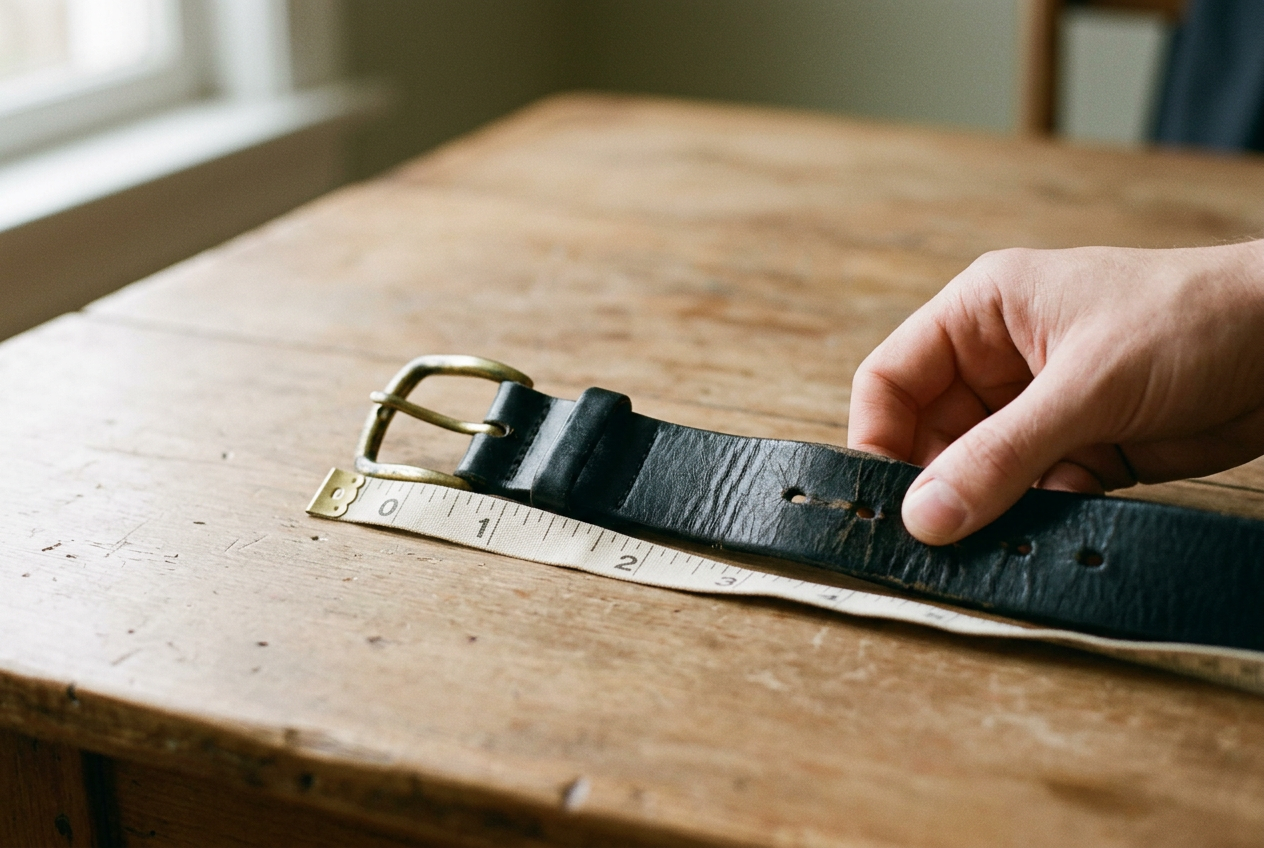
A black leather belt, 30 millimeters wide, with five holes and a rectangular brass buckle is the useful object here. Worn at the natural waist over a cotton dress, it closes comfortably on its third hole. Its full length tells us almost nothing about fit; the working distance between buckle and hole does.
That distinction matters because brands use “belt length” to mean different things. One chart may list the distance from the buckle attachment to the middle hole. Another may give the strap’s total length. A third may recommend a labeled size from a body measurement, leaving the construction math hidden.
The same printed number can therefore describe belts that fit differently.
This is unisex advice. Buckle construction, clothing thickness, and where the belt sits matter more than the department where it is sold.
Start with the belt that already fits
Lay the black leather belt flat without pulling it. A prong buckle, meaning a frame buckle with a hinged pin that passes through a hole, gives you a visible reference point. Place the tape at the center of the bar where the prong pivots, then run it along the strap to the center of the hole used most often.
Suppose that working measurement is 34 inches, or about 86 centimeters. Record both units if you shop across US and European size charts. Do not round it down to the nearest familiar pants size, and do not include the leather beyond the chosen hole. The remaining tail affects appearance and whether it reaches the keeper, but it does not define the current fit.
Measure to the center of the hole even if repeated wear has pulled it into a slight oval. Measuring to the stretched outer edge quietly adds length. On softer leather, that difference grows as the hole deforms, while coated canvas and dense synthetic straps tend to hold a cleaner opening.
The belt should be measured in the condition in which it is worn. If its leather has curved around the body, let it relax flat rather than forcing it straight under tension. Stretching the strap while measuring can turn a familiar fit into an order that arrives too short.
Prong buckles give the cleanest reference
The 34-inch figure is a personal fit measurement, but it is not automatically the size to select on every site. Read the chart’s measuring note. When a brand defines size as the distance from the buckle end to the middle hole, compare its stated distance with 34 inches and check where that would place your preferred setting.
A five-hole belt offers the best adjustment when the target measurement lands near the center hole. Hole spacing is not universal, so count the distance rather than assuming each step adds the same amount. A chart that provides the first-hole and last-hole measurements is more useful than one that gives only a size name.
The starting point can also shift by a small but meaningful amount. Some diagrams begin at the center of the buckle bar. Others begin where the strap folds around the buckle hardware. Follow the pictured reference when ordering from that brand; when measuring your own belt for a portable comparison, stay with the prong’s pivot point and note the method beside the number.
Buckle swaps complicate the result. A longer frame moves the front edge of the belt without changing the holes, while a removable buckle may attach through snaps or screws that shorten the usable strap. If the buckle will be replaced, measure the closed inside circumference after the swap rather than trusting the old label.
Plaque buckles change the arithmetic
A plaque buckle, where a broad metal plate forms the visible front closure, may use a concealed hook or post instead of an exposed prong. Measuring from that hook to a hole can omit part of the plate, even though the hardware occupies real space around the body. A wide plaque makes that omission large enough to spoil the comparison.
Close the belt on the setting that fits. Place a flexible tape against the inside surface and follow the complete loop, including the section formed by the buckle, without compressing the leather or fabric. That inside circumference is the useful number for matching the fit to another buckle style.
If the plaque belt cannot hold its shape while off the body, fasten it around a firm cushion or a box with rounded corners, then measure the inside path. This takes longer than laying a prong belt flat, but it captures the hardware contribution and the thickness of any overlapping strap.
Brand instructions still take priority at checkout. A size chart built around the strap’s attachment point and center hole may already account for the plaque width in the finished product, while a chart that lists total strap length may not. Look for a drawing. Without one, compare the stated size range with your closed-loop measurement and favor a returnable option.
The black 30-millimeter belt does not need this extra step because its rectangular buckle adds little ambiguity. Its 34-inch prong-to-hole measurement remains the cleaner shopping reference. A plaque belt that fits the same body, however, may show a different flat measurement and still produce the same inside circumference.
Waist and hip positions require separate numbers
A waist belt sits near the torso’s narrowest point; a hip belt crosses lower, often over belt loops and thicker layers. Moving the same belt down changes both circumference and the angle at which the strap lies. Pants rise matters too. A belt worn through low-rise loops cannot be sized from the natural waist measurement.
Measure the body over the clothing planned for the belt, keeping the tape close but not tight. Then compare that number with the working measurement of a belt worn in the same position. A cotton dress adds little bulk under the black leather belt. Denim waistbands, tucked knitwear, and a jacket worn beneath a belt require more room, though the exact difference belongs to the outfit rather than a universal allowance.
Contoured waist belts need special care. A contoured belt, meaning a strap cut with a curve rather than as one straight strip, can sit smoothly at the waist but resist dropping to the hips. Its edge lengths differ, so a flat end-to-end measurement is especially weak. Fasten it and measure the inside circumference at the line where it contacts the body.
Trying to make one short waist belt cover both placements often uses the last hole at the hips and leaves no room for heavier clothing. Buying longer fixes the hip fit but may produce an excessive tail at the waist, particularly when the belt has only one fixed keeper. Separate belts are the neater answer when the two working measurements sit near opposite ends of the hole range.
Compare size charts without trusting the size name
Begin with the 34-inch working measurement from the black belt. On each product page, identify whether the listed figure describes a body circumference, the distance to the middle hole, or the full strap. Translate only after that definition is clear.
For a middle-hole chart, choose the size whose center setting comes closest to the working measurement while leaving usable holes on either side. For a body-measurement chart, use the measurement taken over the intended clothing and confirm that the brand has already built in overlap. A total-length chart is the least portable because buckle length, tip shape, and the leather needed beyond the final hole all consume part of that figure.
Letter sizes deserve the same skepticism. Small, medium, and large have no transferable mechanical meaning without a measurement range. Pants sizing is also a rough lead rather than a final answer, since labeled waist sizes do not consistently equal the waistband’s physical circumference and belts may sit above or below it.
Save a note with the brand, buckle type, chosen size, and the chart’s measuring convention. The next comparison then takes a minute rather than another round of measuring, and a return becomes useful fit data instead of a repeated guess.
Preserve adjustment room
The center hole is the safest target for an everyday belt. It leaves room for clothing changes, normal shifts in body measurement, and gradual leather relaxation. Landing one hole away from center can still work if the tail sits neatly through the keeper.
Avoid choosing a size that fits only on the first or last hole unless the belt is reserved for one fixed outfit. There is nowhere to move. Adding a hole later can rescue the circumference, but it may leave a short tail that misses the keeper or a long tail that hangs past the intended proportion.
On the black belt, the third-hole fit is the valuable detail, not the number stamped on the underside. Measure that relationship, identify how the next brand defines its chart, and buy the setting that keeps the same fit near the middle of the range.
Questions people ask
Where exactly do I start the tape on a prong buckle?
Start at the center of the bar where the prong pivots, then measure along the strap to the center of the hole you use. If a brand’s diagram starts at the leather fold instead, use its method for that purchase and keep your personal measurement labeled with its original reference point.
Can I use my pants size as my belt size?
Use it only as a starting range. Pants labels do not consistently match the waistband’s measured circumference, and a belt may sit at the natural waist, through higher loops, or lower on the hips. Measuring a belt that already fits in the intended position gives a more reliable comparison.
What if my measurement falls between brand sizes?
Check the full hole range rather than choosing by the nearest size name. Select the belt that places your measurement closer to its middle setting while leaving enough tail to reach the keeper. If both options push the fit toward an end hole, the model’s spacing may be wrong for you.
Can a cobbler add holes without changing the fit?
A cobbler can add a clean hole that matches the existing diameter, but the strap’s tail length and keeper position will not move. The belt may close comfortably yet look poorly proportioned. On plaque buckles or heavily coated straps, ask whether the closure and material can be altered without visible damage.
One update a day
Today's fashion update, in your inbox
One fashion update each morning — no hype, no filler, just pieces worth wearing.