White Pants Show the Pockets Before They Show the Underwear
Underwear color matters, but fit, stretch and pocket construction decide whether unlined white pants look clean. Here is what to check before keeping the pair.
September 19, 2026 · 8 min read
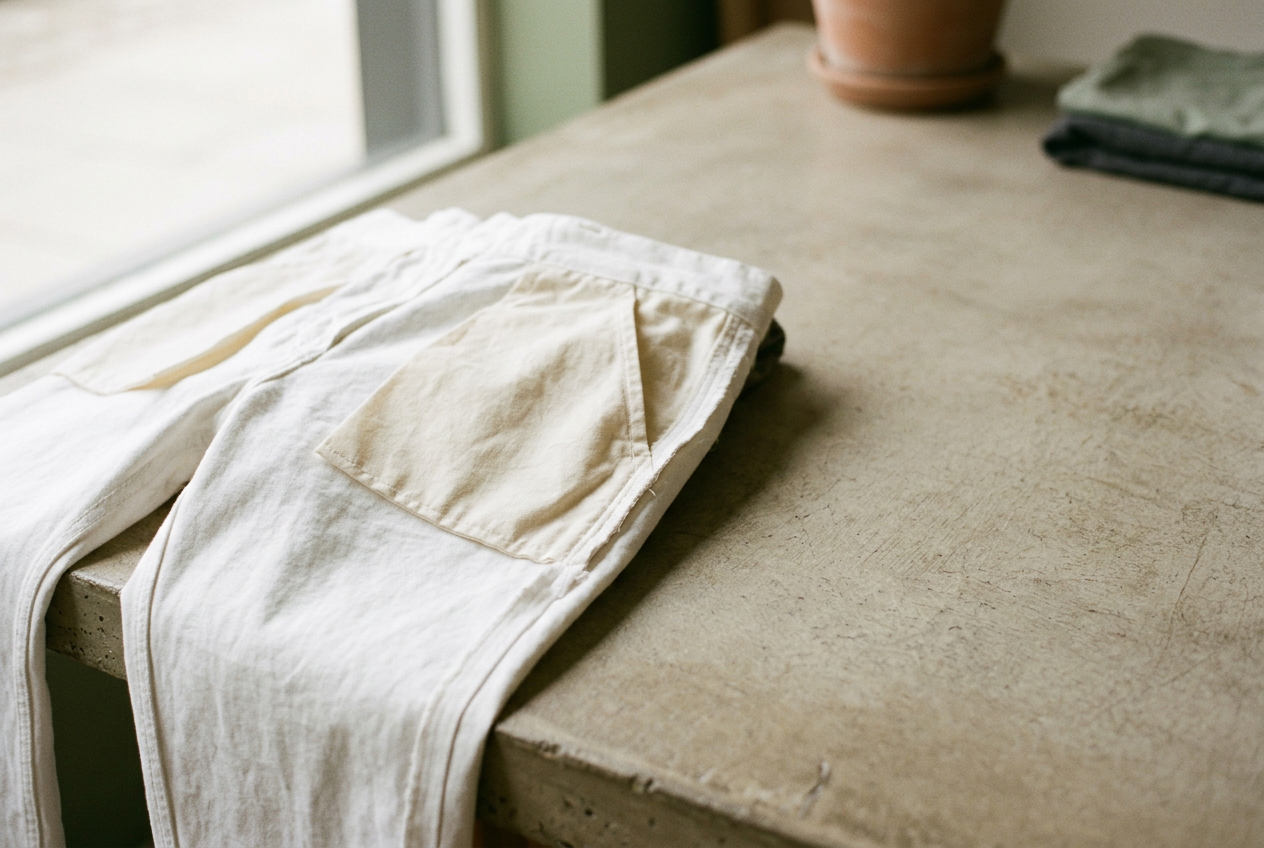
The test pair was an unlined white cotton-twill trouser with a little elastane, a straight leg, slant front pockets and two back welt pockets. On the hanger, the fabric looked substantial. Once worn, the front pocket bags made pale rectangles across the hips, while the outer edges of briefs traced a separate line through the seat.
Changing from white underwear to a skin-adjacent shade reduced the color contrast. It did not erase the pocket bags, the side seams or the strain lines at the upper thigh. Those belonged to the pants.
This is unisex advice. The underwear shapes and sizing departments may differ, but pale fabric behaves the same way across wardrobes: tension opens the weave, raised edges cast tiny shadows, and extra layers create blocks of opacity.
Start with the pants, not the underwear
White is unforgiving because there is less visual noise to disguise construction. In the test pair, the twill’s diagonal texture helped when the trousers were hanging loose, yet the area across the lap became more transparent while seated because the fabric stretched over the thigh. Elastane improved movement but could not make the cloth opaque.
A larger size was the useful comparison. It created less tension at the pocket opening and upper seat, allowing the twill to keep more of its original density, though the waistband then needed adjustment. That tradeoff matters: tailoring a waistband is often more sensible than spending the day trying to hide underwear beneath trousers that pull across the hips.
Look at the fly first. Horizontal creases radiating from it usually mean the front rise or hip area needs more room. At the back, a seam that sinks deeply between the cheeks, diagonal lines running toward the side seams, or pocket welts that bend instead of lying straight all point to fit pressure. Underwear cannot correct those signals.
The same rule applies to pale linen, viscose blends and summer-weight wool. A fabric can feel thick between your fingers yet become sheer over the body, especially where it spans the seat rather than falling from it. Pinching a loose section of cloth tells you very little about how the finished garment will behave.
Read the pocket bags from the outside
A pocket bag, meaning the fabric pouch hidden inside a pocket, adds another layer behind the trouser cloth. That sounds helpful. In white pants, however, the doubled area can look noticeably brighter than the single-layer fabric around it, leaving a sharp outline over the hip.
The test pair had white cotton pocketing that ended several inches below the slanted opening. Its lower edge was visible even with skin-tone underwear because the problem was opacity, not color. Tucking in a darker shirt made the contrast stronger: the shirt showed faintly through the single layer but disappeared behind each pocket bag.
Better construction does not always mean heavier pocketing. A thin pocket fabric close to the wearer’s skin depth may blend more quietly than an optic-white bag, while a self-fabric pocket can look cohesive but add bulk. Some trousers use a pocket stay, a panel that extends from the pocket toward the fly, which spreads support across the front instead of leaving two isolated shapes. It can still show, but the transition is broader and often less distracting.
Put your hands into the pockets, remove them and look again. If the pocket mouth gapes or its lining creeps outward, the trousers are tight across that area or the pocket has poor stability. A phone pressed into a slant pocket also pulls the opening forward, so test the pair with whatever you normally carry rather than judging empty pockets alone.
If everything else works, a tailor can close and remove front pocket bags. This is a relatively contained alteration, but it costs you functional pockets and may leave the original opening faintly visible. Adding a full lining is a larger intervention that changes the drape, warmth and laundering requirements. For everyday summer trousers, that cure may defeat the point.
Check every raised edge
Underwear visibility is often discussed as a color problem, although the most persistent marks are physical edges. A sewn leg opening has elastic, folded fabric and thread stacked together; even when its color blends with skin, that ridge can press into the body and show through a close trouser.
Bonded or laser-cut underwear removes much of that bulk by using a flat, cut edge rather than a turned hem. It works best when the size is secure without digging. Too small, and the edge presses into the seat. Too large, and it shifts or rolls, producing a wider line than a conventional seam would.
Thongs remove the leg opening from the fullest part of the seat, but they do not fix a visible waistband, a thick gusset or pants that are stretched tight. Briefs with a lower leg can place the edge beneath the curve of the seat, where it may show less. Longer boxer briefs move the edge farther down the thigh, provided the leg stays flat and does not bunch under the trousers.
The trouser’s own seam allowance can create the same effect. A seam allowance is the strip of fabric inside a garment beyond the stitching line. On the test pair, the allowances at the side and center-back seams were finished and pressed to one side, creating a narrow raised strip that became clearer in direct daylight. No underwear swap changed it.
That distinction is useful in a fitting room. If a line follows the side seam, pocket edge or back rise exactly, inspect the pants. If it arcs across the seat or circles the thigh independently of the garment seams, inspect the underwear and fit together.
Pick color by contrast, then consider texture
White underwear is frequently visible under white pants because it reflects more light than skin does. Black and saturated colors create the opposite contrast. The practical target is a shade near your own skin depth, which may be beige, brown, copper or another muted tone; labels that call one pale beige “nude” are describing a product color, not a universal match.
An exact match is unnecessary under the test pair. A matte shade with similar lightness blended better than a closer-looking color made from shiny microfiber, whose surface caught light through the cotton twill. Prints, lace ridges and high-contrast logos remained visible even when the base color was suitable.
Fabric thickness matters less than edge behavior. Very thin underwear can roll, while a slightly firmer stretch knit may stay flat and disappear more effectively. Wear comfort still sets the limit. A thong or compression brief that solves the mirror test but feels intrusive after sitting is a poor foundation for trousers meant to be worn all day.
Do the daylight fitting-room test
Stand away from the mirror first. White fabric viewed from inches away will reveal construction that nobody sees at normal conversational distance, and chasing total invisibility can lead to underwear that is tighter, hotter or less comfortable than necessary.
Then turn toward indirect daylight and check the front, side and back while standing. Sit on a bench or chair, because the test pair looked calm upright but exposed the pocket edges and thigh tension once the knees bent. Walk several steps, reach into the pockets and make one ordinary squat. These movements show whether the weave opens, the waistband drops, or an underwear edge migrates.
Take a phone photo without flash from a few feet away. A fitting-room mirror can flatter or distort depending on its lighting, while a photograph makes broad blocks of contrast easier to spot. Flash is a poor buying test because it can exaggerate transparency far beyond the conditions in which most trousers are worn.
Change one variable at a time. Compare another trouser size before trying several underwear styles, since added room may solve the opacity and edge problem together. If the larger size hangs badly at the waist, pinch the excess to estimate whether a waistband alteration would preserve the cleaner hip fit. Only then compare a flat-edged brief, thong or longer boxer brief.
The test pair improved most with more room through the upper thigh and a matte, skin-adjacent undergarment. Its bright pocket bags remained visible. That was the deciding construction flaw, and buying special underwear would not have removed it.
Questions people ask
Should underwear under white pants match the pants or my skin?
Choose a matte color close to your skin depth rather than white. The aim is to reduce contrast between covered and uncovered areas beneath the trousers, though color cannot hide thick hems, lace texture or fabric pulled tight across the seat.
Are seamless thongs always best under white trousers?
No. A flat-edged thong removes leg lines across the seat, but its waistband and gusset can still show, and the cut may not be comfortable for long wear. Briefs or boxer briefs can work better when their edges sit below the trouser’s tension points and remain flat.
Can a tailor stop pocket bags from showing?
A tailor can close the pocket openings and remove the bags, which eliminates the brightest doubled layer but sacrifices storage. Replacing pocketing or adding a lining requires more work and can change the trousers’ weight, drape and heat level, so alteration makes sense only if the overall fit is already strong.
How can
I tell whether white pants are too tight?
Look for horizontal pulling at the fly, diagonal creases toward the hips, distorted back pockets and fabric that becomes more transparent when you sit. Try the next size and assess the hips before the waistband; taking in a loose waist is often more effective than disguising tension with different underwear.
One update a day
Today's fashion update, in your inbox
One fashion update each morning — no hype, no filler, just pieces worth wearing.