Toe-Ring Sandals Fail When the Loop Lands in the Wrong Place
The smallest part of this sandal determines whether it walks like a shoe or survives only for photographs. The useful versions keep the loop quiet and the foot stable.
Women's · October 24, 2026 · 7 min read
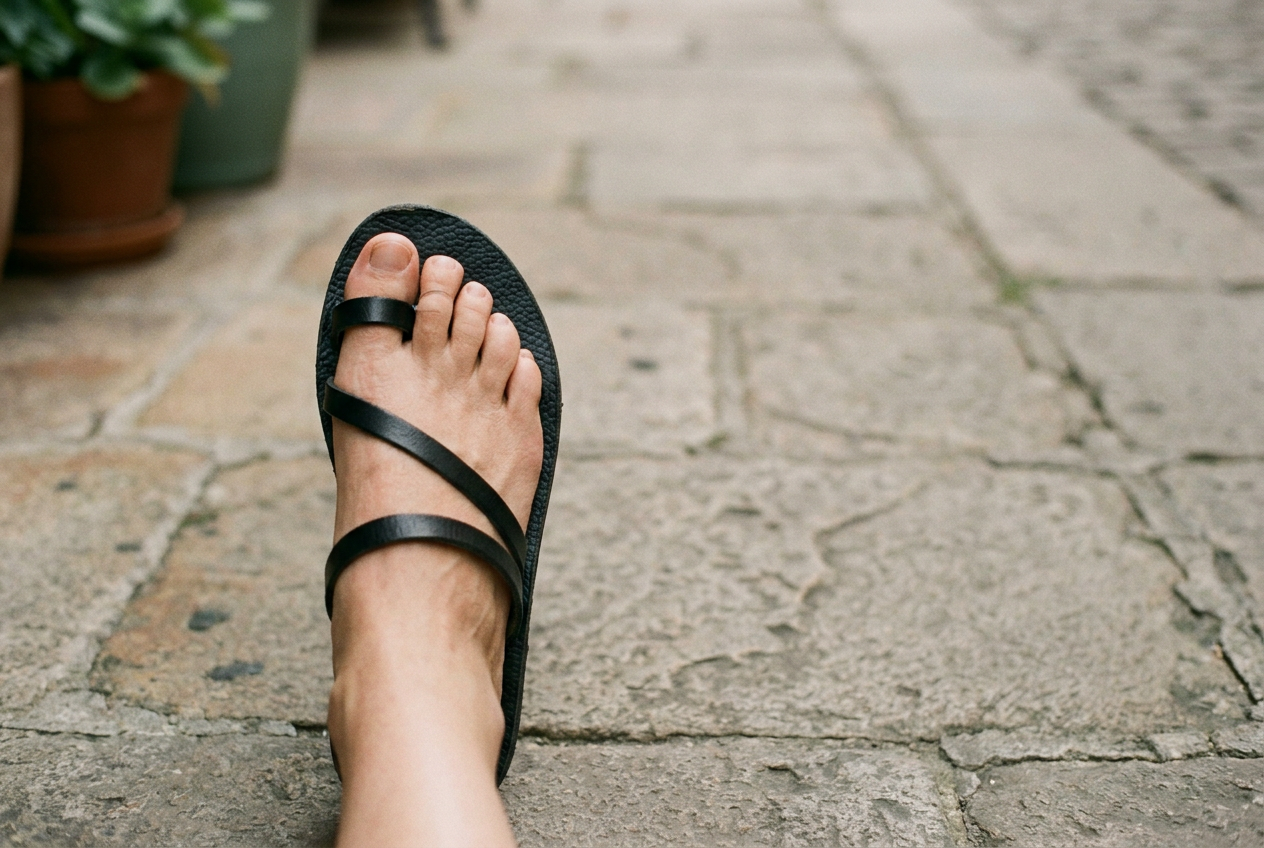
The pair that clarified this micro-trend was a flat black leather sandal with a thin sole, an adjustable ankle strap and a narrow leather loop rising from the footbed. On the first indoor fitting, the loop appeared to encircle the second toe. Once the foot settled into the shoe, it slid backward and rested across the webbing between the first and second toes instead.
That shift looked minor. It changed the whole fit.
Worn for short walks over a week, the loop did not squeeze the toe, but it repeatedly caught the front edge of the second toe joint as the foot flexed. Loosening the ankle strap stopped the catching and allowed the foot to move forward, where the loop finally sat in the soft space behind the joint. The tradeoff appeared immediately: the heel began lifting from the footbed, and the sandal felt less secure on stairs.
This assessment focuses on women’s sandals, where the shape is most visible in current warm-weather assortments and where narrow, low-volume fits remain common. The central issue applies beyond one styling category, though. A toe-ring sandal can use its loop as a functional anchor, a light guide or a visual suggestion. Those versions look similar online.
They do not walk the same way.
The loop has three different jobs
A true toe ring wraps around one toe and bears some of the force created as the foot pushes forward. On the black leather test pair, the loop was stitched directly into the footbed and attached to the vamp, meaning the upper section that crosses the front of the foot. It had a structural job even though the product’s slim proportions made it look decorative.
This is the version most likely to fail precisely. If the circumference is too small, it presses the sides or top of the toe. If it is too large, the loop migrates backward, catches at the joint or allows the forefoot to slide sideways. Toe length varies independently of shoe size, so moving up half a size may lengthen the footbed without putting the loop in a better place.
A second construction places a broader loop farther back, over the soft webbing between the big toe and second toe. The toe is not truly encircled. Pressure spreads across more leather, and the foot can flex without dragging a seam around the toe itself. This version has the strongest chance of lasting beyond a single trend cycle because it behaves more like a thong sandal with extra coverage.
The third version is mostly visual. A curved strap forms a loop shape over the front of the foot but does not close tightly around a toe. Another strap, usually across the instep or around the ankle, carries the load. This gives the clean, jewelry-like line associated with the trend while removing most of its sizing risk.
It can also look less convincing from the side, particularly when a stiff synthetic loop stands above the foot rather than resting against it.
The useful fitting point is behind the joint
The fitting-room test takes less than a minute. Put the sandal on without tightening the ankle strap, plant the foot fully, then curl and release the toes. The front edge of the loop should stay behind the second toe joint, not ride onto the joint as it bends. Next, tighten the ankle strap to a comfortable setting and walk through a full stride rather than taking tiny fitting-room steps.
Watch the loop, not the heel.
A good loop barely changes position as the foot rolls forward. You should be able to slide the tip of a finger under it without stretching the upper, but an obvious gap suggests the foot will wander within the sandal. If the loop leaves a line after a brief try-on, catches a toenail or makes you hold the toes rigid, no break-in period is likely to correct its location.
The black leather pair passed the standing test and failed during the push-off phase, when the heel lifts and the toes bend. This is why product images are poor evidence. A foot placed neatly on a flat sole can make almost any loop look correctly positioned, while motion exposes whether that loop matches the wearer’s toe length and forefoot volume.
Width matters differently here than it does in a plain slide. A wide forefoot can pull the vamp tight and lift the loop away from the foot. A narrow or low-volume foot may slide forward until the loop jams against the toe joint. An adjustable ankle strap helps only when the front geometry is already close; using it to drag the foot backward concentrates pressure at the ankle and still leaves the toe ring doing too much work.
Soft leather helps, but placement matters more
Unlined leather has the best chance of settling around the foot because warmth and movement soften it. The edge still needs to be smooth. A narrow strip with a bulky seam underneath can create a hard ridge exactly where the toe flexes, and that ridge may become more noticeable as the rest of the leather relaxes.
Padded leather feels forgiving at first, but padding adds volume inside a small loop. It suits a design that rests farther back on the foot better than one intended to surround the toe. Suede reduces surface friction initially and can feel softer against dry skin, although it absorbs moisture more readily and may darken where it contacts sunscreen or perspiration.
Synthetic loops vary. A thin, flexible strip can work when another strap stabilizes the foot. Thick polyurethane with a sealed edge often bends as one piece, so the pressure shifts to the loop’s two attachment points rather than dispersing along its curve. Transparent vinyl makes the construction look almost absent, yet heat and moisture can increase grip against the skin.
In that material, a loose visual loop is safer than a tight functional one.
No material rescues the wrong location. The leather test pair softened slightly during the week, but its loop did not move forward or backward because its attachment points were fixed in the sole. The shoe became less stiff without becoming better aligned.
Price does not solve a fixed loop
Toe-ring sandals now appear from inexpensive synthetic flats through mid-market leather styles to designer pairs priced like a substantial wardrobe purchase. Paying more may buy cleaner edge finishing, a shaped footbed or softer leather. It does not guarantee that a fixed loop will match a particular foot.
That makes this a poor category for a speculative final-sale purchase. At the lower end, a visual loop supported by an ankle strap is the more rational gamble because less depends on exact toe geometry. In the middle price band, look for supple leather, an adjustable rear strap and a loop positioned behind the visible toe joint. At designer prices, the sandal still has to pass the walking test; intricacy and finer materials raise the cost of the mistake rather than reducing its likelihood.
Online, check side-view images for the loop’s angle. A nearly vertical ring is more likely to surround the toe and demand an exact match. A loop that slopes backward toward the vamp tends to rest over the webbing, where a small amount of variation is tolerable. Product measurements rarely describe this placement, so a returnable order is worth more than an optimistic size conversion.
The version that can leave vacation behind
The strongest everyday version has a loop that acts as a guide, a separate strap that stabilizes the foot and enough sole structure to keep the toes from gripping. It works with straight-leg trousers, a below-the-knee skirt or relaxed tailoring because the upper reads as a deliberate line rather than beach equipment. A paper-thin sole can still make the same design feel destination-specific, regardless of how elegant the leather looks.
A toe ring that carries most of the load belongs to a narrower use case. It can be fine for dinner, a short outing or any setting where walking is limited. It is harder to justify as a daily sandal, particularly on sloped sidewalks or stairs, where the foot moves against the upper in more than one direction.
The black leather pair landed between those outcomes. Its material and restrained shape were polished enough for city clothes, but the loop’s fixed position required a choice between toe pressure and heel movement. That is too exacting for an everyday flat. The micro-trend may last, though probably in the softened form: less literal ring, more visual loop, with the real work handed to a broader strap farther back.
Questions people ask
Should a toe-ring sandal touch the toe all the way around?
Light contact is acceptable, but the loop should not grip the toe or leave a deep line after a short fitting. The safer construction rests behind the toe joint and allows the toe to bend without dragging the loop forward. A visible gap is also a warning if the loop is supposed to stabilize the shoe.
Can leather toe-ring sandals stretch into a better fit?
Leather can soften and gain a little ease, especially when it is unlined, but fixed attachment points will not relocate. Stretch may reduce general tightness; it will not correct a loop that sits directly on the joint, catches the nail or forces the foot too far backward on the sole.
Should I size up in toe-ring sandals?
Only if the footbed itself is too short. Sizing up often adds length without changing the loop’s position relative to the toe, and it may create heel lift or excess sole beyond the toes. Compare where the loop lands during a full stride before treating the problem as standard shoe sizing.
Which toe-ring sandals are best for walking?
Choose a soft loop that rests behind the toe joint, plus an adjustable ankle or instep strap that keeps the foot from sliding forward. A slightly structured sole is more useful than a paper-thin one. If the toe ring is the main anchor, keep the shoe for shorter, lower-demand wear.
One update a day
Today's fashion update, in your inbox
One fashion update each morning — no hype, no filler, just pieces worth wearing.