Square Toe Flip Flops Need More Clearance Than You Think
The extra front corners rarely matter on level ground. Stairs, curbs, and broken pavement expose the difference between a flexible foam sole and a rigid footbed.
September 10, 2026 · 7 min read
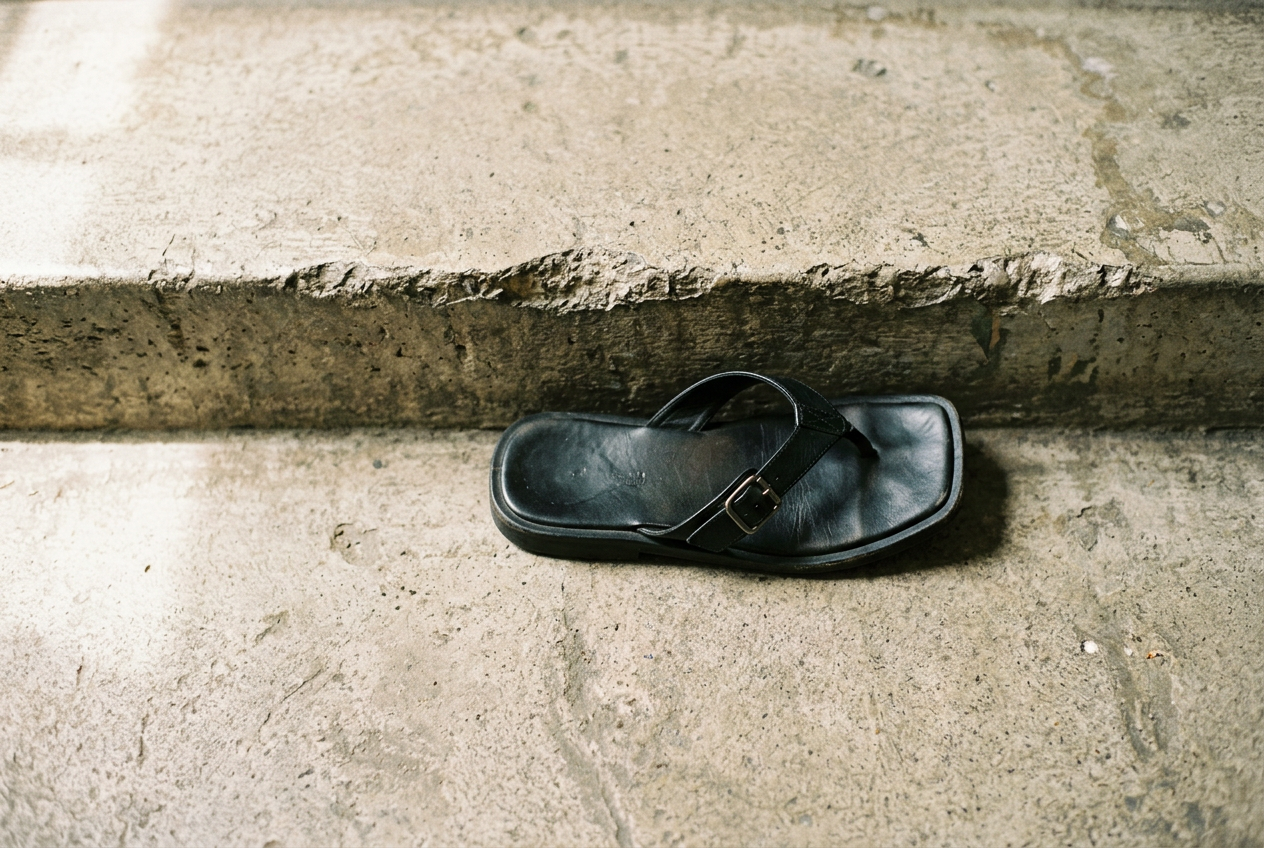
The part worth examining is not the whole square toe. It is the front outside corner, the small patch of sole that sits beyond the little toe and has no foot directly above it to control where it lands.
Take a typical square-toe thong sandal with a thin, flexible foam footbed, meaning the surface your foot rests on, and compare it with the same broad outline built on a rigid leather-wrapped base. Both may look equally blunt from above. Underfoot, they behave like different shoes.
This is unisex advice. The mechanics apply across wardrobes, although anyone shopping between men’s and women’s size ranges should compare the actual sole outline rather than trust the number printed on the box.
The corner is the issue
A rounded flip flop narrows around the toes, so a slightly misplaced step usually presents a curved edge to a curb or stair. A square style keeps more material at the front corners. That extra area creates the polished, graphic line people are buying, but it also gives the ground something else to meet.
On flat pavement, the distinction is minor. The foot swings forward, the heel lands, and the front of the sandal follows without much negotiation. Trouble becomes more plausible when the front edge approaches a vertical surface: the lip of a stair, a raised paving slab, or a curb that is higher than expected.
The unsupported outside corner matters because the little toe cannot lift it independently. If the sole projects well beyond the foot, the wearer must clear the entire sandal rather than only the toes, which slightly changes how high the foot needs to travel during the swing portion of a step. Usually that change is too small to notice. A shallow stair taken quickly is where small becomes educational.
The useful shopping check is overhang, not squareness by itself. Stand normally and look down. If the front edge ends close to the longest toes while the outside corner merely fills the natural diagonal beside them, the silhouette has not added much functional length. If a visible platform of empty sole sits ahead of every toe, the sandal demands clearance for material that contributes nothing to fit.
Do not size down automatically to remove it. In a thong sandal, the post between the toes fixes the foot’s position, and a shorter size may pull the heel off the back while leaving the front corner nearly as exposed. Discomfort has many administrative departments.
Flexible foam recovers from a clip
A flexible sole made from EVA, a lightweight foam called ethylene-vinyl acetate, can bend when its front edge meets a stair. The corner may fold downward or upward for a moment rather than stopping the whole shoe. That does not make clipping pleasant, but it can reduce the amount of force transferred to the toes and ankle.
Flexibility also lets the sandal follow the forefoot as the toes bend over a curb. When the wearer pushes off, the sole curves rather than moving as one flat board, which shortens the effective front projection during that instant. A modest square extension is less troublesome on this construction because it does not remain rigidly presented to every obstacle.
Too much flexibility has its own bill. Thin foam can curl under at the front after a scrape, and a corner that repeatedly bends may begin to look chewed before the rest of the shoe appears worn. Very soft footbeds can also twist on sloped paving, especially when the upper consists of one narrow thong strap and offers little side-to-side control.
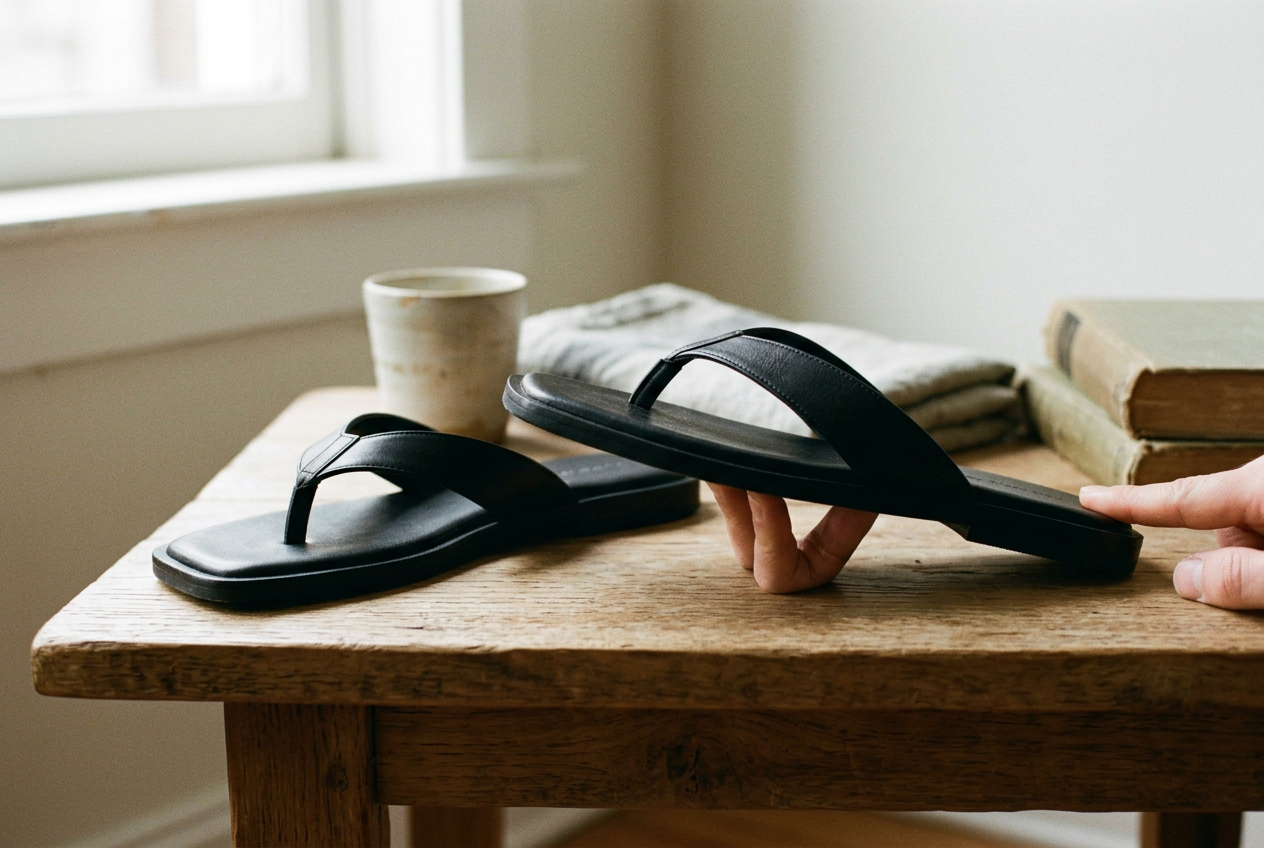
Press the front corner upward with one finger before buying. A city-friendly version should bend without requiring a wrestling match, then return to shape rather than staying folded. Next, hold the heel and twist the front gently. Some movement is useful; a sole that wrings out like a dishcloth may feel vague on uneven stone.
Budget square-toe flip flops often use one-piece molded foam or a foam sole with a synthetic upper. They can be the easier walking choice even when the finish reads casual. The tradeoff is faster edge wear and less structure, not automatic inferiority.
Rigid footbeds require deliberate placement
A rigid footbed, often built from dense material and covered in leather or synthetic leather, preserves the square outline beautifully. It also keeps the front corner square when that corner meets masonry.
On stairs, a rigid sandal needs the wearer to lift the whole platform above the stair lip. There is little bending to forgive a low step, and a longer front overhang increases the distance that must clear. Walking upstairs tends to expose this first because the approaching riser sits directly in front of the shoe; going down, the larger concern is placing enough of the footbed securely on the tread rather than letting a broad toe disguise how little sole is supported.
Curbs create a different calculation. Stepping up usually works if the foot lands squarely and the front edge clears. A rushed half-step can drive the corner into the curb while the foot continues forward inside the upper, which makes a loose thong strap feel looser at the exact moment one would prefer governance.
Rigid square soles are not unwalkable. A well-fitted pair with minimal empty space ahead of the toes can feel predictable, particularly if the base has some toe spring, meaning the front of the sole curves slightly upward. That upward curve buys clearance without changing the top-down silhouette, although a completely flat sole gives the cleanest appearance in product photographs and the least assistance on the street.
This construction makes more sense when the square-toe effect is subtle, the foot sits securely behind the thong post, and the intended route is mostly smooth pavement. If the pair costs roughly what one might spend on good sneakers, inspect the front profile before paying for leather and finish. Expensive corners still meet cheap concrete.
Stairs reveal fit before style does
A staircase test should begin slowly and with a handrail, not as a dramatic trial of personal balance. Watch whether the front edge clears when the knee lifts at its normal height. Deliberately exaggerating the step proves only that exaggerated steps work.
Then note the sound. A repeated tap against the riser suggests the sandal is arriving too low or too far forward, even if it has not caught hard enough to interrupt movement. Flexible foam may brush and bend. A rigid base is more likely to knock, which is useful feedback delivered in an irritating format.
On the way down, place the forefoot on the tread and check where the heel lands. A square front can make the shoe appear fully planted while the back remains close to the edge, particularly on narrow stairs. The outline is visual information, not a guarantee of support.
Uneven sidewalks test lateral control instead. A broad square front may bridge a shallow crack without incident, but one outside corner can meet a raised slab before the rest of the sole, turning the shoe slightly beneath the foot. A supportive upper would resist that rotation. A single thong strap does not have much material available for the discussion.
Anyone who regularly moves quickly through subway stairs, old sidewalks, or steep curb cuts should favor a flexible sole, a close toe fit, and at least a little upward curve at the front. A rigid, fully flat pair is better treated as a dress sandal for predictable routes rather than an all-day city default.
The fitting decision takes one minute
Put both sandals on and stand with weight distributed normally. The heel should sit on the footbed, the thong post should not force the foot backward, and the longest toe should remain inside the front edge without a large empty shelf beyond it.
Walk toward a low, visible change in level and step over it at an ordinary pace. The purpose is not to manufacture a failure but to see whether the shoe asks for a higher step than the footwear already in your rotation. If the corner clips during a calm fitting-room test, a crowded staircase will not improve its manners.
Compare the front overhang with a rounded flip flop that already fits. A few millimeters of shape at the outer corner can deliver the trend without adding obvious length across the entire toe line. The strongest square may look better with wide-leg pants or a long skirt because the blunt edge remains visible, yet that same projection is the part most likely to announce itself against a stair.
Choose the rigid version for finish and shape retention when the route is controlled. Choose flexible foam for mixed pavement, accepting that the corners may show abrasion sooner. Skip either construction if the thong post leaves a broad, empty forecourt in front of the toes. The problem there is fit wearing a fashionable outline.
Questions people ask
Do square toe flip flops catch on stairs?
They can when the front corners or full toe edge extend beyond the foot. A flexible sole may bend after contact, while a rigid footbed is more likely to knock against the stair riser and require the wearer to lift the foot higher.
Are flexible square toe flip flops safer for uneven sidewalks?
Flexible foam is generally more forgiving when a corner meets a raised paving slab because the sole can bend instead of remaining a flat lever. It can still twist beneath the foot, especially with a loose thong upper, so close fit matters as much as softness.
How much space should sit in front of the toes?
The toes should remain inside the sole without leaving a broad strip of unsupported material ahead of them. Judge the space while standing, since the foot spreads under weight, and do not size down if that pushes the heel off the back or jams the thong post.
Can a rigid square toe sandal work for city walking?
Yes, if the front overhang is small, the upper holds the foot securely, and the sole has a slight upward curve at the toe. A fully flat, projecting footbed suits smooth routes better than rushed stairs, high curbs, or broken pavement.
One update a day
Today's fashion update, in your inbox
One fashion update each morning — no hype, no filler, just pieces worth wearing.