Soft Suede Bags Are Back. Check the Base Before You Buy.
The new suede shoulder bag looks easy after years of rigid minis. Its base, lining and handle attachment decide whether that slouch stays useful once the bag is full.
Women's · September 26, 2026 · 8 min read
The useful bag in this softer cycle is not the one that collapses most attractively in a product photograph. It is the one that can take a water bottle, wallet, phone, sunglasses, keys, a small pouch and perhaps a paperback without turning those ordinary objects into a single heavy knot at the bottom.
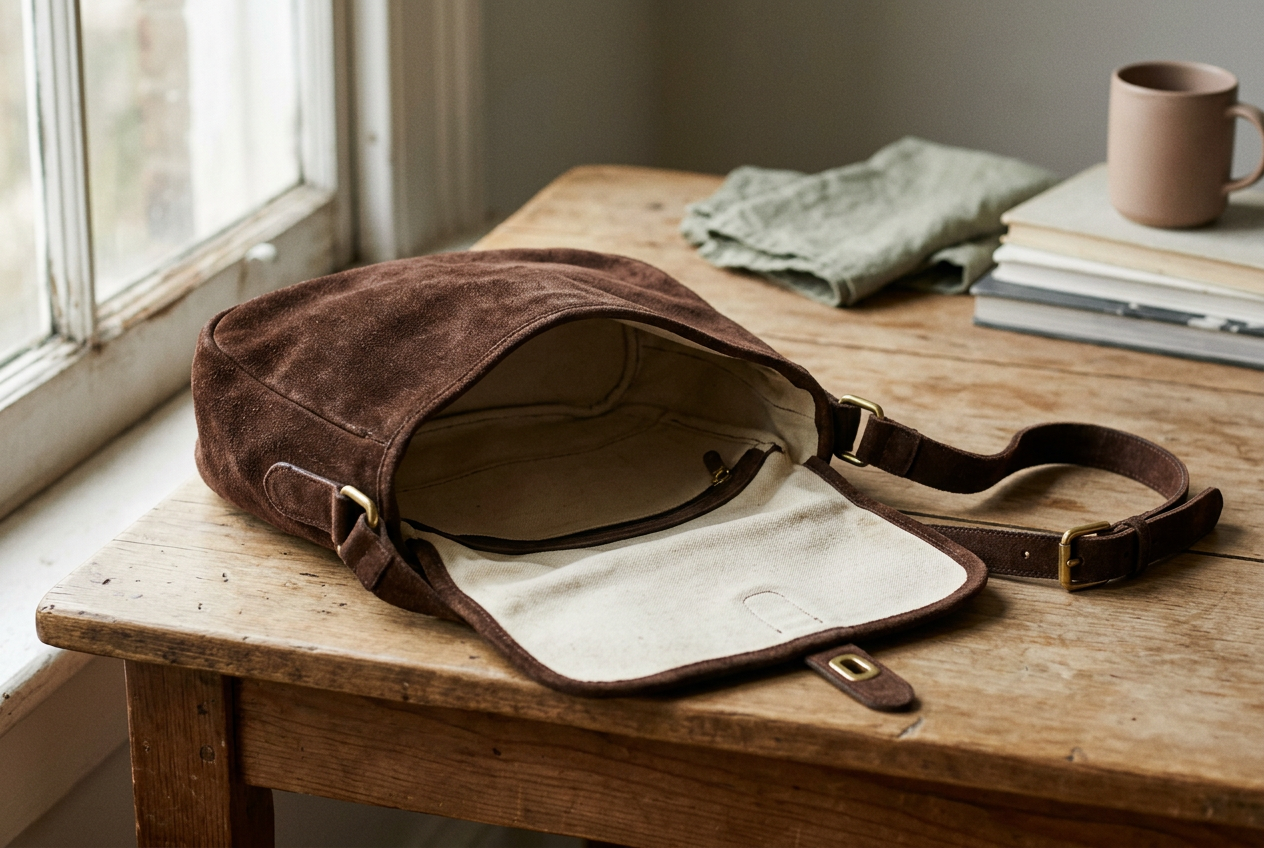
I kept returning to one medium chocolate-brown suede shoulder bag during this evaluation. It had an oval leather base, a cotton-twill lining and a wide strap attached through stitched tabs that continued several inches down each side. Loaded for five days of desk-to-errands use, it softened around the contents but retained a flat enough floor to sit down without falling over. That distinction sounds minor.
It governed almost everything.
This is women's coverage, since the current shift is most visible in women's shoulder bags, hobos and softened east-west shapes, though the construction checks apply to any suede carryall.
The base controls the slouch
Suede brings texture and movement that a rigid mini cannot offer. Its nap, meaning the raised fibers that give the surface its soft finish, changes slightly as it is brushed, handled and pressed against clothing. Dark brown, tobacco and muted olive make that variation look intentional, while the relaxed silhouette brings back enough capacity for the daily objects that stopped fitting when bags became little hard-sided cases.
The complication is structural. Suede is leather, but it does not behave like a thick polished hide with a firm finish. A bag made from pliable suede can stretch under repeated load, especially where the body curves into the bottom. If the base has no reinforcement, the lowest point keeps dropping while the opening draws inward, leaving a deep pouch that is roomy by volume and awkward by access.
The chocolate bag avoided that outcome with a separate oval bottom in smoother, firmer leather. Between the exterior base and lining sat a base board, a thin internal panel that helps the floor retain its shape. I could not see the panel itself without opening the bag, but the bottom resisted folding when pressed between two fingers and returned to its plane after the bag was emptied. Those are useful signs in a store.
Set an empty candidate on a flat surface. A fully unstructured bag may fold, which is not automatically a fault, but the base should still reveal a deliberate shape rather than an accidental crease. Next, press one corner inward. If the whole floor buckles along the same fold line, expect a bottle or makeup pouch to pull the bag into a point.
A base that gives locally while staying broadly flat will produce a softer, more controlled sag.
Width matters too. A narrow base makes a hobo look sleek under the arm, yet it forces thicker objects to stack vertically and pushes them toward the opening. A moderately wide oval or rectangular floor lets daily items sit beside one another, so the bag remains searchable even after the sidewalls relax. The chocolate bag carried its bottle horizontally only when overfilled; during an ordinary day, the bottle stayed upright against one end and the paperback rested against the base instead of bending around it.
Feet are less important than they appear. Metal feet can protect small points of the base, but they cannot stop a weak floor from bowing between them, and on a very soft bag they may create four visible dimples. A continuous leather base or concealed reinforcement did more for the test bag than decorative hardware would have done.
Lining changes how the bag fails
An unlined suede bag can feel luxurious because the interior reveals the reverse of the hide, but loose objects meet a surface with friction. Receipts catch. Fine fibers transfer to dark cases. A pen cap or lip product can mark the leather from inside, where cleaning remains difficult.
A lining also distributes some strain, provided it fits the bag rather than hanging as a loose sack. Cotton twill, a woven fabric with visible diagonal ribs, gave the chocolate bag enough body to slow the movement of small objects without making the exterior look stiff. When I lifted the loaded bag by its strap, the lining stayed close to the suede shell; it did not pull into a separate hammock beneath the opening.
That is the check to make. Pinch the lining and shell together near the bottom, then lift them lightly. A small amount of independence allows the outer leather to move, but a lining that rises several inches before the shell follows can gather around the contents. It may also twist after a few days, taking the interior pocket with it.
Pale synthetic linings make objects easier to see, though a thin, shiny fabric can undermine an otherwise substantial bag and may tear where keys repeatedly settle. Dark cotton hides marks but turns the bottom into a search exercise. A mid-tone lining, firmly caught into the lower seams, is a practical compromise. It should not be bonded so rigidly that the suede loses its drape.
The pocket deserves similar scrutiny. A small hanging pocket attached only to the lining is suitable for a cardholder, not a loaded phone. On the test bag, the pocket was stitched through a backed section close to the upper seam, so the phone remained high and did not drag the lining toward the base. That kept the bag balanced on the shoulder and left the floor free for larger items.
Follow the handle below the opening
A soft bag often fails first where the handle meets the body. The relevant detail is not the thickness of the strap by itself, but the area over which its pull is spread.
Short tabs sewn only into the top edge concentrate the load at the opening. As the bag becomes heavier, those tabs can pull the edge into sharp peaks, distort a zipper or magnetic closure and stretch the suede around the stitch holes. This is especially risky when the handle hardware is attached through a small patch with little visible backing.
The strap tabs on the chocolate bag continued down the side and ended well below the opening. Their stitching enclosed a broad area, while the smooth leather tabs acted as reinforcement against the softer suede. After five loaded days, the sidewalls had developed a mild inward curve, but there was no puckering around the stitch line and the opening still met evenly.
Look inside as well as outside. A handle attachment that passes through the suede and a reinforced interior layer should feel thicker around its stitching. Gently move the strap from side to side. The bag body may follow, but the attachment point should not hinge sharply along one row of stitches.
Rivets can help, although they are not proof of a strong connection when they pass through soft leather without a washer or backing patch.
Wide straps generally suit this silhouette because they spread pressure on the shoulder, but width cannot correct poor anchoring. Nor can a detachable crossbody strap rescue a bag whose side rings pull the opening out of shape. Load-bearing rings belong on reinforced tabs or seams, not on isolated holes punched into suede.
Price does not settle the construction question
At roughly the cost of a decent pair of sneakers, a suede bag may use split suede, which comes from a lower layer of hide, or a suede-effect synthetic. Neither choice guarantees failure. A well-backed split-suede bag with a stable base can outperform a more expensive, beautifully colored bag built as one uninterrupted pouch.
Higher prices may bring finer hides, neater edge finishing and more substantial hardware, but softness is sometimes treated as the selling point and reinforcement is deliberately minimized. That produces an appealing fold when the bag is empty. It also places more responsibility on the owner to keep the load light, store the bag stuffed and avoid setting it on damp or dirty surfaces.
For a daily bag, pay first for the structure you cannot add neatly at home. An organizer insert can create compartments and lend some support, but a stiff rectangular insert inside a curved hobo often shows through the suede and creates a hard ridge. A repair shop may replace a lining or strengthen a handle later. Installing an invisible base board after construction is more invasive and may alter the silhouette.
The chocolate bag worked because its reinforcement was selective. The base stayed calm, the handle attachments resisted stretching, and the rest of the body moved. It still looked soft when half full. Empty, it folded slightly at the sides rather than collapsing through the floor.
The purchase test takes two minutes
Bring the objects you carry most often, or ask to use clean store packing to approximate their weight. Place the heaviest item on the base rather than holding the bag in the air while it is empty. Close it, put it on your shoulder and watch the bottom in a mirror. A useful soft bag can round under load, but it should not form one narrow low point.
Reach for the phone without looking. If the opening closes around your forearm or every object slides beneath the same fold, more capacity will not make the bag easier to use. Check whether the strap attachment puckers, then set the bag down and remove the contents. The base should recover rather than preserve a hard central crease.
Readers who carry only a cardholder, phone and keys can reasonably choose the looser construction. The exaggerated collapse is part of the look, and a structured floor may seem too composed. Anyone adding a bottle, glasses, charger, pouch or book should treat a reinforced base as the dividing line between a relaxed daily bag and an occasional fashion piece.
I remain undecided on the softest versions. They capture the change away from rigid minis more clearly, and they can look better tucked under an arm, but many are selling volume that becomes inconvenient once used. The chocolate bag made the stronger case: keep the movement in the walls and put the discipline underneath.
Questions people ask
How can
I tell whether a suede bag has a reinforced base?
Press the empty floor between your fingers and bend one corner gently. A reinforced base offers light resistance and returns toward its original plane, while an unsupported one folds across the full width. A separate leather bottom and clean lower seam are helpful clues, though neither proves there is an internal board.
Does a soft suede bag need a lining?
No, but a fitted lining protects the leather from pens, cosmetics and loose objects while making the interior easier to clean. Choose one that follows the shell closely. A loose lining can become its own pouch, allowing the bag's contents to collect below the opening even when the exterior still looks composed.
Will an organizer insert stop a suede bag from sagging?
A light insert can support the floor and keep small objects apart, but a stiff box may create visible corners through soft suede. Match the insert to the shape of the base and stop below the bag's widest curve. It cannot correct weak handle attachments or leather that is already stretching around the seams.
What should
I store inside a suede bag when it is not in use?
Use clean, colorfast tissue or a soft cotton cloth to support the base and sidewalls without stretching them. Keep the handle in its natural position and use a breathable dust bag. Avoid overstuffing, since the last fold pressed into suede during storage may still be visible when you next carry it.
One update a day
Today's fashion update, in your inbox
One fashion update each morning — no hype, no filler, just pieces worth wearing.