A Wide Bag Strap Can Still Dig Into Your Shoulder
A loaded canvas tote exposed the flaws width can hide: rigid edges, thin padding and hardware that lands on the shoulder. Here is what felt better and what to check before buying.
September 19, 2026 · 7 min read
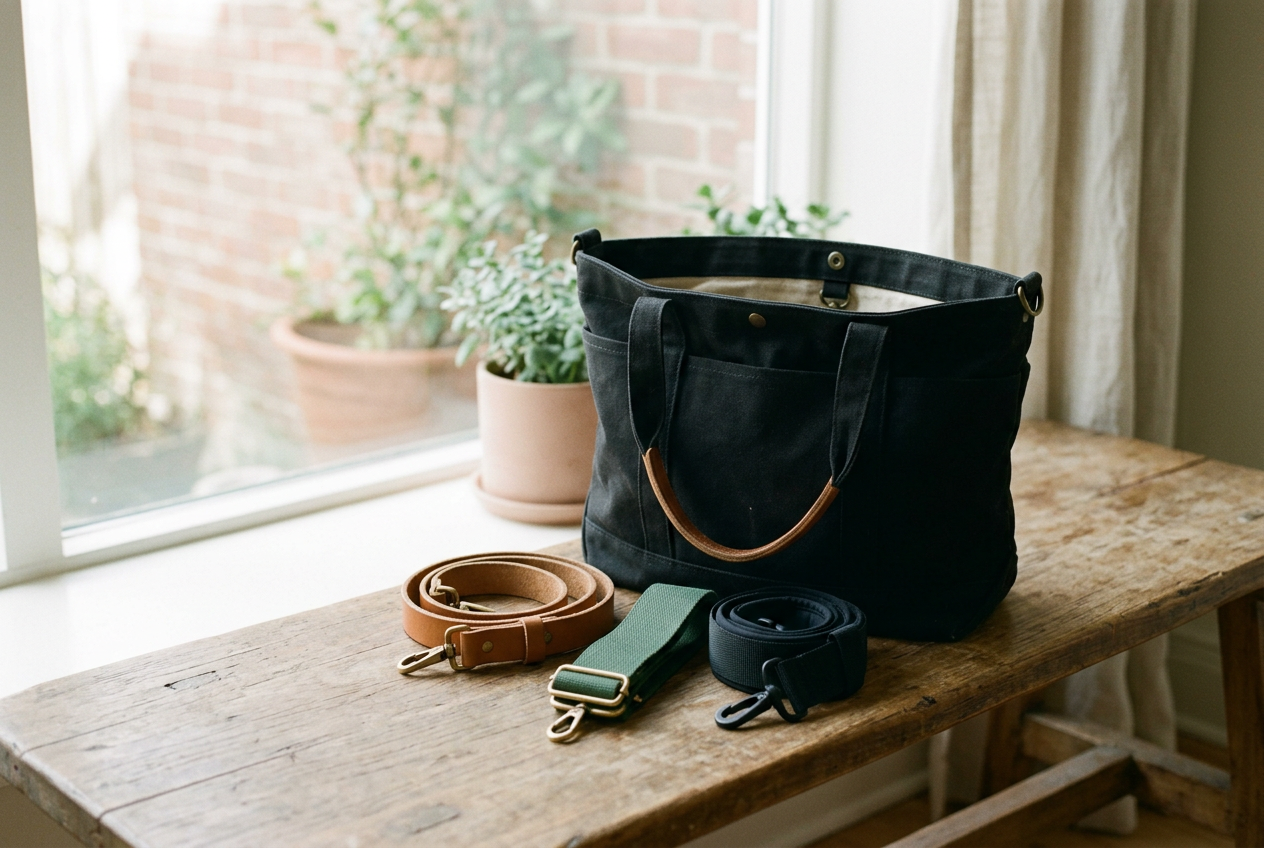
The black canvas tote looked as though it had the right strap already. Its detachable leather strap was broad, substantial and visually balanced against the large bag. Once the tote held a laptop, a filled bottle and the usual daily contents, one folded leather edge pressed into the front of my shoulder while the rectangular slider sat close behind it.
Width was not solving the load. It was framing two pressure points.
I carried that same tote with three interchangeable straps over the course of a week: the original leather strap, a plain polyester webbing strap and a padded nylon strap intended for heavier equipment. The contents stayed in place, the bag hung at the same point near the hip, and I wore a thin cotton shirt so a coat would not disguise the contact points.
The comparison applies across wardrobes. This is unisex coverage because shoulder anatomy, strap construction and bag load matter more here than the department named on the tag.
The loaded carry test
The original leather strap was the widest-looking option. It was made from two layers folded and stitched together, with painted edges and a metal adjustment slider. Edge paint is the sealed coating applied to a cut leather edge; it can make a strap look finished, but a thick application may also create a firm ridge.
That ridge became the problem. The center of the strap stayed flat, yet its outer edge resisted curving around the shoulder, so the load concentrated along a narrow line rather than spreading across the full width. The strap also had a short adjustment range, which left the slider near the shoulder crest at my preferred crossbody length. Each step nudged the hardware against the same spot.
The polyester webbing strap looked less luxurious and had no added padding. Webbing means a flat, densely woven strip designed to carry tension. Its edges were softer than the leather strap’s folded sides, and the material bent around the shoulder instead of holding a shallow channel shape.
That flexibility made the unpadded strap more comfortable than the wider leather one during the first part of the route. The improvement did not last indefinitely. Under the full load, the webbing began to feel like a broad band of steady pressure, especially once the bag swung forward on stairs, but there was no single sharp edge and the adjustment hardware could be moved behind the shoulder.
The padded nylon strap performed best with this tote. Its foam section was wider than the supporting webbing and tapered gradually at both ends, rather than stopping in a thick ledge. The foam compressed under the bag without collapsing into a cord, while the nylon cover flexed enough to follow the slope from neck to shoulder.
Padding did not make the bag lighter. It delayed the moment when the load became distracting and removed the localized bite that the leather edge caused. After a longer carry, the shoulder still felt the weight, but I was not shifting the strap every few minutes to escape one hard spot.
Why width fails
A width measurement describes the strap on a flat table. A shoulder is curved, moving and usually covered by fabric with its own seams, texture and friction. If a wide strap cannot conform to that surface, only part of it carries the bag.
Folded construction is a common culprit. A leather strap may have a supple top layer but a stiff internal reinforcement, and the stitched edges can behave like rails that keep the center slightly lifted. That structure is useful when the goal is a crisp, polished strap that will not stretch. It is less useful when a heavy bag needs to settle over the shoulder.
The original strap on the black tote showed the tradeoff clearly. It kept its shape when the bag was set down and did not twist near the clips, yet the same stiffness prevented it from wrapping around the body. Soft webbing looked more utilitarian. It carried better.
Edge shape matters as much as edge softness. A rounded or lightly bound edge tends to disappear against clothing, while a square folded edge can press through a shirt, particularly when the bag hangs crossbody and the strap approaches the shoulder at an angle. A bulky side seam on a padded strap can create the same failure, even when the foam itself feels generous under a thumb.
Hardware needs somewhere else to go
The buckle should not sit at the highest point of the shoulder under load. Nor should a swivel hook, meaning a rotating metal clip that lets the strap turn, land against the collarbone or upper back.
This sounds obvious in a fitting room, but adjustment hardware moves when the strap length changes. A buckle positioned harmlessly near the chest for shoulder carry may travel upward when the same bag is lengthened for crossbody wear, and a strap with a limited adjustment range may offer no way to shift it clear without changing where the bag sits.
On the leather strap, the slider’s flat face was not enough to make it comfortable. Its corners sat above the strap surface, and the doubled section of leather passing through it created a rigid block. The webbing strap allowed that block to slide farther down my back. The padded nylon design placed its adjuster beyond the pad, where it stayed below the shoulder during the test.
Clip placement matters too. Large hooks add weight at each end and can pull a short strap outward, changing the angle where it crosses the shoulder. For the black tote, the heaviest hooks were not painful by themselves, but they encouraged the bag to swing because they held the strap slightly away from its metal rings. A compact hook kept the connection closer and steadier.
Padding has to work under weight
A plush strap can feel convincing when squeezed in a store and disappointing once loaded. Very soft foam compresses until the supporting webbing underneath takes over, so the wearer gets the bulk of a padded strap without much pressure relief.
The useful version has resilience, meaning the foam springs partway back after compression. It also covers the full contact area. On the nylon strap, the padded section remained under the shoulder when the tote moved behind my hip; a shorter pad would have migrated toward the chest and left plain webbing carrying the load.
Thickness brings a tradeoff. A substantial pad can rub against the neck, catch long hair and look out of scale on a compact leather bag. It may also slide on a smooth coat if the underside has a slick finish. For a lightly loaded bag, pliable webbing can be the cleaner and cheaper choice because it removes hard edges without adding volume.
Padded nylon replacement straps generally occupy a middle price band between basic webbing and well-finished leather, though materials and hardware shift that order. The nylon strap was worth the visual compromise on the canvas tote because the bag regularly carried a laptop. I would not pay extra for thick padding on a small bag used for a phone and cardholder.
Check the strap before keeping the bag
Load the bag with what you normally carry before deciding that a strap fits. Empty-bag try-ons reward appearance and hide pressure points.
Run a finger along both edges, then bend the strap into the curve it would take over your shoulder. If the center wrinkles while the edges stay rigid, the full width is unlikely to make contact. On leather, inspect the underside as well as the visible face; a stiff backing can control the fit even when the top grain feels soft.
Next, adjust the bag to the exact height you wear. Put it on over a thin layer and locate every buckle, keeper and clip. A keeper is the small loop that holds the loose tail of a strap. None of that hardware should occupy the top of the shoulder, and the adjustment range should leave room to move it away without sending the bag to an awkward position.
Walk with the bag instead of standing at a mirror. Let it move behind the hip, bring it forward as though reaching for a wallet, and notice whether the strap rolls onto one edge. The black tote’s leather strap appeared flat while I stood still; its front edge began pressing only after the weight shifted during walking.
A replacement strap is often a better buy than replacing an otherwise useful bag. Match the clip opening to the bag’s rings, check that the hardware can support the intended load, and keep the original strap for lighter days or occasions when its polished finish matters more than carrying comfort.
Questions people ask
Is a wider bag strap always more comfortable?
No. Width helps only when most of the strap touches the shoulder. Stiff backing, raised seams or hard folded edges can concentrate the load into a narrow strip, while a flexible webbing strap may distribute the same bag more evenly despite having less visible bulk.
Is leather or nylon better for a heavy bag?
Padded nylon usually handles a sustained heavy load more comfortably because it can curve around the shoulder and cushion movement. Leather can work if it is supple, lightly reinforced and free of bulky edge construction, but a structured leather strap often prioritizes shape and appearance over pressure relief.
Where should the adjustment buckle sit?
Place it below or behind the shoulder, away from the collarbone and the point where the load bears down. Test this at your real shoulder or crossbody length, since shortening or lengthening the strap can move a harmless buckle directly onto the contact area.
Can
I replace the strap instead of the whole bag?
Yes, if the bag has detachable clips or rings designed to accept them. Check the clip opening, hardware strength and finished strap length before buying. For a frequently loaded tote, a flexible webbing or padded nylon replacement can improve comfort while the original leather strap remains available for lighter use.
One update a day
Today's fashion update, in your inbox
One fashion update each morning — no hype, no filler, just pieces worth wearing.