Soft Drawstring Ballet Flats Still Let the Heel Slip
The gathered opening suggests a custom fit, but the cord may only tighten the front. The useful test is whether pulling it moves the back edge of the shoe.
Women's · September 2, 2026 · 8 min read
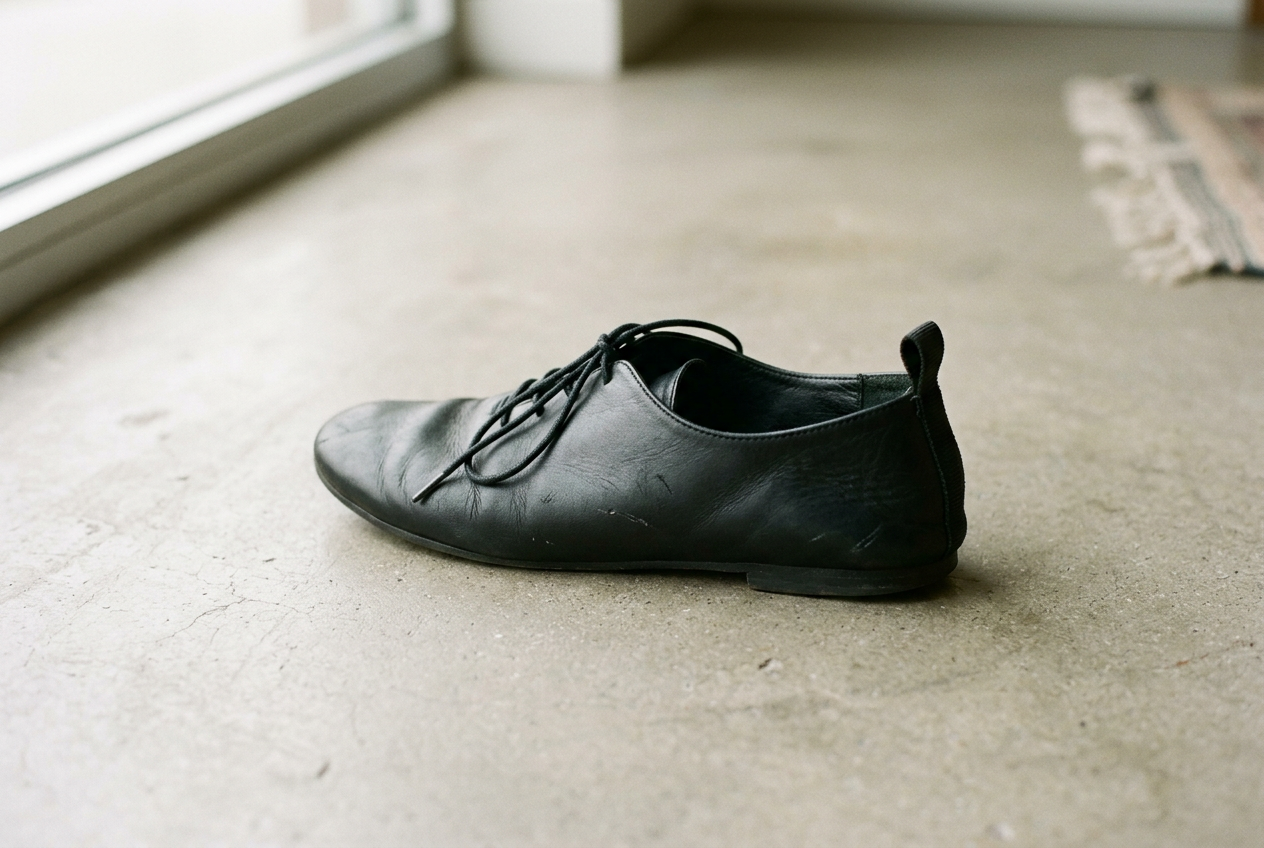
The pair at the center of this assessment is a black ballet flat with a leather upper, textile lining, thin rubber outsole and a cord threaded through a gathered channel around the opening. It was worn barefoot for repeated indoor laps and a short pavement walk, first with the cord left as supplied and then tightened until the front edge began to pucker.
The shoe looked adjustable. It was only partly so.
Pulling the cord narrowed the opening over the toes and drew the sides inward, yet the back edge barely changed. The heel lifted during the rolling part of each step, then dropped back into the shoe with a soft slap. Tying a firmer knot reduced side gaping but also pressed the gathered leather into the top of the foot. The fit problem had moved rather than disappeared.
This matters because soft drawstring ballet flats are being presented as an easy, collapsed alternative to the more structured flat: less polished than a classic ballerina, more deliberate than a slipper, and appealing precisely because the wrinkled opening looks forgiving. For women's footwear shoppers, though, the visual signal of adjustability is unreliable. A visible cord does not guarantee heel control.
The drawstring may be tightening the wrong area
The topline, meaning the upper edge around the foot opening, can be gathered in several ways. On the black evaluation pair, the cord ran freely across the front and sides but met enough friction near the back that a pull at the bow did not travel evenly around the shoe. Most of the adjustment collected near the toes.
That is useful if the opening gaps at the sides or feels loose across a shallow forefoot. It does little for a narrow heel, because heel hold depends on the rear portion of the topline moving inward and staying there while the foot flexes. A cord that only changes front tension gives the appearance of a smaller opening without changing the point where the shoe is being lost.
Knot placement adds another limitation. A bow centered over the foot is easy to reach and visually familiar, but a long front section can absorb the pull before tension reaches the back. Side knots may shorten that distance, although they can press against the foot or leave one side tighter than the other. An ornamental bow sewn in place offers no adjustment at all, even when a separate elastic thread creates the gathers beneath it.
The casing is the narrow channel that holds the cord. Before trying on a pair, hold the heel in one hand and pull the cord ends with the other. Watch the back edge rather than the bow. If the heel section draws inward by a visible amount and relaxes again when released, the adjustment reaches the area that matters.
If only the front wrinkles deepen, treat the drawstring as styling.
Test the shoe before testing your patience
With the black pair, the most revealing check happened off the foot. Pulling one cord end made the leather bunch beside the knot, while the rear channel stayed almost fixed. Working the gathers backward with the fingers redistributed some tension, but that reset took time and did not survive walking. The cord returned to the path of least resistance.
A store fitting can show the same weakness within minutes. Put both shoes on, tie the cords with moderate tension and walk at a natural pace on a clean, hard floor. The heel should remain seated as the foot bends, without the toes curling down to keep the shoe attached. Toe gripping can disguise poor hold during a brief fitting, then leave the forefoot tired after a longer walk.
Next, press one finger between the back edge and the heel while standing. A small amount of space is not automatically a failure, particularly in an unstructured leather shoe, but the edge should recover after the finger is removed. If it stays flared outward, pulling the front cord harder is unlikely to correct it.
The knot should also remain where it was tied. Smooth round cords can creep through a slick lining, while flat fabric ties tend to hold more securely but create a larger knot. On the evaluation pair, a double knot stayed closed yet concentrated pressure over the front of the foot, which made the shoe feel smaller without making the heel feel safer. That is a poor exchange.
Do all fit testing indoors until the decision is settled. Soft soles mark quickly, and gathered leather can develop creases where the cord has been overtightened, making a return harder even though the underlying fit remains unresolved.
Sole flexibility can defeat a decent upper
The sole deserves equal attention. A ballet flat needs to bend at the ball of the foot, but a sole that folds almost anywhere can lag behind the heel during lift-off, particularly when the upper has no firm rear structure. The heel counter, meaning the reinforcing piece at the back of a shoe, was minimal on the black pair; once the rubber sole bent, little else kept the rear aligned with the foot.
Hold the shoe at the heel and press upward beneath the forefoot. The bend should occur near the place where the toes join the foot rather than through the middle of the arch. Then twist gently. Some movement suits this soft silhouette, but a shoe that can be wrung with almost no resistance may feel less secure once body weight and walking speed are added.
The evaluation pair passed the first bend test and failed the second. Its forefoot flex felt natural, yet the middle twisted easily enough that the upper shifted sideways on turns. Tightening the cord reduced that movement near the opening, though it could not give the sole more structure.
This is the central tradeoff. The softness that makes the style appealing also removes several tools that ordinarily stabilize a flat. A slightly firmer rubber sole, a modest heel counter or an elasticized rear edge may look less collapsed in the hand, but each can improve the connection between foot and shoe. Buyers who walk farther than the distance between a car and a restaurant should value that connection over perfect slipper-like softness.
Sizing down is the tempting wrong fix
This is women's coverage, and the familiar variation in women's shoe sizing makes the drawstring look especially useful. It seems capable of absorbing a half-size discrepancy or accommodating a narrow heel with a broader forefoot. In practice, it can only adjust the parts reached by the cord.
Sizing down may trap the heel, but it can also shorten the toe box and push the gathered edge harder against the foot. On the black pair, the original size left the toes lying flat while the heel lifted; a smaller fit would have addressed the symptom by reducing overall space, not by correcting the weak rear tension. That approach is unsuitable when the longest toe already sits close to the front.
The vamp, meaning the section of upper covering the front of the foot, also affects the result. A higher vamp gives the shoe more surface area to hold onto the foot and can make moderate heel movement less disruptive. A very low vamp leaves the drawstring doing more work, which is precisely where a front-biased casing becomes noticeable.
People with narrow heels should compare this silhouette with a flat that has a true elastic perimeter, where the elastic continues around the back and visibly contracts, or with a softly structured Mary Jane. A slim strap changes the look, but it secures the shoe across the instep instead of asking the toes to retain it. That alternative is less trend-specific and often easier to walk in.
The price does not settle the construction
Soft drawstring flats appear from low-cost high-street pricing through contemporary designer territory. Paying more may bring supple leather, cleaner lining or a better outsole, but the casing still needs to be checked; expensive materials do not prove that tension travels around the heel.
Material changes the comfort calculation. Unlined leather and suede can conform to the foot, although stretching may increase heel movement if the original fit is already loose. Satin and soft woven uppers hold less promise of molding and may show stress where the casing gathers. Synthetic leather can maintain its shape, yet a sharp folded edge may remain sharp rather than easing with wear.
The black evaluation pair makes the trend's status fairly clear. The silhouette is convincing, the soft leather feels pleasant, and the gathered line looks current without demanding a new wardrobe. Its cord cannot justify a fit that fails at the heel. At a modest price it could work as an occasional indoor or short-distance shoe; at the price of a dependable everyday flat, the same construction is not worth buying yet.
Questions people ask
Do drawstrings stop ballet flats from slipping at the heel?
Only when the cord or elastic tightens the rear section of the opening. Pull the ends while holding the shoe and watch the back edge. If the front gathers deepen while the heel remains unchanged, the drawstring can reduce side gaping but will not provide dependable heel hold.
Should I size down in soft ballet flats?
Do not size down solely to stop heel lift if your toes already approach the front or the vamp feels snug. A smaller size compresses the whole foot, while the defect may sit in the casing or sole. Compare a half size only when the shoe is also too long through the toe box.
How flexible should the sole of a ballet flat be?
It should bend near the ball of the foot without folding freely through the arch. Gentle twist is normal in a soft flat, but extreme torsional flexibility, meaning easy side-to-side twisting, can let the upper shift during turns and make a weak heel hold more obvious.
Can heel grips rescue a loose drawstring flat?
A thin heel grip can fill a small amount of excess space, provided it does not push the toes into the front. It will not correct a cord that tightens only the vamp or a sole that twists underfoot. Test any grip indoors and check whether its edge creates a new rubbing point.
One update a day
Today's fashion update, in your inbox
One fashion update each morning — no hype, no filler, just pieces worth wearing.