Rope Jewelry Is Back. The Closure Decides How Long It Lasts
Cord necklaces look easygoing, but their weak point is highly engineered. Sliding knots offer range; sealed ends and replaceable clasps offer a better chance of lasting.
November 24, 2026 · 7 min read
Cord jewelry has moved beyond the souvenir pendant. The current version is cleaner and more deliberate: dark braided cord carrying a polished charm, waxed cotton tied close to the neck, or a soft rope bracelet used as the plain counterweight to a watch. Across unisex wardrobes, it sits comfortably with tank tops, open shirts and spare tailoring without requiring the wearer to commit to precious-metal pricing.
The problem is hidden at the back.
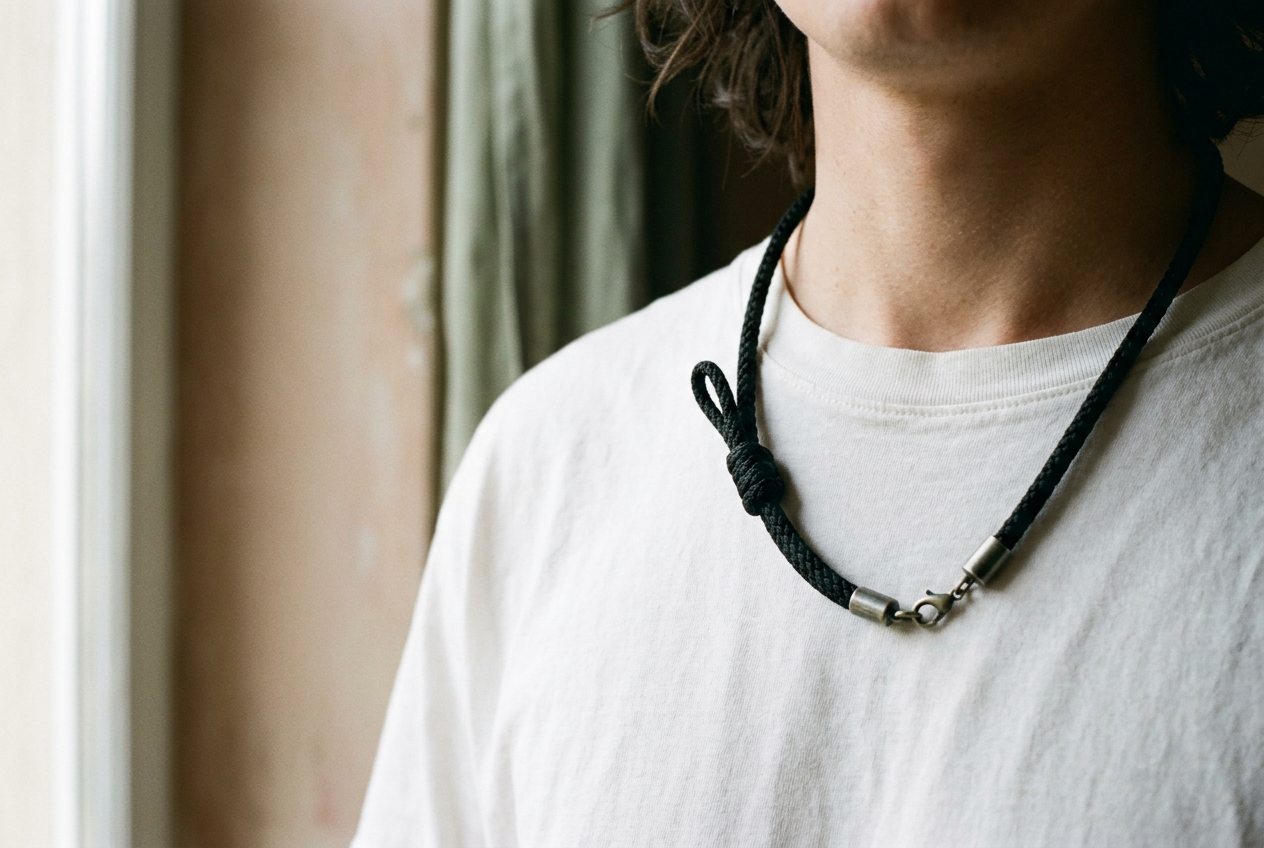
For this assessment, I kept returning to one black braided polyester necklace with a small pendant, a sliding knot and molded metal-look caps over the two cord ends. It had the right visual balance. The cord was substantial enough not to resemble string, while the narrow profile allowed the pendant to sit under a shirt collar. After a week of ordinary summer wear, however, the knot tightened unevenly and one short section beside it began to look slightly fuzzy.
The necklace still worked. It no longer looked untouched.
That small failure explains the trend’s likely shelf life better than the pendant does. Rope jewelry can carry into fall and return next summer, but only if its closure does not treat the cord as a disposable component.
The closure is the wear surface
A metal chain distributes movement across many links. Cord bends at the same few places each time it is opened, adjusted or pulled over the head, which means the closure becomes a wear surface rather than a minor finishing detail. Friction roughens fibers; trapped moisture keeps them compressed; a sharp cap edge can begin cutting the cord long before anything appears wrong from the front.
The polyester necklace made that sequence visible. Its main length stayed smooth, including the section touching the back of the neck, while the cord passing through the sliding knot picked up texture. Adjustment caused more visible wear than skin contact did. A necklace described only as water resistant may therefore survive a splash yet still deteriorate through the ordinary act of changing its length.
Material matters, though less than sellers sometimes imply. Polyester and nylon resist water better than untreated cotton, but neither is immune to abrasion. Waxed cotton initially sheds light moisture and holds a neat shape, then develops pale bends as the coating wears. Leather cord brings a different problem: repeated soaking and drying can leave it stiff or uneven, especially where it enters a metal fitting.
Sliding knots trade polish for adjustability
A sliding knot, meaning a knot that moves along the standing cord to alter its length, is the easiest closure to understand and the hardest to judge from a product image. It needs enough grip to stay put without clamping so tightly that every adjustment drags fiber against fiber.
That tradeoff makes sliding knots useful for styling. A single necklace can sit at the collarbone with a crewneck, then drop lower over an open shirt, and bracelets can accommodate wrists without a size run. There is no metal clasp to press against the skin or rotate toward the pendant. For anyone with limited hand dexterity, pulling two cord ends may also be easier than operating a tiny spring lever.
The same mechanism creates its own damage. A compact knot concentrates pressure, particularly when the cord is damp with sweat, sunscreen or water. Fine braided polyester can glaze, flatten or grow fuzzy at that point. Cotton tends to swell when wet, so a once-fluid knot may seize until it dries.
If the exposed tails have no sealed finish, adjustment can also pull loose fibers back through the knot.
On the black necklace, the useful length range survived the week, but the action became less even. One side moved first and the other followed with a firmer tug. That is tolerable in a vacation piece worn occasionally. It is less convincing for everyday jewelry, where a roughening knot will be handled dozens of times before the rest of the necklace shows age.
Look for a broad knot with tidy, compact wraps and no loose filaments. Move it several times before keeping the piece. If the cord squeaks, sheds fibers or requires enough force to distort the necklace, the adjustment range is theoretical rather than useful.
Metal end caps only work when the join is sound
An end cap is a small metal fitting that covers and secures the cut end of a cord. It can make inexpensive rope jewelry look resolved, but it also decides whether the cord meets the clasp through a protected fitting or through a vulnerable dab of adhesive.
The cleanest version encloses the cord deeply and meets it without a visible gap. A crimped cap, meaning one mechanically pressed around the cord, can be stronger than a shallow cap held by glue alone, although a poorly crimped edge may bite into soft fibers. Glue is not automatically a flaw. It becomes one when hardened adhesive sits outside the cap, when the cord enters at an angle, or when the fitting has too little depth to spread tension.
The metal-look caps on the test necklace covered the raw ends neatly, yet they did not protect the section doing the adjusting. They improved appearance more than durability. That distinction is easy to miss online, where close-up photography often shows the pendant and front texture rather than the rear construction.
Metal quality also affects wear. Plated base metal can discolor where sweat collects around the neck, while stainless steel or solid precious metal generally tolerates moisture better. A seller should identify both the cord and hardware rather than describing the whole piece with a broad phrase such as mixed materials. If the metal remains unspecified, assume its finish may require more care than the cord.
A lobster clasp gives repair a chance
A lobster clasp is a spring-loaded metal fastener operated by a small lever. On cord jewelry, it usually connects to end caps through a jump ring, the small circular link joining separate components. This adds hardware and removes some of the handmade simplicity, but it gives the necklace a familiar opening motion and creates replaceable parts.
That last point matters. A jeweler or competent repair service can often replace a worn clasp or open jump ring without rebuilding the necklace. A failed sliding knot may require re-knotting, shortening the cord or replacing it altogether. Repairability is one reason a restrained cord necklace with properly fitted metal ends can outlast a more artisanal-looking design.
A lobster clasp is not automatically secure. The lever should return cleanly, the jump ring should meet without a visible gap, and the cap should remain still when the cord is pulled gently. Very small clasps can be frustrating behind the neck, especially with short nails, while oversized hardware may rotate forward on a light pendant necklace. An extender chain adds length options but also creates a dangling wet spot after swimming or exercise.
For daily use, this construction is the strongest of the three under review when the caps are deep, the clasp is proportionate and the cord can eventually be replaced. It gives up the wide adjustability of a sliding knot. That is a fair trade if the chosen length already works with the wearer’s usual necklines.
Sweat is a different test from swimming
Water exposure is often treated as one category, though chlorinated pools, salt water and perspiration leave different residues. Cord absorbs or traps some of them at the knot and beneath metal caps, where drying is slowest. Sunscreen can add a film that gathers lint and makes a pale cord look dirty before it is structurally worn.
After damp wear, the black test necklace looked unchanged along its main span. The knot was the exception. It stayed firmer until fully dry, and repeated adjustment while damp would have increased friction at the exact point already beginning to fuzz. The practical move is modest: set the length before heat or water exposure, then leave the knot alone until the cord dries flat.
Rinsing is only sensible when the maker’s care guidance allows it and the hardware is identified. Otherwise, wipe the cord with a barely damp cloth and blot the fittings rather than soaking the whole piece. Do not hang a wet pendant necklace by its clasp, since the pendant’s weight pulls on softened cord ends. Dry it flat away from direct heat.
What deserves more than impulse-buy money
A higher price is justified by construction that can be inspected: identified cord fiber, end caps with a deep and straight join, hardware made from a named metal, and a clasp that can be replaced. A precious pendant on anonymous cord does not meet that standard. Nor does elaborate knotting compensate for raw ends that are already separating in the product image.
At the low-priced fashion end, a sliding-knot bracelet or necklace can be a reasonable seasonal buy if the tails are sealed and the knot moves without scraping. Treat it as an accessory that may soften and fade. In the mid-price range, exposed glue, unspecified hardware and decorative caps that do not secure the cord are harder to excuse. Once the cost approaches that of established everyday jewelry, repairable metal fittings should be part of the proposition.
The black polyester necklace lands between those positions. I would keep wearing it with a white tank or an open cotton shirt, but I would not buy the same construction around a valuable pendant. Its adjustable knot is convenient enough for styling and visibly too busy for long-term confidence.
The versions likely to move beyond vacation dressing are quieter: smooth cord, restrained hardware and a fixed clasped length chosen with the same care as a chain. Sliding knots will remain useful, particularly on bracelets and pieces meant to shift position. They just should not be mistaken for the durable option because they contain fewer parts.
Questions people ask
Are sliding-knot necklaces safe to wear in water?
They can tolerate occasional splashes when the cord is synthetic and the ends are sealed, but water may tighten the knot and increase friction during adjustment. Pool chemicals, salt and sunscreen can remain inside the wraps. Set the necklace length before exposure, avoid moving a damp knot and dry the piece flat.
Is polyester cord better than cotton for everyday jewelry?
Polyester generally absorbs less water and keeps its shape better than untreated cotton, making it the more practical choice for humid weather. It can still flatten or fuzz where a knot rubs repeatedly. Cotton feels softer and develops character, but swelling, staining and worn wax coatings make it less predictable around moisture.
What should I check on metal end caps before buying?
Look for a deep cap that meets the cord cleanly, with no exposed glue, sharp edge or visible gap. Pull very gently to see whether the cord shifts inside the fitting. The listing should identify the hardware metal, since an unnamed plated alloy may discolor from sweat before the cord itself needs replacement.
Is a lobster clasp worth choosing over an adjustable knot?
Choose the lobster clasp when durability and repair matter more than changing the necklace length. Properly attached clasps and jump rings can often be replaced, while a worn sliding knot may require rebuilding the cord. Check that the lever closes promptly and that the clasp is large enough to operate without strain.
One update a day
Today's fashion update, in your inbox
One fashion update each morning — no hype, no filler, just pieces worth wearing.