Bubble Hems Can Go Flat. Check the Casing Before You Buy.
The revived bubble skirt depends on hidden engineering at the hem. A quick look at the lining, elastic, and care label reveals whether its volume will survive washing or suit later alterations.
Women's · November 24, 2026 · 8 min read
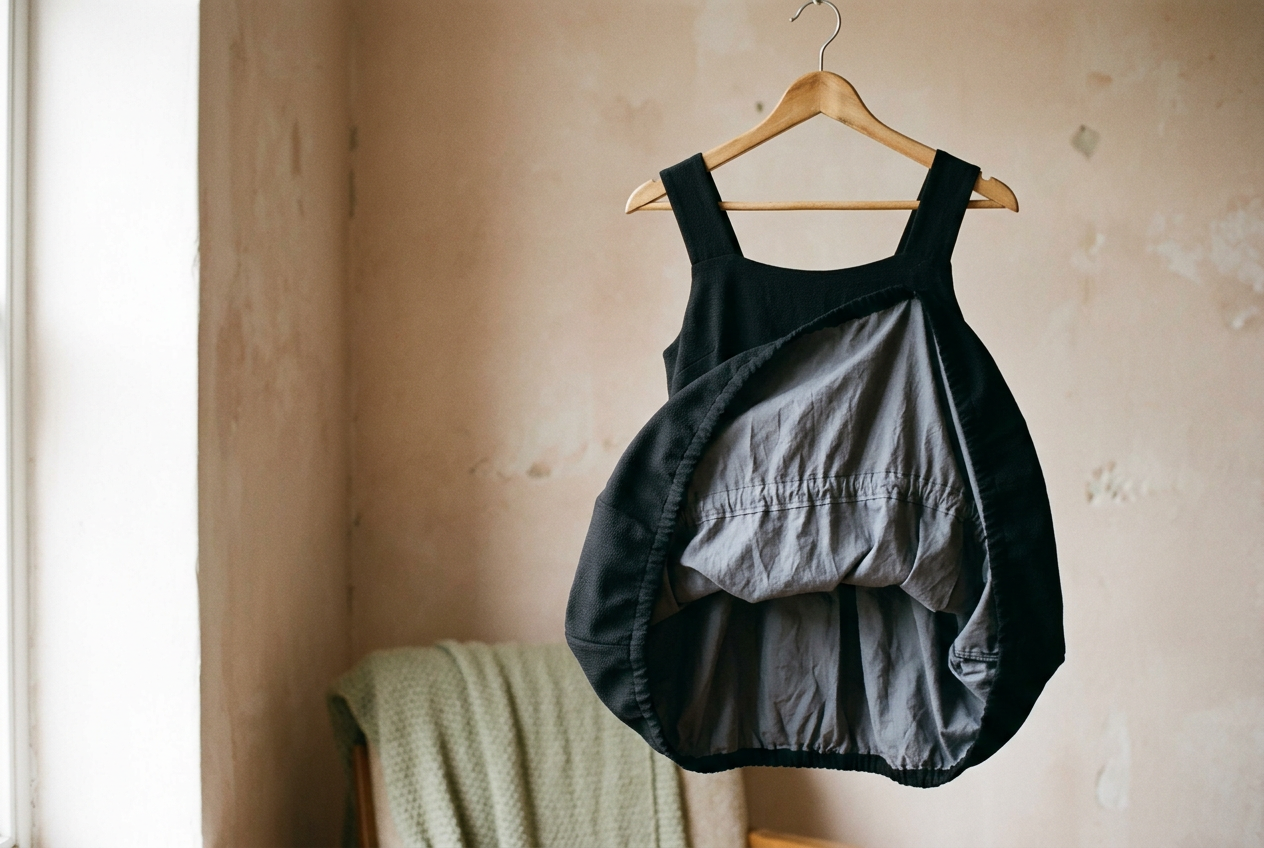
The useful place to start is a black polyester bubble-hem midi skirt examined on a high-street rail: crisp woven shell, fixed lining, and a narrow elasticated lower edge that pulled the fabric inward around the calves. It looked convincing from standing height. Turned inside out, it became clear that the shape relied less on generous cutting than on a firm strip of elastic hidden inside the hem.
That distinction matters. Bubble skirts, dresses, and tops all create a rounded lower edge by making the visible outer layer longer or wider than the structure beneath it. The excess fabric folds under. Yet the part doing the pulling varies, and that hidden choice determines whether the bubble stays buoyant, collapses after laundering, or can be altered without dismantling much of the garment.
This is women’s coverage, although the construction principles apply wherever the silhouette appears. For shoppers, the immediate task is not deciding whether bubble hems are flattering in the abstract. It is working out what holds a particular one in place.
The rounded shape comes from tension
On the black midi, the shell continued below the lining and turned inward into an elastic casing, meaning a folded fabric tunnel that contains elastic. The elastic circumference was smaller than the shell hem, so the polyester gathered around it and rolled underneath. A line of stitching kept the folded edge closed.
This is the familiar high-street solution because it delivers a visible bubble without demanding a highly engineered pattern. It can also feel secure during a fitting: the hem does not need arranging, and the elastic stops the skirt from hanging like an ordinary gathered midi. The tradeoff sits against the legs. Firm elastic may grip the calves when walking, while a loose casing can migrate upward and leave more volume at one side.
Try the skirt with a full stride rather than assessing it only in front of the mirror. Sit down, stand up, and walk again. If the hem catches high on the back of the leg, the bubble may need pulling into place throughout the day; if it drops unevenly, check whether the elastic has already twisted inside its channel.
A good casing should feel smooth when pinched between finger and thumb. Hard knots suggest joined elastic or a twist. Look for a small opening in the stitching, too. An accessible opening makes later elastic replacement possible.
A casing sewn shut can still be opened, but that turns a modest repair into careful unpicking and restitching.
A fixed lining gives a cleaner bubble, with less flexibility
Another common construction joins the outer shell to a shorter lining. The lining becomes an anchor: because it ends higher and has a smaller lower circumference, the longer shell has nowhere to go except inward and upward. The result can be rounder and more evenly distributed than a basic elastic hem, particularly in taffeta, crisp cotton blends, or polyester fabrics with enough body to hold away from the legs.
A fixed lining, meaning a lining sewn permanently to the shell rather than hanging free, also hides the gathered seam. The inside may look neater. From the outside, the bubble often appears controlled instead of puckered.
It is less forgiving when fit is wrong. If the lining is too narrow, the wearer feels the restriction even though the shell looks roomy; a skirt that appears generous through the hip can still shorten the stride because the inner layer carries the tension. Put one foot forward on a fitting-room step or low platform. The lining should move without pulling the waistband down.
Alteration is possible, but changing the length generally means separating the shell from the lining, recalculating how much fabric must be gathered, and joining both layers again. A straightforward-looking hem therefore carries more labor than a conventional A-line skirt. If the garment costs about what you would normally spend on an uncomplicated day skirt, paying for that reconstruction later may not make sense.
Fixed linings also expose differences between materials in the wash. A polyester shell may change little while a viscose or cotton-rich lining draws up, leaving the outer layer more ballooned or slightly crooked. The reverse can flatten the intended shape. Fiber content on both labels matters here, not just the fabric named first on the main composition tag.
Drawcords make the micro-trend adjustable
The most flexible version uses a drawcord threaded through the lower channel. Pulling the cord reduces the hem circumference, while releasing it lets the garment fall closer to a straight or softly gathered shape. This construction appears on casual skirts and parachute-influenced dresses, where visible toggles belong to the design rather than being concealed inside it.
Adjustment has practical value. A wearer can loosen the hem for a longer stride, then gather it again to restore volume. It also allows some control over where the fabric sits, although pulling hard tends to create concentrated bunching near the cord exit instead of the even, continuous curve associated with a fixed lining.
Inspect the exit points. Eyelets or stitched openings should lie flat, with no loose threads for the cord to catch. Pull from both sides and watch whether the gathers travel around the full hem. If only the fabric nearest the toggle moves, the channel may be too tight, the cord may be snagging, or a seam allowance inside the tunnel may be blocking it.
Drawcords need attention in the laundry. Secure the ends loosely so they cannot disappear into the casing, close any toggle, and use a laundry bag if the hardware could strike the drum or catch another garment. A missing cord can be rethreaded with a bodkin, a blunt tool used to guide elastic or tape through a channel, but that is more maintenance than many shoppers expect from a trend-led skirt.
The care label predicts whether the volume lasts
The black polyester midi carried the kind of care instructions that deserve more weight than they usually receive. Its bubble depended on elastic tension, while its crispness depended on the shell retaining enough body to stand away from the lining. Those are separate properties, and either can weaken.
Heat is the obvious concern for elastic. Follow the stated wash temperature and drying instructions rather than treating all polyester garments alike; the shell may tolerate conditions that shorten the useful life of the elastic hidden inside it. High tumble-dryer heat is particularly unhelpful where the casing is narrow and the elastic stays under tension.
Wet weight creates another problem. A soaked bubble skirt can hang heavily from its gathered lower edge, distorting the casing while the garment dries. If the care label permits washing, support the skirt when lifting it from the machine and reshape the gathers before air-drying. Hanging a very wet skirt from the waistband leaves the elastic carrying the weight of the shell.
With a fixed lining, smooth both layers after washing rather than arranging only the outside. Reach inside and check that the lining is not twisted. Steam may relax storage creases, but press cautiously from the reverse at the temperature allowed for the most heat-sensitive fiber; crushing a crisp shell removes some of the structure that made the bubble legible.
The first wash is the important test. A garment that requires dry cleaning, hand washing, or extended reshaping may still be worthwhile for occasional wear, but it is a weak candidate for a frequently worn summer skirt. The care cost is time even when no specialist bill is involved.
The inside tells you whether to buy it
Return to the black midi. Its elastic was enclosed with no obvious access point, the fixed lining limited how far the hem could stretch, and the polyester shell supplied most of the visible lift. That combination can hold a neat shape, but it offers little control to the wearer and makes elastic replacement harder than the outside suggests.
For regular wear, an accessible elastic casing is the more repairable choice. For the smoothest, dressier curve, a well-cut fixed lining can justify its extra complexity if the inner layer allows a normal stride. A drawcord suits someone who values adjustment and accepts visible hardware or uneven gathers.
None guarantees longevity. Before paying more for the silhouette, turn the garment inside out, stretch the hem gently, and read the composition and care labels for both layers. The trend is visible from across the room. Its shelf life is written inside the skirt.
Questions people ask
How can
I tell whether a bubble hem uses elastic?
Pinch and stretch the lower edge gently. Elastic will contract immediately and usually feels like a flat band inside a folded channel; if the hem does not stretch but the shell still rolls under, a shorter fixed lining is probably creating the shape.
Will a bubble-hem skirt lose its shape after washing?
It can if heat weakens the elastic, wet fabric stretches the casing, or the shell and lining shrink at different rates. Follow the care label, support the skirt while wet, and arrange both layers before drying rather than expecting the bubble to reform by itself.
Can a tailor shorten a bubble-hem skirt?
Usually, but construction sets the cost and difficulty. An accessible elastic casing may be opened and rebuilt, while a fixed lining often requires both layers to be separated, shortened, regathered, and rejoined. Ask for an alteration estimate before keeping a skirt that is substantially too long.
Is a drawcord bubble hem better than a fixed one?
A drawcord is easier to adjust for walking and can release the silhouette when you want less volume. It may bunch near the cord exits, and the cord needs securing in the wash; inspect whether it moves freely through the full channel before buying.
One update a day
Today's fashion update, in your inbox
One fashion update each morning — no hype, no filler, just pieces worth wearing.