Raffia Bags Can Work at the Office. Check the Handles First.
The raffia tote has left vacation mode, but many versions are still too fragile for a commute. Handles, lining and exposed fibers reveal which ones can manage work.
November 14, 2026 · 8 min read
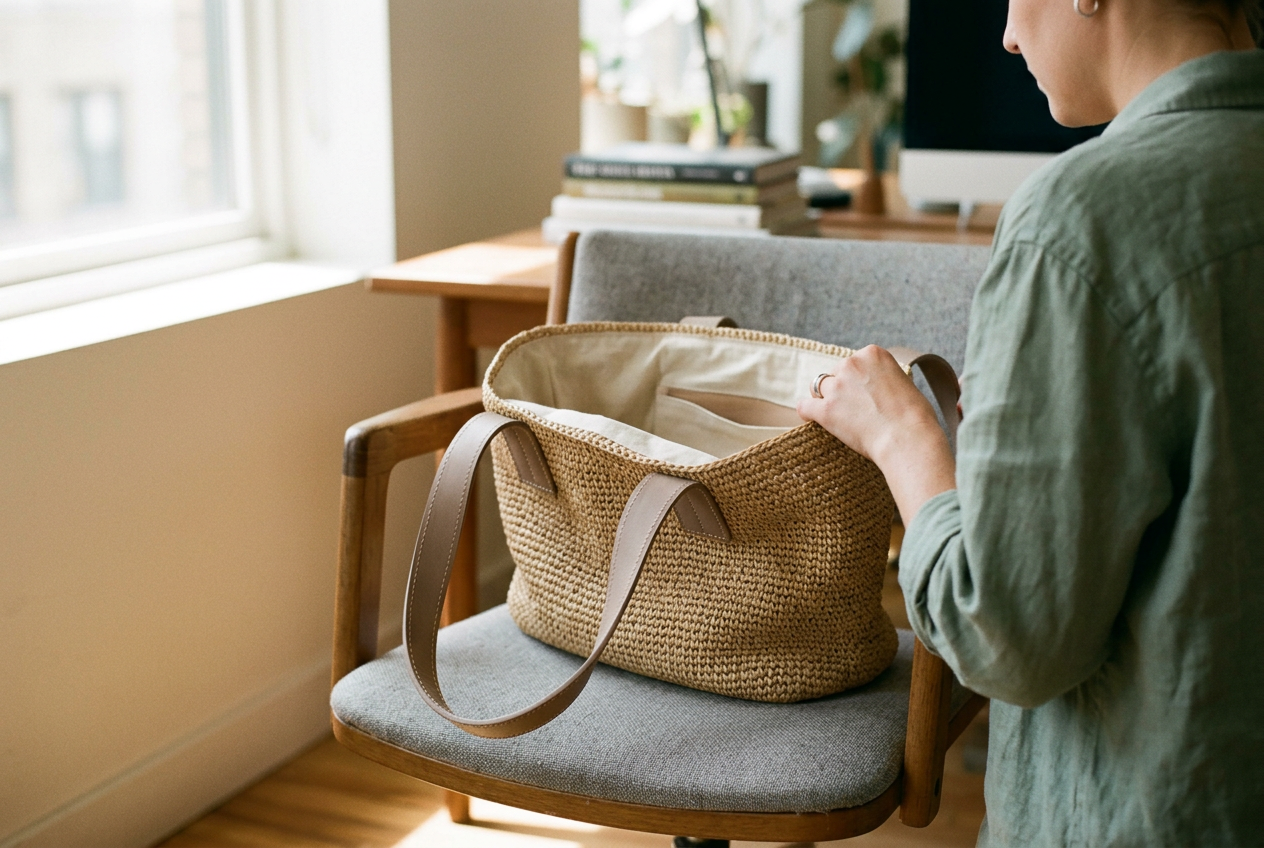
The bag that clarified this shift for me was a medium rectangular tote made from woven paper yarn, a common raffia-look material, with a cotton lining and rolled leather handles. Its dark trim and straight top edge looked closer to a conventional work tote than a beach basket, which was the point. It sat cleanly beside a blazer and wide-leg trousers without asking for sandals, sun or a hotel key.
Then I carried it through a working week with the ordinary load that exposes optimistic bag construction: a laptop in a separate sleeve, a notebook, charging cable, small pouch and water bottle. The tote kept its shape, but the handles began pulling its upper edge inward, and pale fibers lifted where the side repeatedly brushed my hip. Nothing failed. The gap between looking office-ready and being built for office use became visible.
This is unisex coverage because the relevant questions are load, clothing and construction rather than gendered sizing. A raffia bag may be sold in a women’s accessories department, but the same handle attachment and snag checks apply across wardrobes.
Raffia-look can be the practical choice
Natural raffia, meaning fiber stripped from the leaves of the raffia palm, has irregular color and texture that give a bag much of its appeal. It can also split, soften or shed at exposed ends. The material is flexible rather than inherently weak, but performance depends on how it has been dried, twisted, woven and supported.
Many city-facing bags use raffia-look material instead. Paper yarn can produce an even weave and a crisp silhouette, although repeated friction may make its surface fuzzy and moisture remains a concern. Polypropylene or other synthetic strands generally resist water and abrasion better, yet they can feel wiry, catch delicate fabric and look shiny under office lighting. Material labels matter here.
“Woven” describes a method, not a fiber, while vague phrases such as “raffia effect” should prompt a check of the composition panel.
The paper-yarn test tote occupied the middle ground. Its weave looked restrained from arm’s length, and the cotton lining stopped pens and keys from poking through. At the lower corner, however, one raised strand caught the knit cuff of a lightweight sweater. That small snag mattered more than whether the fiber was technically natural: a work bag spends hours against trousers, jackets and sleeves, so its exterior must coexist with the clothes that make it look polished.
Run a dry palm over the side and base before buying. A city-capable surface should feel consistent, with no stiff ends projecting from the weave and no powdery fibers left on the hand. Press lightly at a corner, where abrasion appears first. If strands separate at once or the color flakes from folded areas, the bag is better treated as a seasonal prop.
Handles decide how much the bag can carry
The quickest useful check happens where each handle meets the body. On the test tote, the leather handles were stitched through rectangular tabs on the outside, but the lining hid whatever sat behind them. After the laptop went in, the top edge bowed at those four attachment points. The stitches held, though the woven body was taking more of the strain than its structured shape suggested.
A reinforced handle has an extra layer that spreads weight beyond the visible seam. That layer may be leather, coated fabric or a dense internal panel, and it should extend farther than the handle base rather than ending directly beneath it. Pinch the attachment from inside and outside. A substantial, broad area is more reassuring than one hard little lump surrounded by flexible weave.
Stitching also needs context. Neat stitches through a narrow tab can still concentrate force in one patch, while a wider attachment with an internal backing distributes the load across more material. Metal rings are not an automatic upgrade. If a ring connects to a small raffia loop, the hardware becomes a lever that pulls on a vulnerable point every time the bag swings.
The test tote’s rolled handles remained comfortable in the hand, but they were too short to move easily onto my shoulder over a jacket. That fit quirk changed the load pattern. Hand carrying kept the heavy bag away from clothing, yet it made doors and transit more awkward; forcing it onto the shoulder increased rubbing at the side panel and pushed the handles outward. Before buying, try the bag over the thickest layer you expect to wear with it, then confirm that the opening stays usable without distorting the handle bases.
A removable crossbody strap can help only when its anchor points are reinforced. Small clips attached directly to an open weave are not suitable for a loaded laptop bag. Look for anchors connected to a leather or fabric section that reaches into the bag’s structure.
The lining is part of the frame
A full lining does more than hide the back of the weave. It keeps small objects from working between strands, reduces pressure from hard corners and catches loose fibers before they transfer to a laptop sleeve or dark clothing. In the test tote, the cotton lining also made the interior quieter and easier to search than an unlined basket construction.
Loose lining brings its own irritation. When fabric is attached only around the top edge, it can rise with a notebook or bunch under a water bottle, leaving the woven shell to carry the object’s shape. A lining secured at the base or side seams behaves better. Pull upward gently.
Some movement is useful for cleaning, but the whole interior should not arrive with your hand.
Check seam allowance, the strip of fabric beyond a sewn seam, by opening any interior pocket and looking along its edges. Fraying fabric or an extremely narrow allowance can lead to a pocket separating under the modest weight of a phone. A zipper top should be supported by a fabric or leather facing rather than sewn straight into coarse strands, which can loosen as the zipper is pulled repeatedly.
Color matters less than contrast. A dark lining conceals marks but makes small items difficult to find, while a pale one reveals pen leaks quickly. For work, I would favor a washable or wipeable lining in a medium tone over an elaborate compartment layout. A padded laptop section adds bulk and may encourage overloading; a separate sleeve gives the fragile exterior a better chance because it can move to another bag when rain is expected.
Shedding and snagging are different failures
Shedding shows up as dust, short fibers or wispy ends leaving the bag. Snagging happens when a projecting strand or rough join catches another surface. One bag can do either, both or neither, and a smooth lining cannot correct a rough exterior.
Against cotton poplin, denim and tightly woven suiting, the test tote caused little concern beyond the raised corner. Fine knitwear was less forgiving. The side-to-side motion of walking gave that strand repeated access to the same cuff and hip area, which is why a bag that passes a quick mirror test may still be wrong for soft summer tailoring.
Use the clothes in your wardrobe as part of the purchase test. Hold the bag against a sleeve or an inconspicuous area of a jacket and move it once or twice without pressing hard. Do not rub a retailer’s merchandise aggressively. The aim is to notice immediate catches, not stage a laboratory abrasion test.
Loose fibers can be trimmed only with restraint. Cutting a long structural strand may open the weave, and pulling it is worse. A tiny projecting end can sometimes be clipped level with small scissors, provided it is clearly an end rather than a loop under tension. Clear glue and hairspray may darken natural fiber, harden the surface or transfer to clothing, so they are poor general fixes.
The useful price distinction is construction, not fiber prestige
At the lower end of the market, a raffia-look tote can be a reasonable summer accent when expectations remain light: wallet, sunglasses, phone and a soft pouch. It is not good value as a work bag if the unlined weave drops fibers onto dark trousers or the handles attach through four small, unsupported patches.
Spending roughly what a decent pair of sneakers costs should buy more than branding and leather-colored trim. Look for a secured lining, backed handle attachments and a base that does not collapse around its contents. At higher prices, natural raffia may be chosen for hand feel and variation rather than durability. That can be worthwhile, but the material’s delicacy does not disappear because the finishing is refined.
The paper-yarn tote was convincing enough for a light office day and still unsuitable for my heaviest routine. Removing the water bottle reduced the bowing at the handle attachments; swapping the laptop for a tablet made the bag behave as its appearance promised. That is a real use case, though narrower than the visual language of a roomy rectangular tote suggests.
For daily commuting, the better alternative may be a leather, canvas or tightly woven synthetic work bag, with raffia reserved for days when the load is small and the forecast is dry. I remain undecided on expensive natural-raffia work totes. Beautiful finishing can make them city-capable, but it cannot make leaf fiber indifferent to friction and rain.
Questions people ask
Can a raffia bag carry a laptop safely?
It can carry one if the handles are backed by broad reinforcement, the base stays level and the interior is fully lined. Use a separate padded sleeve and watch for bowing near the handle attachments. If the top edge folds inward as soon as the laptop goes in, the woven body is carrying too much strain.
Is natural raffia better than synthetic raffia-look material?
Natural raffia offers irregular texture and softer visual depth, but it can split or shed at exposed ends. Synthetic strands usually tolerate moisture and abrasion better, although rough or shiny versions may snag clothing and look less refined. Paper yarn sits between them: crisp and even, but vulnerable to repeated rubbing and wet weather.
How can
I stop a raffia bag from snagging clothes?
Check the corners, side seams and handle joins for projecting strands before carrying the bag with knitwear or loose tailoring. Clip only tiny, clearly loose ends without pulling them. If a structural loop is raised or several areas feel rough, return the bag rather than applying glue or spray that may stain clothing.
What makes a raffia bag look appropriate for work?
A controlled shape helps, but construction carries the look through a real day. Choose an even weave, restrained trim, a secured lining and handles that remain comfortable over your usual jacket. Keep the load light enough that the sides do not bulge and the upper edge does not collapse around the attachments.
One update a day
Today's fashion update, in your inbox
One fashion update each morning — no hype, no filler, just pieces worth wearing.