Polka Dots Are Back, but Scale Decides What Looks Current
Pin dots recede, medium spots recall midcentury dresses, and oversized placements act more like graphics. The right choice depends on the garment, spacing, and how long you want it to last.
Women's · November 15, 2026 · 7 min read
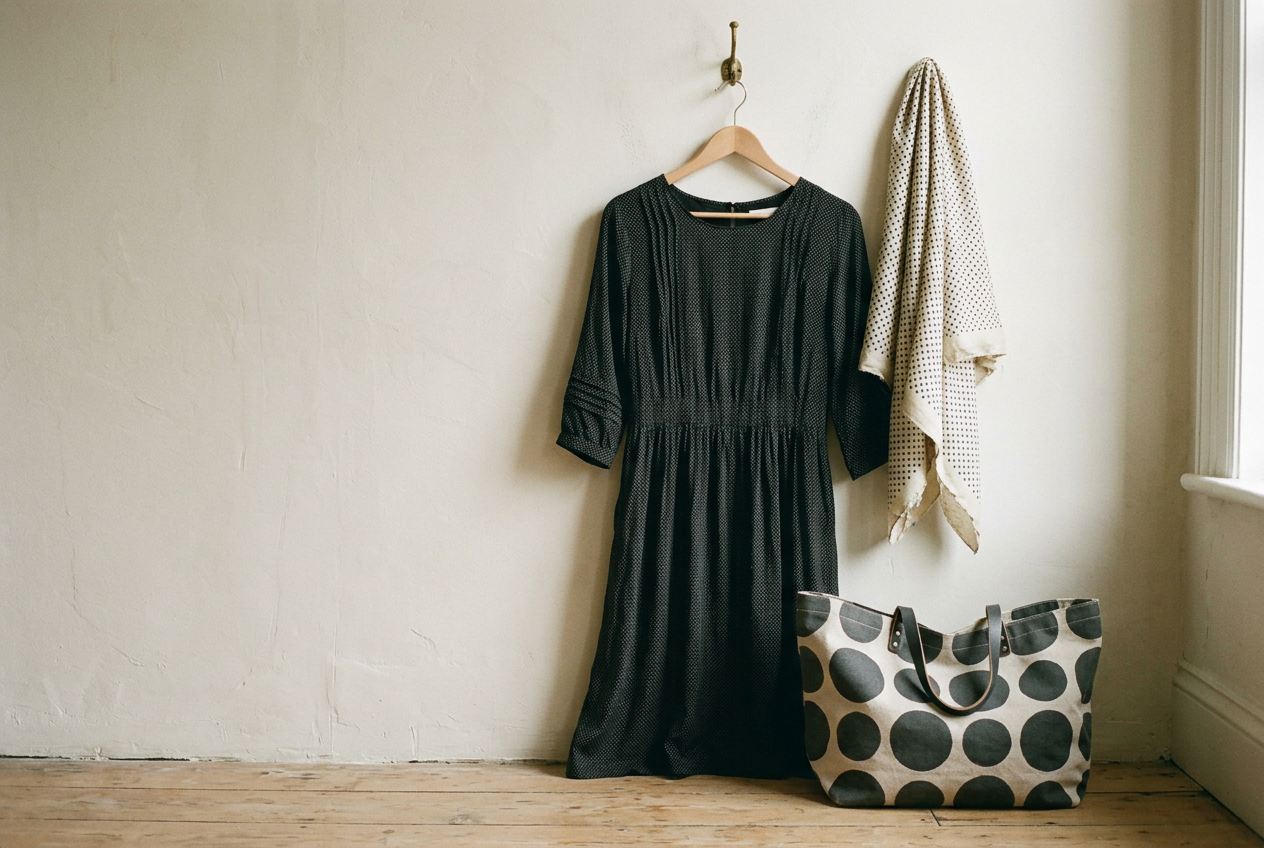
Take one black woven-viscose midi dress with white spots as the test case: a fitted waist seam, short sleeves, a softly flared skirt, and spots roughly the width of a bottle cap. Worn with black leather sandals and a plain shoulder bag, it still reads retro before either accessory has much say.
That dress is useful because nothing about it is extreme. It is the familiar version that appears repeatedly in vintage listings, resale feeds, and new summer assortments. Yet changing only the diameter and spacing of its dots can push it toward office print, 1950s reference, or contemporary graphic pattern. The trend is not one unified return.
This is women’s coverage, focused on dresses and accessories, although the scale principles carry into shirts, ties, and other wardrobes.
Scale carries more meaning than color
Pin dots, meaning spots small enough to merge into texture from several feet away, are the least nostalgic option. On the test dress, shrinking each white circle to something closer to an eyelet would reduce the visual contrast without changing the palette. The dress would behave more like a dark neutral, particularly under a blazer or cardigan, and the fitted waist would stop looking quite so connected to a midcentury day dress.
Small dots also tolerate denser repetition. The repeat, which is the distance before a printed pattern begins again, can be tight without making the surface feel crowded because the individual marks do not command much space. This is useful on viscose, crepe, or silk-like polyester, where folds constantly interrupt the print. The downside is practical: at a distance, a pin-dot dress may lose the reason for buying polka dots at all.
Classic medium spots do the opposite. On our black midi, bottle-cap-scale circles remain visible across a room, and their regularity reinforces every conventional part of the cut: the waist seam, flared skirt, and modest sleeve. Add a red lip, a narrow belt, or a rounded pump and the reference becomes explicit. There is nothing inherently wrong with that, but a buyer seeking “current” rather than “vintage-inspired” should not expect styling alone to neutralize the print.
Oversized dots, especially circles larger than a palm or cropped by the edge of the garment, function more like graphic placements. An engineered placement print, meaning a motif positioned for a particular pattern piece rather than repeated continuously across the fabric, can put one circle across a hip or let half a spot disappear into a hem. That interruption is part of what makes the result feel newer. It is also harder to alter without damaging the composition.
Spacing can rescue or date the familiar spot
Medium dots look most conventionally retro when they sit in an orderly grid with equal amounts of background around each circle. Looser spacing gives the eye more plain fabric and makes the same spot size easier to wear; irregular spacing breaks the association further, although it can expose weak print planning when two circles almost touch at a side seam.
Return to the test dress. If its white spots are evenly packed from shoulder to hem, the print dominates before the drape becomes visible. Spread those same circles farther apart and the black ground takes control, which means a soft viscose skirt can move without turning into a field of flickering contrast.
This matters online. Product thumbnails flatten fabric movement, so inspect the close views and count how many full spots fit across the bodice. Also check the side seams, center front, and waist. Perfect print matching raises production costs and is uncommon at lower price bands, but a large circle cut awkwardly in half at the bust can look like a fault even when the stitching is sound.
The dress shape changes the result
Print scale cannot be separated from silhouette. A medium spot on a fitted-waist midi carries more historical weight than the same spot on a spare column dress, a loose mesh layer, or a shirt dress with a straight body. Our test dress gathers fabric below the waist, so circles cluster inside the folds and spread out again when the wearer walks. That movement intensifies the sweetness already built into the shape.
Material changes the effect as well. Woven viscose usually gives the skirt fluid movement, but it has little useful stretch and can contract after heat or rough washing. A close-fitting bodice therefore needs enough room at the bust before purchase; sizing down to sharpen the waist may pull the spots sideways and make the button placket or side seam buckle. Check the care label, wash cool if permitted, and reshape while damp rather than assuming the dress will return unchanged from a hot dryer.
A sheer or unlined white-ground dress brings another problem. Large dark dots hide some areas while the pale ground exposes others, creating uneven coverage under direct sun. A slip solves opacity but adds warmth and can cling beneath viscose. Black-ground versions are more forgiving, though fading at fold lines and underarms tends to show sooner on secondhand pieces.
The alternative to our fitted midi is not necessarily another dress. A polka-dot scarf or bag can deliver the print without asking the wearer to manage seam matching, opacity, or a waist that sits an inch too high.
Accessories make scale easier to control
Small accessories reward exaggeration. An oversized-dot scarf has enough plain ground to separate the circles, while a compact bag can carry one or two cropped spots and look intentional. Medium dots are trickier on structured handbags because handles, pockets, and hardware interrupt the repeat; inspect whether the motif lines up with the bag’s construction or appears randomly sliced.
Pin dots suit hair scarves and soft pouches, but they often read as texture rather than trend. That may be the better purchase. A silk scarf or cotton bandanna can move between the neck, hair, and a bag handle, and it costs less wardrobe space than a full printed dress.
Shoes demand restraint. Dots placed over toe boxes bend with every step, and a printed synthetic coating may crease through the pale circles first. A dotted sandal strap or fabric flat is less visually demanding, although dirt becomes obvious on white-ground textiles. If the aim is longevity, keep the shoes plain and let the print sit higher on the body.
Secondhand searches work better when they describe structure
Searching only “polka dot dress” returns an enormous mix of novelty prints, pin-up styling, occasion dresses, and contemporary pieces. Add the scale and cut you want. Useful combinations include “micro dot viscose midi,” “pin dot column dress,” “large spot shift dress,” and “oversized dot placement print.” For a deliberate vintage reference, try “1980s polka dot tea dress” or “1950s style spot dress,” while remembering that “style” does not indicate the garment’s age.
Sellers often use “spot,” “dot,” and “circle print” interchangeably. Search all three, then filter by material rather than trusting the visual impression of a photograph. Polyester crepe tends to resist wrinkles and hold color, but it can trap heat. Viscose breathes more comfortably for many wearers and drapes well, yet asks for gentler laundering.
Cotton poplin keeps a clear silhouette and crisp circle edges, which can make medium spots look more emphatically retro.
For the test dress, the strongest resale query is not “black polka dot dress.” It is “black white medium spot viscose fit flare midi,” followed by checks for a stretched waist seam, underarm fading, shrinkage, and a missing belt. Measurements matter more than the tagged size, particularly shoulder to waist, because a high waist seam cannot be lowered without major reconstruction.
The lowest-risk scale is not the newest one
Pin dots have the longest styling range. Oversized placements look freshest now, but their distinct composition may date faster and makes resale alterations difficult. Medium spots remain the honest choice for someone who likes their retro charge, especially when the dress already has a fitted waist and full skirt.
I would not pay an investment price for our test dress unless the seams are clean, the viscose is substantial, and the print placement avoids obvious collisions. At a moderate secondhand price, it earns its place as a specific mood rather than a neutral. For a more adaptable purchase, keep the black sandals and trade the dress for a loosely spaced pin-dot column or one oversized dotted scarf.
Questions people ask
Do small polka dots look more modern than large ones?
Small pin dots usually look less retro because they recede into texture, especially on a straight or relaxed silhouette. Large, irregularly placed dots can look more current than either pin dots or classic spots, but they make a stronger statement and may have a shorter shelf life.
What makes a polka-dot dress look dated?
The strongest retro signal comes from medium, evenly spaced spots combined with a fitted waist, full skirt, short sleeve, and contrast belt. Changing one element helps, but the whole combination matters. A straight silhouette or looser spacing can shift the same black-and-white palette away from costume territory.
What should
I check when buying a polka-dot dress secondhand?
Check fabric composition, garment measurements, underarm fading, and whether large spots collide at prominent seams. On a fitted-waist dress, compare the shoulder-to-waist measurement with a dress you own, since an incorrectly placed waist seam is expensive to move and difficult to disguise.
Are polka-dot accessories safer than a full dress?
Usually. A scarf or small bag limits the print’s visual area and lets an oversized motif feel graphic rather than theatrical. Inspect white-ground fabric for marks and fading, then check whether the dots are positioned intentionally around handles, edges, or folds rather than cut into distracting fragments.
One update a day
Today's fashion update, in your inbox
One fashion update each morning — no hype, no filler, just pieces worth wearing.