Peep-Toe Shoes Are Back. The Opening Decides the Fit.
The useful distinction is not pump versus slingback. It is whether the opening reveals the tips of one or two toes, or places a firm edge across several moving joints.
Women's · September 25, 2026 · 8 min read
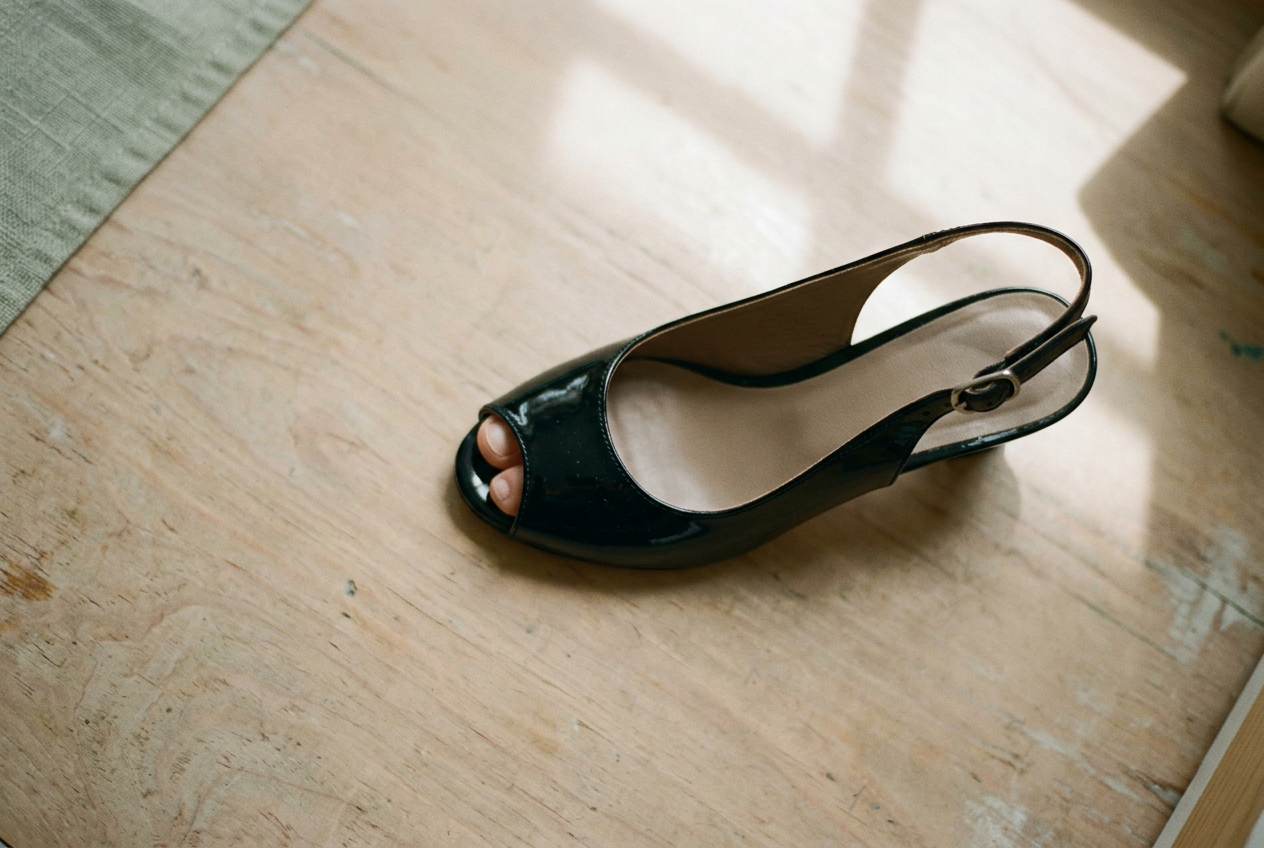
The pair that clarifies the return is Miu Miu’s patent-leather peep-toe slingback pump. Its squared front, slim heel and small central opening bring back an idea that has been largely absent from everyday shoe departments: the dress pump with only a controlled glimpse of toes.
Look past the styling, though, and the opening is doing nearly all the practical work. It is low enough to read as a peep rather than a sandal, yet substantial enough that the toes remain part of the design. That balance looks precise in product photography. On a foot, it depends on whether the rear edge of the opening sits ahead of the nail beds or farther back, where several toes bend and spread.
This is women’s coverage because the current retail examples are concentrated in women’s pumps, slingbacks and heeled mules, with the usual fit complications of pointed lasts and inconsistent width grading. The underlying test applies beyond those categories, but the available market does not yet make this a convincingly unisex trend.
The opening has two measurements that matter
Opening width is the obvious measurement, although it is not the best predictor of comfort. Height and edge placement tell more.
Height means how far the cutout travels back along the vamp, the section of the upper covering the front of the foot. A low opening interrupts the shoe close to its front wall and shows mainly the nail tips. A high opening reaches toward the toe joints, where the foot changes shape with every step.
Edge placement is the line the cutout draws across the toes. A shallow, gently curved edge can frame the big toe and part of the second toe without trapping either. A straighter edge that sits farther back may cross three toes at different points, which is harder to fit because those toes are not the same length and do not flex in one line.
The Miu Miu slingback is useful here. Its opening appears restrained from the front, but the top-down view matters more: the cutout is wide enough to make toe alignment visible, and the squared shape gives the toes less visual room to shift without looking off-center. A wearer whose second toe extends beyond the big toe will fill that opening differently from the foot shown in a campaign or retail image. No amount of choosing a smaller size corrects that geometry.
A runway peep and a walking peep are different
Runway imagery establishes the proportion. It shows whether the opening looks current with a squared toe, a narrow heel or a long vamp. It does not show what happens after the foot slides forward repeatedly, which is common in heels and slingbacks because the back of the shoe offers less resistance than a closed pump.
As the foot moves, the toes spread. If the opening ends before the nail beds, its edge remains near the less flexible tips. If it reaches behind them, the upper can press into the skin above a toe joint while another toe pushes through farther. That is when a neat runway aperture turns into an uneven row of toes, with pressure concentrated at the corners.
The issue is especially visible in a high-cut oval opening. It may appear generous, yet generosity is not the same as clearance: a broad opening can still place its rear edge directly over moving joints, while a smaller and lower cutout leaves them covered by a continuous upper. For real walking, the second construction is often easier.
Slingbacks add another variable. Tightening the rear strap may reduce forward movement, but it can also pull the upper back against the toes. Leaving it loose gives the foot space to slide. On the Miu Miu pump, as on any similarly shaped slingback, the successful fit requires the heel strap and front opening to hold the foot between them without either becoming the main anchor.
Material can rescue or ruin the same shape
Patent leather makes the resurfacing peep toe look deliberate. Its shine emphasizes the cut line and gives a small opening enough visual weight to register from a distance. It is also relatively unforgiving at a narrow edge, particularly before the shoe has flexed to the foot.
Construction matters at that edge. A turned edge, meaning the upper material is folded inward before finishing, can feel smoother but adds a small amount of bulk. Piping creates a rounded border, which may soften contact while forming a firmer ridge. A thin cut edge looks cleanest in photographs, though the comfort depends on how well it is sealed and whether its corners meet the toes.
Soft leather behaves differently. It can yield around a wider forefoot, but a soft upper may also collapse into the opening and rub as the toes bend. Fabric and mesh reduce some pressure while introducing stretch, fraying or a less stable shape. Synthetic patent can hold a crisp line at a lower price, yet a rigid version may not relax much with wear.
This is why copying the Miu Miu silhouette at a lower price does not guarantee the same result. The opening can be traced accurately while the edge finish, lining and stiffness change. A high-street pair deserves closer inspection precisely because the cutout looks simple.
Read the product page from the toes backward
Start with the top-down image. Ignore the styled foot if there is one and follow the rear boundary of the opening. A practical cutout ends close to the front of the shoe and leaves enough uninterrupted upper to contain the toe joints. If the opening travels far back or widens sharply at its rear corners, expect more dependence on individual toe length.
Next, use the side view to judge depth. The toe box, the enclosed space around the toes, should have enough vertical room that the upper does not push the foot downward into the opening. A shallow pump with a high cutout can pinch from above and below at once. Visible cushioning does little to solve that.
The front view reveals whether the opening is centered on the shoe or biased toward the big toe. A centered aperture suits some feet, while an opening placed slightly inward may frame the big toe more naturally. Neither is universally better. The correct one follows the wearer’s toe line without forcing the foot sideways inside the shoe.
Retail photography often leaves one unanswered point: the edge viewed from inside. If the product page does not show it, inspect that area as soon as the shoes arrive. Run a fingertip around the opening for raised seams, stiff corners or adhesive residue, then try the pair on clean carpet late enough in the day that the feet are no longer at their smallest. Walk, stop and take a few careful steps downward.
Forward slide usually becomes clearer on a descent.
Check the retailer’s return conditions before removing protective films or marking the sole. Peep toes can fail quickly in the fitting stage, which is preferable to waiting for a supposed break-in that a coated or heavily reinforced edge may never provide.
The version worth buying is less dramatic
The most wearable revival is likely to be the low peep-toe slingback or pump with a softly curved opening, a stable mid-height heel and a leather lining around the front. It gives the trend a visible signature without asking several toe joints to meet one rigid line.
The harder version is the elongated cutout that reaches up the vamp. It photographs as more directional because it reveals more foot, but it also starts to compete with the structure of the shoe. At luxury prices, that is not worth accepting unless the exact opening matches the exact foot. At a lower price, the construction needs scrutiny rather than optimism.
Styling does not require a full return to the dress codes associated with older peep toes. A squared slingback can sit under straight trousers with the hem ending above the opening, or work with a plain knee-length skirt where the shoe supplies the sharper line. Very long trousers hide the feature and may catch under the exposed front. Tights introduce a visible toe seam unless they are designed without one, and the fabric can gather at the cutout.
The Miu Miu pair makes the case for the silhouette, but it also exposes the limit. Its polish comes from control: squared front, measured aperture, restrained reveal. Once the opening rises too high or its edge lands across several toes, the shoe stops looking controlled on anyone whose foot diverges from the photographed sample.
Peep toes appear to have enough runway and retail support to last beyond a single styling cycle, though the most conspicuous versions may date faster. A low cutout is the safer buy because it reads as a small change to a pump rather than a costume reference. I am less convinced by the high oval opening. The fit margin is too narrow, and the visual payoff depends on standing still.
Questions people ask
How should a peep-toe shoe fit at the opening?
The rear edge should sit ahead of the toe joints and should not press into the skin when the toes spread. One or two toe tips may show, depending on foot shape, but no toe should look trapped at a corner or pushed above another.
Should I size up in peep-toe pumps?
Usually not as a first fix. Extra length can increase forward sliding and drive the toes harder into the opening. Start with your normal size, assess the shoe’s width and depth, then try a wider fit if the forefoot feels compressed while the heel and overall length feel correct.
Are patent-leather peep toes likely to stretch?
Patent leather may soften slightly, but its coated surface and reinforced edges generally offer less give than soft uncoated leather. Do not rely on the opening becoming much larger. If its edge presses across a toe joint during an indoor fitting, treat that as a construction mismatch rather than a break-in plan.
Can peep-toe shoes be worn with tights?
They can, but the toe seam may show or bunch inside the opening. A seamless-toe style gives a cleaner result, while a fine, closely fitted knit is less likely to gather. Check that the tights do not make the foot slide farther forward against the edge.
One update a day
Today's fashion update, in your inbox
One fashion update each morning — no hype, no filler, just pieces worth wearing.