Almond-Toe Shoes Offer More Room, but Width Still Matters
The shape is turning up in women’s flats, pumps, and boots, not just social posts. Its softer point may last, provided the shoe is wide enough where your toes bend.
Women's · September 23, 2026 · 7 min read
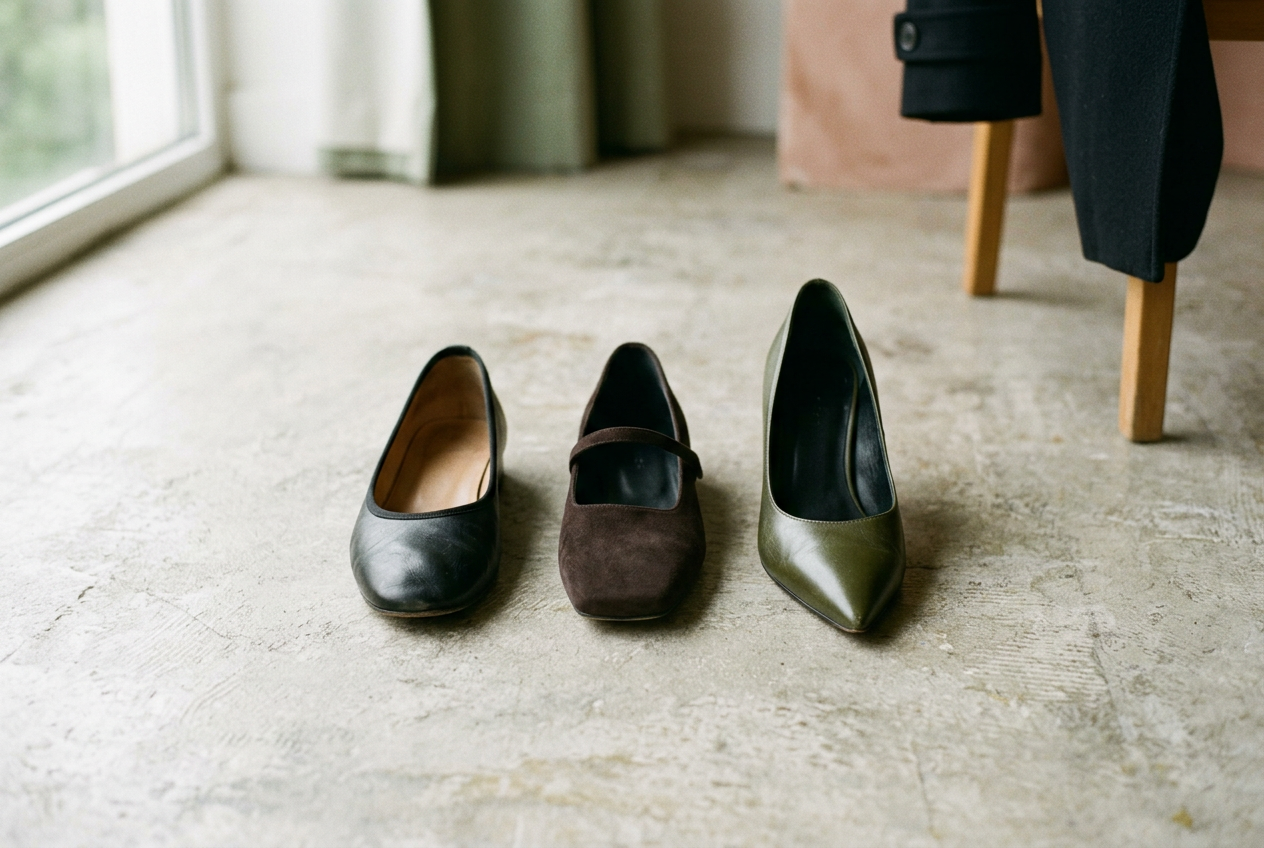
The useful test is a black leather ballet flat such as Margaux’s The Demi, a long-running style with an almond-shaped front, low profile, grosgrain binding and a small bow. It is not here as proof that one shoe makes a trend. It is here because its toe sits between the two recent extremes without looking indecisive, and because a flat exposes the fit issue that product photos tend to conceal: a graceful outline can still squeeze the foot if the shoe narrows too early.
That distinction matters now. Public fashion reporting has been tracking a retreat from emphatic square toes and severe points, while a review of women’s footwear assortments at department stores and fashion retailers shows softened, tapered fronts recurring in ballet flats, slingback pumps and ankle boots. Retailers do not always label them “almond.” Some call the same shape round, tapered or soft pointed, so the evidence is clearer in the outline than in the filter menu.
The shift looks broader than an isolated social-media pose because it survives changes in heel height and shoe construction. A micro-trend usually depends on one tightly recognizable object. Here, the toe is migrating.
What counts as an almond toe now
An almond toe has a rounded tip that tapers inward from the ball of the foot, resembling a softened point rather than a full semicircle. The current versions vary. Margaux’s Demi sits near the rounder end, while many pumps use a longer taper that appears pointed from above until the curved tip comes into view.
The most useful dividing line is not the product name. Look at where the shoe begins to narrow. On a moderate almond, the sidewalls stay relatively full through the forefoot before drawing inward around the toes. On an aggressive almond, the taper starts near the ball joint, creating much of the visual length in empty space beyond the toes while pressing the outside edge of the foot.
Square toes had an obvious graphic edge, particularly on sandals and close-fitting boots. Needle points added length and formality. The almond offers less of a statement, which may be why it is moving easily between categories: it can make a ballet flat look composed without turning prim, and it gives a pump direction without requiring the wearer to tolerate a sharply compressed toe box.
That quieter quality is also its limitation. If the rest of the shoe is generic, an almond toe will not make it interesting. A thin leather sole, a shaped low heel or a well-cut vamp, meaning the upper section that covers the front of the foot, has to do more of the visual work.
The flat tells you where the shape can fail
Return to The Demi. Its almond outline is useful for a replacement decision because it shows why toe shape and toe room are related but not interchangeable. Margaux offers multiple widths, an acknowledgment that two shoes with the same elegant outline can fit very differently across the forefoot.
A shopper replacing a worn ballet flat should stand in the new pair and check where the big-toe joint and little-toe joint meet the upper. If either joint sits on the point where the shoe starts narrowing, the almond is too aggressive for that foot, even when there is space in front of the longest toe. Going up half a size may create heel slip without solving the pinch. A wider fitting, or a rounder almond from another brand, is the better correction.
Material changes the calculation. Soft nappa or lambskin can relax across the foot, though it will also show the outline of toe joints sooner and may lose its clean shape. Firm calfskin keeps a polished contour but offers less forgiveness during break-in. Patent leather is the least persuasive choice for a close almond flat because its coated surface stretches reluctantly; buying a painful pair in the hope that it will soften can turn a versatile-looking shoe into one that stays under the desk.
The top edge deserves attention too. A low-cut flat may feel roomy at first because it leaves more of the foot uncovered, yet a stiff binding can still rub once the foot swells during a full day. With a bound style such as The Demi, the correct width should let the upper sit smoothly rather than bow outward at the joints. The bow is decoration.
The side profile reveals the fit.
Pumps and boots make a pattern, not a guarantee
The same softened taper is showing up on slingbacks and mid-height pumps, where it offers a less severe alternative to the elongated point that has dominated dress shoes. On a pump, however, heel pitch pushes the foot forward, so even a generous-looking almond can become crowded after an hour. A secure heel counter and enough width at the ball matter more than the amount of visible shoe beyond the toes.
This is where square toes retain a practical advantage. A genuinely broad square or rounded-square pump can give the first and fifth toes more lateral space, assuming the internal shape follows the exterior. The tradeoff is visual: a blunt front can feel tied to the strong late-2010s and early-2020s square-toe cycle, particularly when paired with a flared heel.
Boots make the almond case more convincingly. Leather ankle boots need enough front structure to handle pavement and repeated flexing, while an extremely pointed toe can scuff at its tip and make everyday trousers fall awkwardly around the foot. A medium almond works under straight jeans and wider tailored pants, and it does not demand a particular heel shape to make sense.
Still, shoppers should inspect the sole outline. The last, the foot-shaped form around which a shoe is built, determines the internal volume; a rounded upper stretched over a narrow last remains a narrow shoe. Turn the boot over. If the outsole pinches sharply inward before the toe, the extra-looking room above may be cosmetic.
The replacement decision is narrower than the trend
For someone replacing one worn pair now, the safest almond is neither especially long nor almost round. Choose a toe that starts tapering beyond the widest part of the foot and leaves enough depth for the toes to lie flat. In a pump, test it on the surface where you will wear it rather than only on carpet, since forward slide becomes clearer when you walk at normal speed. In a boot, use the sock thickness intended for daily wear.
Price should follow construction rather than novelty. At the lower end of the market, a synthetic almond-toe flat may capture the outline but offer little ability to stretch, repair or recover once the upper creases. Mid-priced leather can be the sensible replacement tier when the lining is smooth, the heel is stable and the sole has enough substance for repeated use. Paying more becomes defensible when the shoe offers width choices, replaceable heel lifts or a stitched sole that a cobbler can service.
Do not pay an investment premium for the toe shape alone. The Demi makes a stronger longevity argument through its restrained proportions and width range than an exaggerated almond pump whose elongated front will date as soon as the cycle swings back toward roundness. A trend can be real without making every expression of it durable.
Color also changes the shelf life. Black or deep brown lets the almond recede into the shoe, which is useful for a pair expected to work across several years. A pale high-shine finish emphasizes every curve and turns the toe into the main event. That may be the point, but it is a fashion purchase rather than a neutral replacement.
The emerging shape does not require clearing out square toes. Keep a square sandal if its footbed works, and keep a pointed pump that earns its place for dressier clothing. The practical change is at the moment of replacement: the moderate almond now has enough support across flats, pumps and boots to feel current without depending on one viral styling cue.
Questions people ask
Are almond-toe shoes more comfortable than pointed shoes?
They can be, because the rounded tip usually removes pressure from the center toes. Comfort depends on where the taper begins, however. If the shoe narrows at the ball of the foot, it may squeeze as much as a pointed style. Check joint placement and width rather than judging the tip alone.
Should I size up in an almond-toe flat?
Not automatically. Extra length often causes heel slip while leaving the forefoot tight. Start with your usual size, then try a wider fitting or a rounder almond if the upper presses the big-toe or little-toe joint. Leather may relax, but binding and coated patent finishes usually give less.
Will almond-toe boots look dated next year?
A moderate almond is less tied to one season than a very blunt square or dramatically extended point. For better longevity, choose a toe that follows the foot, a simple leather upper and a stable heel. An exaggerated, long almond carries more trend risk because the empty front space becomes the defining feature.
Is a square toe still better for wide feet?
Sometimes, but the exterior outline does not guarantee internal width. A square shoe built on a narrow last can still pinch, while an almond style offered in wider fittings may work better. Compare the outsole at the ball of the foot and make sure both toe joints sit before the taper begins.
One update a day
Today's fashion update, in your inbox
One fashion update each morning — no hype, no filler, just pieces worth wearing.