Padded Flip-Flops Feel Better Until the Sole Starts to Shift
Puffier straps and thicker foam soften each step, but they also put more material between the foot and the ground. The right pair depends on fit, firmness, and where you walk.
Women's · August 23, 2026 · 7 min read
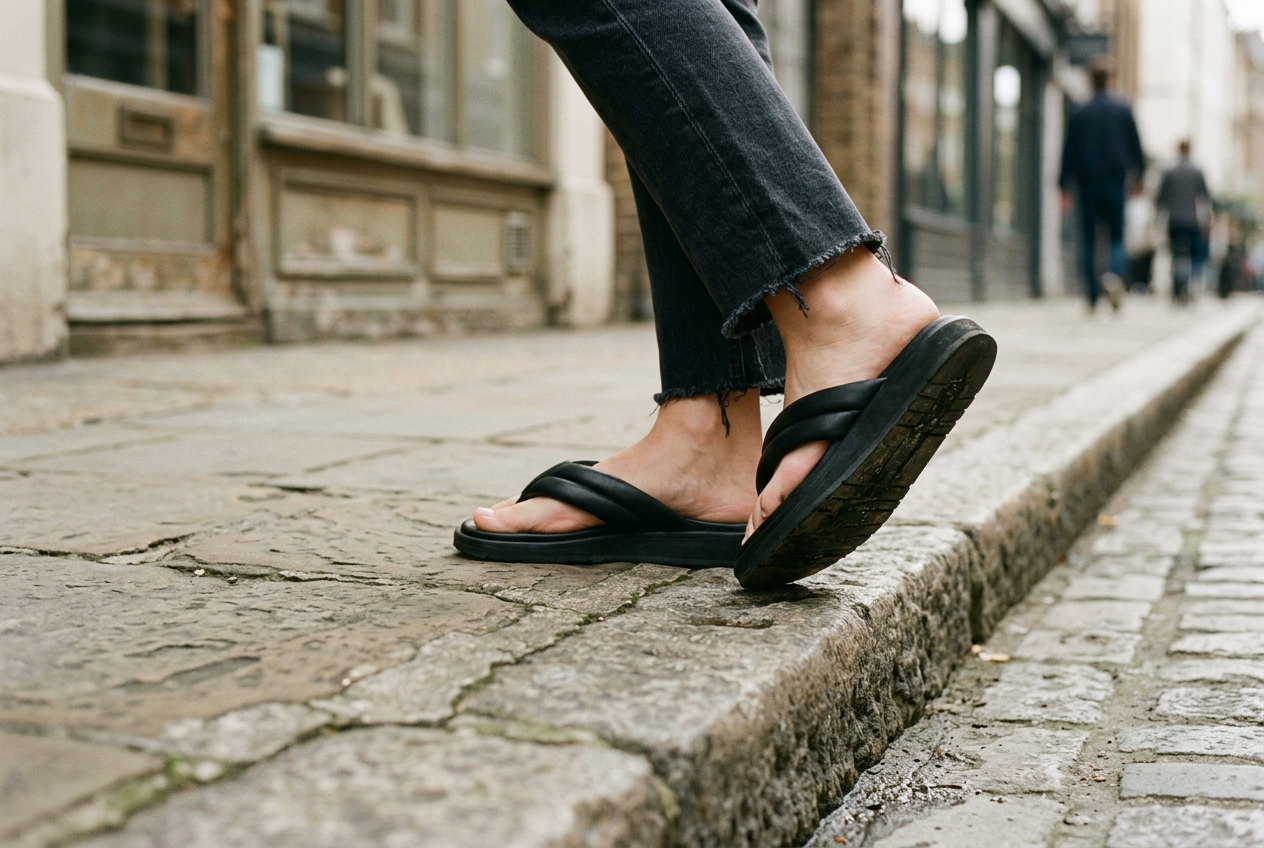
The useful test for a padded flip-flop begins after the first pleasant step. Cushioning is easy to notice in a fitting room; control takes a curb, a quick change of direction and enough walking for the foot to warm up.
I used the black FitFlop Lulu Padded-Leather Toe-Post Sandal as the concrete case for a week of ordinary wear. The women's sandal combines softly padded leather straps with FitFlop's Microwobbleboard midsole, a layered cushioning structure shaped to place different densities of material under different parts of the foot. It sits well above a thin beach flip-flop without becoming a full flatform, meaning a shoe with a similarly elevated sole from heel to toe.
The Lulu is not the newest or most exaggerated version of this look. That made it more useful. Its proportions show what happens when a familiar thong sandal gains enough padding to change the walk, rather than merely looking puffy in a product photograph.
The thin sole is losing fashion ground
The narrow leather thong and nearly flat rubber flip-flop have not disappeared. They still work with long skirts, loose tailoring and the revived taste for spare late-1990s dressing. What is rising beside them is more upholstered: rounded straps, broad toe posts and soles built from thicker foam, sometimes with platform height added for visual weight.
The Row's Ginza sandal helped establish the polished thick-soled flip-flop as something other than pool footwear, while recovery-shoe brands and mainstream sandal makers made cushioning familiar at less rarefied prices. Current versions range from molded EVA, meaning the light, springy plastic foam widely used in shoe soles, to padded leather uppers set over layered midsoles. The shapes differ, but the proposition is consistent. A flip-flop can look substantial and feel soft without becoming a strapped walking sandal.
That last point contains the tradeoff. Added foam changes impact, not the basic fastening system. A thong still relies on a toe post and two straps to keep the foot aligned, so a high, yielding sole can move farther beneath the wearer than a thin one does.
The
Lulu softened impact but demanded more toe work
Across dry sidewalks, store floors and a standing-heavy afternoon, the Lulu took the sting out of hard ground. Its midsole compressed without collapsing flat, and the wider padded straps spread pressure more comfortably than a narrow strip of leather. There was no sharp edge at the base of the toes during the week's shorter outings.
The toe grip became noticeable once the pace increased. Toe grip is the unconscious curling or pressing used to keep a backless shoe attached during the swing phase of a step. A well-fitted flip-flop still prompts some of it, but a heavier sole and loose straps ask for more, particularly when walking uphill or trying to keep pace with someone in sneakers.
On the Lulu, the broad upper held the forefoot better than a basic rubber flip-flop, yet the substantial midsole lagged slightly when I lengthened my stride. The effect was not dramatic. After several blocks, though, my toes were doing work that the padded footbed initially disguised. Shortening the stride helped, as did letting the sandal roll forward rather than pushing off sharply.
This is where trying on both a half size down and the expected size can be useful, provided the smaller footbed still contains the heel and toes. Length alone does not secure a thong sandal. The straps should meet the foot without a visible pocket of space when standing, and the toe post should sit close enough to prevent forward sliding without pulling tightly into the web between the toes.
A padded upper can complicate that judgment. It may feel snug when new, then soften and gain a little room as its lining compresses. The Lulu's leather straps relaxed modestly through the week, which improved the initial fullness across the forefoot but also made the fit less precise by the final wears. A foot already swimming under the straps in the store is unlikely to become more secure.
Height exposes sideways movement
The more important limit was lateral stability, meaning how securely a shoe resists side-to-side movement. Walking straight on level pavement felt settled. Turning around a grocery aisle, stepping off a sloped curb and crossing uneven paving made the footbed's height more apparent.
A thick sole raises the foot farther from the ground, while soft foam allows the foot to sink and tilt before the outsole fully responds. With no heel strap to pull the shoe back into line, the sandal can land a fraction off-center. The Lulu remained manageable because its sole is broad and not extremely tall, but it never felt as planted as a thin, moderately firm rubber flip-flop.
This distinction matters more than softness under the heel. Press the display shoe at the center of the footbed, then try to twist the sole gently from opposite ends. A little flex allows a natural step; easy twisting through the middle suggests the platform may feel vague on broken pavement. Next, stand on one foot and turn the torso slightly.
If the heel moves toward the edge while the sandal stays behind, the straps are not controlling the extra sole.
Anyone expecting long sightseeing days, fast station changes or repeated stair use should treat padded flip-flops as the relaxed option, not the comfort equivalent of a supportive walking sandal. A low sandal with an adjustable instep strap, heel strap and firm midsole gives the foot much more help. It may look less current, but it also reduces the need to grip.
Leather padding and water are an awkward pairing
The padded trend borrows the visual language of pool shoes, but not every pair behaves like one. The Lulu's leather upper absorbed surface moisture around the strap edges during a controlled dampening test, and the padded area stayed cool and slightly damp longer than the exposed footbed. It was wearable again after drying in open air, though not as quickly as a one-piece molded sandal would have been.
Foam construction needs scrutiny too. Closed-cell foam, which has sealed internal pockets that resist taking in water, usually dries faster than fabric-covered padding. Even then, water can remain where a strap enters the sole or beneath a glued lining. A sandal that feels dry on top can still release moisture when flexed.
For beach showers, pool decks or a commute that regularly ends in summer rain, molded EVA is the more practical version of this trend. Leather and fabric-covered padding suit dry city wear. Neither should be left against direct heat to hurry drying, since concentrated heat can distort foam, harden adhesives or alter leather. Open the straps as far as their construction allows, blot the surface and leave the pair where air reaches both sides.
The price should buy construction, not just volume
Padded flip-flops occupy an unusually broad price ladder. Basic molded pairs sit near the low end of summer footwear; layered recovery sandals and leather versions move into the middle; designer leather interpretations can cost more than a good pair of sneakers. More foam alone does not justify the climb.
At the middle price band, look for an outsole distinct from the cushioned midsole, visible shaping around the heel and straps that enter the sole cleanly without rough glue lines. An outsole is the ground-contacting layer, and a firmer one slows wear while giving soft cushioning a more stable base. Deep decorative puffing on top cannot compensate for a narrow platform or a loose toe post.
The Lulu made the strongest case for itself during low-speed, dry days: errands, lunch, a mostly seated office and an evening where a thin beach flip-flop would look underdressed. Its black leather and moderate sole worked with wide-leg trousers and a column skirt because the visual weight repeated the volume of the clothes. Under narrow ankle pants, the same sole looked heavier and made the exposed foot seem shorter.
After a week, I would not replace every thin flip-flop with it. The padding earned its place when pavement impact was the main discomfort, but the less secure platform became the larger issue on uneven ground. The trend has room to last in softened, lower profiles. Its most inflated versions may fade once buyers notice that visual cushioning and walking security are separate features.
Questions people ask
Are padded flip-flops better for walking all day?
They reduce the sharp feeling of hard pavement, but cushioning does not secure the foot. For an all-day route with stairs, slopes or fast walking, choose a sandal with a heel strap and adjustable instep support. Keep padded flip-flops for shorter, slower stretches unless the sole is firm and the straps fit closely.
Should padded flip-flops fit tightly at first?
The straps should touch the foot without pinching, while the heel and longest toe remain fully inside the footbed. Soft leather or fabric padding may compress with wear, so a visibly loose upper is a poor starting point. Do not size down if that pushes the toe post painfully backward or leaves the heel at the edge.
Can padded flip-flops get wet?
Molded EVA pairs usually tolerate splashes and dry faster than leather or fabric-covered styles, although seams and strap sockets can retain water. Blot wet sandals and air-dry them away from direct heat. A padded leather pair such as the Lulu is better treated as a dry-weather city sandal than as a pool shoe.
How can I test stability before buying?
Stand on one foot, turn slightly and notice whether your heel drifts toward the side of the footbed. Walk quickly, make a tight turn and step down from a low fitting-room platform if permitted. A stable pair should follow the foot without forcing the toes to curl hard to keep it attached.
One update a day
Today's fashion update, in your inbox
One fashion update each morning — no hype, no filler, just pieces worth wearing.