Nickel-Free Earring Hooks Don’t Cover the Jump Ring
On a dangling earring, the hook is only one point of contact. The tiny ring, charm, plating, and solder all deserve the same material check.
September 25, 2026 · 7 min read
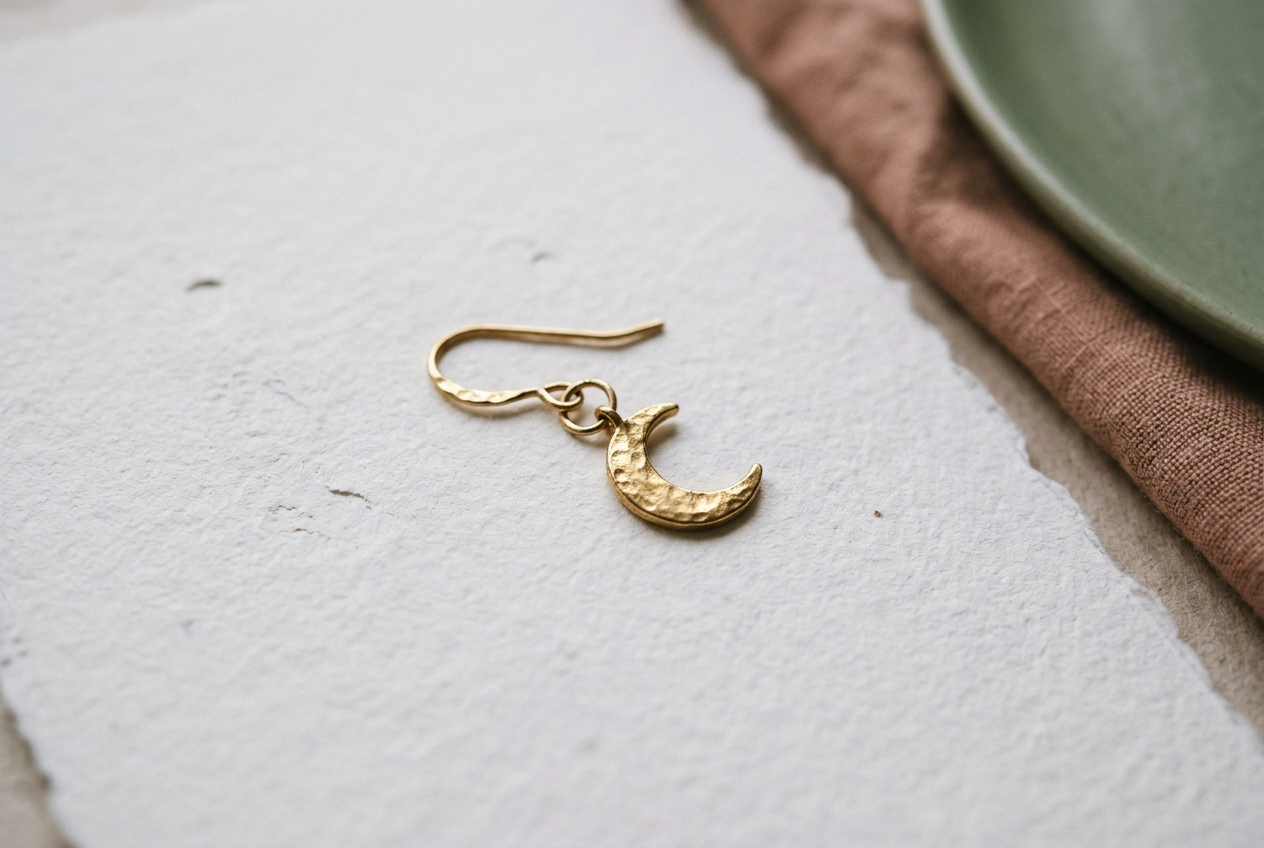
Take a gold-tone crescent drop earring. The curved hook passes through the piercing, while a tiny circular connector suspends the crescent below it. That connector is a jump ring, meaning a small metal ring with a cut that lets a maker open and close it. It looks incidental.
For sensitive-ear shopping, it is part of the earring.
The crescent drop is the useful test case here because its construction is visible: hook, decorative coil, jump ring, charm, plating, and any solder used to close or attach those pieces. If a listing identifies only the hook as nickel-free, it has answered one material question. The rest remain open.
This advice is unisex because the construction does not change with the wardrobe around it. It applies to delicate drops worn with tailoring, small charms added to a curated ear, and inexpensive statement earrings reserved for dinner. The relevant distinction is how the metal sits and moves against skin.
Follow the earring from piercing to charm
Start with the ear wire, the curved hook that passes through the piercing. A useful listing names its material rather than relying on “hypoallergenic,” a broad marketing term that cannot promise a reaction-free experience. “Titanium hook” is more informative. “ASTM F136 implant-grade titanium,” which identifies titanium made to a recognized implant-material specification, is more precise still.
Niobium and solid gold are other materials shoppers may consider, although solid gold is an alloy rather than pure gold in most wearable jewelry, so the seller should still identify the karat and ideally the alloy composition. White gold deserves an extra check because its alloy can vary. Stainless or “surgical” steel may contain nickel, even when it is corrosion resistant, and suitability differs from person to person.
Now move down the crescent earring. Some hooks have a wrapped coil and bead just above the loop. Those details may be made from the same wire, or they may be separate components with a different finish. A product page that says “nickel-free ear wires” does not automatically cover the coil, bead, or loop.
The jump ring comes next. It can swing close enough to graze the lower edge of the lobe, especially when the hook is short or the charm is light. An open jump ring, one closed by bringing its cut ends together rather than soldering them, also has two edges where plating can wear first. The exposed base metal, which is the structural metal underneath a surface finish, may differ from the gold- or silver-colored layer that attracted you.
Then inspect the charm. A flat crescent tends to rotate as the wearer walks, so both faces and the thin edge can touch the neck. Larger charms may reach the jaw or catch against a high collar. The hook can remain neatly inside the piercing while the charm creates the longest and broadest skin contact of the entire piece.
Material wording that earns trust
The strongest product description follows the whole construction. Look for wording such as “hook and jump ring are titanium; charm is solid 14-karat gold,” or a statement that all metal components are made from the named material. A component table is even easier to assess, particularly when an earring combines a titanium hook with a plated brass charm.
“Nickel-free hooks” is narrow wording. Read it literally. “Nickel-free earrings” sounds broader, but it still helps to check whether the brand defines that claim, tests the finished piece, or lists each material. Nickel rules and labeling practices vary by market, while a test for nickel release is not necessarily a statement that no nickel exists anywhere in an alloy.
The word “hypoallergenic” carries less construction detail. It does not identify the base metal, the plating thickness, the solder, or the test method. A precise material disclosure is worth more than a prominent badge, even when the badge appears beside soothing language about sensitive skin.
For the crescent drop, the deciding line would not be the large “nickel-free hook” note near the buy button. It would be the smaller materials line naming the jump ring and charm. If those entries are absent, the uncertainty belongs in the buying decision.
The component-by-component shopping check
Use the product photographs first. Enlarge the area immediately below the hook and trace every visible join. A charm may hang from one jump ring, two linked rings, or a short chain, and each extra connection adds another component whose composition may differ.
Then work through this compact check:
- Ear wire or post: Find the exact material, including any coating or plating. For studs, include the post rather than assuming the decorative front and post match.
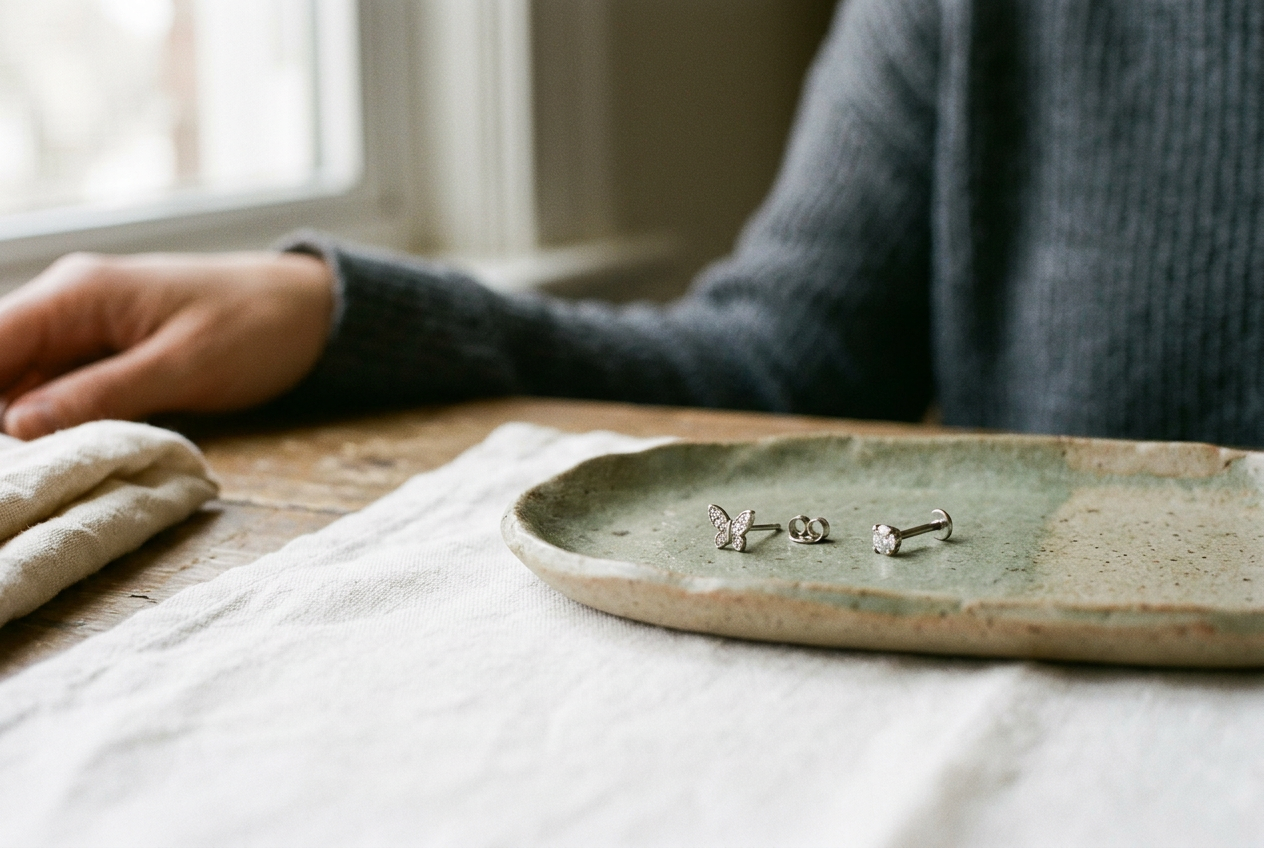
- Backing: Check the butterfly clutch, flat disc, or other closure separately. A backing presses against skin and may come from a different supplier than the earring front.
- Coils, beads, and connectors: Treat every small metal detail as functional hardware, even when it shares the hook’s color.
- Jump rings and chain: Look for a material statement covering all links, not merely the main finding, which is the jewelry-making term for functional hardware such as hooks and clasps.
- Charm or setting: Check the core material as well as the finish. “Gold tone” describes color, not composition.
- Solder and bonded joins: Ask whether a different alloy is used at fixed connections when the brand offers that level of documentation.
This is one checklist, not six separate shopping missions. A seller may settle it in a single sentence by confirming that every metal component is the same documented material. If customer service can only confirm the hook, decide on the earring as a mixed or unknown construction rather than extending that answer to the rest.
Plating changes the wear calculation
Plated earrings can be wearable favorites, but the surface layer is not permanent. Friction concentrates at moving points: the cut in a jump ring, the loop at the foot of a hook, and the hole drilled through a charm. Sweat, cosmetics, hair products, and storage against other jewelry can also shorten the useful life of a finish.
That makes our crescent earring a higher-maintenance proposition if its gold color comes from plating over an unidentified base metal. Remove it before showering, swimming, exercise, and sleep; wipe it with a soft dry cloth after wear; and store it separately so the charm does not scrape the connector. Those steps cost time. They cannot turn an unknown alloy into a documented one.
Clear barrier coatings are also temporary. They can miss the inside of a ring or chip at a moving join, and recoating a tiny hook assembly becomes fiddly. For a pair worn once for an evening, that compromise may feel acceptable. For daily drops, buying a fully documented construction is usually the cleaner choice.
The price tradeoff is mostly about certainty
An inexpensive fashion earring often combines materials to keep cost and weight down: a better-documented hook, a plated base-metal charm, and generic connectors between them. That is not automatically poor construction. It does mean the low price may buy less material traceability.
Replacing the hook can help when the hook is the only concern, and a jeweler or experienced maker can also exchange a jump ring for a compatible titanium, niobium, or solid-gold component. The charm remains. If it swings against the neck, changing two small findings does not resolve an unidentified plated surface several times their size.
Fully documented titanium, niobium, or solid-gold components generally move a purchase away from the impulse-buy end of the market, particularly when every connector matches. The useful comparison is not between two hooks. It is between the cost of the complete earring and the cost, effort, and uncertainty of rebuilding a cheaper one.
Skip the premium when the listing still hides half the construction. A higher price and a “sensitive ears” label do not compensate for an unspecified jump ring.
Limits of an at-home inspection
Color cannot identify a metal. A magnet cannot reliably tell you whether an earring contains nickel, and surface plating can conceal what lies underneath. Consumer nickel spot tests may screen accessible surfaces when used according to their instructions, but they have limits and do not reveal every alloy or every possible cause of irritation.
Past comfort with one titanium, steel, or gold piece does not guarantee the same result from another item carrying a similar label. Material grade, alloy, finish, wear, and construction can differ. Stop wearing jewelry that causes discomfort, and seek qualified medical guidance for persistent or severe symptoms; a shopping checklist cannot diagnose a skin reaction.
Questions people ask
Does a nickel-free hook make the whole earring nickel-free?
No. The claim may apply only to the wire passing through the piercing. Check the jump ring, decorative coil, chain, charm, backing, and any plated or soldered sections that can touch skin, then look for wording that covers all metal components or names them separately.
Can I replace the hook and keep the charm?
Yes, if the construction allows the jump ring to open and a competent maker uses compatible replacement hardware. That change addresses the hook, and perhaps the connector if both are replaced, but an unidentified charm may still brush the lobe, neck, or jaw as it moves.
Is solid gold always suitable for sensitive ears?
Solid gold is generally an alloy, so karat and composition matter. Yellow, rose, and white gold use different added metals, and formulas vary by maker. Look for a clear karat disclosure and more alloy detail when available rather than treating color or the phrase “solid gold” as a guarantee.
What should
I ask when a product page lists only nickel-free hooks?
Ask for the materials used in the jump rings, charm, chain, backing, plating, and solder, and request confirmation of which claim applies to the finished earring. If the seller cannot identify those parts, treat the crescent drop as an unknown mixed-metal piece and decide accordingly.
One update a day
Today's fashion update, in your inbox
One fashion update each morning — no hype, no filler, just pieces worth wearing.