Mesh Sneakers Earn the Airflow. Mesh Flats Pay in Snags.
Open mesh feels useful on a ventilated sneaker, less convincing across an unprotected toe, and risky on a bag carrying keys. The supporting structure decides whether it lasts.
August 30, 2026 · 7 min read
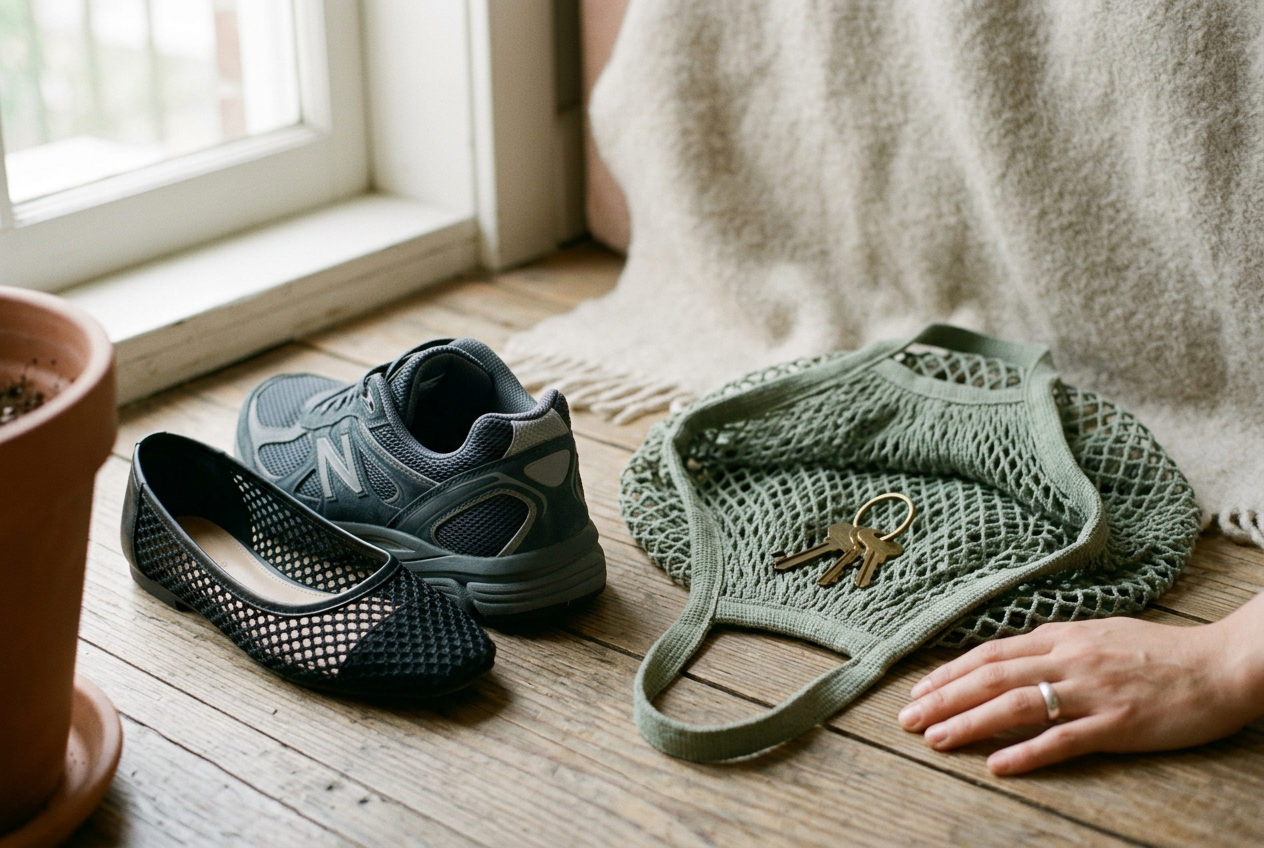
The piece that clarified the trend for me was a black open-mesh ballet flat with a synthetic woven upper, grosgrain binding around the opening, a leather sockliner and a thin rubber outsole. I wore it through one warm week with bare feet and lightweight socks, using it for ordinary city walking rather than treating it as an occasion shoe.
Air passed through the upper. Street grit did too. By the end of the week, the flat had not fallen apart, but the mesh over the big toe had begun to look slightly fuzzy, and the seam joining the upper to the binding was easier to see because there was no opaque material to disguise it. The experiment made mesh's current spread into sneakers and bags look less like one coherent trend than three different construction bets.
This is unisex coverage, even though many mesh ballet flats are sold through women's sizing. The material behaves the same across wardrobes; the relevant differences are toe shape, foot width, load and how much protective structure sits behind the holes.
The flat puts skin behind the trend
Open mesh, meaning a textile woven or knitted with visible spaces between its strands, solves one obvious summer problem. It lets heat escape. On the black test flat, the effect was most noticeable across the forefoot, where a conventional leather or tightly woven synthetic upper can feel close by late afternoon. The shoe also looked lighter with wide-leg trousers and a long cotton skirt because the upper did not create a solid block across the foot.
The fit quirk was less flattering. Mesh can yield sideways without gaining useful length, so the test pair accommodated the widest part of my forefoot while still pressing the front edge of the big toe against the upper. That pressure matters more than it would in soft leather. Each step pushed the nail and toe into the same small area of woven strands, which explains why the first visible wear appeared there rather than along the side.
A toe cap would have helped, but it would also have changed the point of the flat. The appeal is the nearly bare foot, framed by a narrow binding and thin sole. Once reinforcement covers the front, the shoe starts moving toward a sneaker or a conventional fabric flat, both of which are less visually delicate and more sensible for repeated walking.
Visibility is part of the bargain. Toes, sock seams and changes in skin tone show through a wide weave, while the shoe's own construction becomes unusually legible: adhesive at the sole edge, folded seam allowances and uneven tension cannot hide beneath an opaque upper. The black pair looked neat from standing height, though close inspection revealed where the mesh met the binding at the inner arch. A pale or brightly colored version would make that junction harder to ignore if the thread or glue did not match.
The flat therefore makes sense as a rotation shoe, especially for short, dry outings when ventilation and visual lightness matter more than protection. It is harder to defend as an investment purchase unless the maker has reinforced the toe from inside, secured the perimeter with dense stitching and supplied a sole substantial enough to keep the mesh away from rough pavement.
Sneakers give mesh a job and a guardrail
Mesh earns its place more convincingly on a sneaker because it rarely works alone. A typical ventilated sneaker places the open textile over a lining or around synthetic overlays, which are extra pieces bonded or stitched across high-stress areas, while the rubber sole rises far enough to protect the lower edge from scuffs. The holes still move air, but the laces, heel structure and toe reinforcement carry much of the strain.
That distinction was clear when I compared the ballet flat with a mesh running-style sneaker already in regular rotation. The sneaker's forefoot fabric flexed as the toes bent, yet a denser panel around the toe kept nails from sitting directly against the most open section. Its mesh could still snag on a sharp edge. It was simply less likely to meet one during an ordinary step.
Sneakers also handle fit adjustment better. A lace-up shoe can hold the heel and midfoot even when the mesh relaxes, while a ballet flat depends on its topline, meaning the finished opening around the foot, to stop the heel from lifting. If that opening stretches, there is no lace to recover the lost hold. Sizing down is a poor fix because it moves the toes closer to the fragile front panel.
For buyers, the useful inspection point is not the size of the holes alone. Press inside the toe, look for a second layer, then follow the outer edge to see whether the sole or a denser textile protects the mesh where it meets the ground. A sneaker with open ventilation zones and solid stress zones is using the material selectively. One wrapped almost entirely in loose mesh is asking the textile to provide breathability, shape and abrasion resistance at once.
This is where paying more can make practical sense, although price does not guarantee sound construction. Money spent on a well-finished sneaker may buy internal lining, cleaner bonded edges and a replaceable insole. Paying designer-level money for an unreinforced mesh flat buys a more delicate proposition, and the first snag will still sit over the toe.
A mesh bag exposes the wrong things
The bag version reverses the airflow argument. Most bags do not need ventilation during an ordinary day, and open mesh adds visibility at the cost of containment. A phone, cardholder, keys and loose cosmetics become part of the exterior appearance, while small objects can press into individual openings and distort them.
The black flat kept bringing me back to this point. Its contents were toes, which are soft and broadly distributed even when they push against one spot. A bag carries hard corners and concentrated weight. Keys settle at the bottom seam, a charger plug catches in the weave, and a narrow sunglasses case can pull one section out of shape when the bag swings against the body.
Mesh totes can work for a towel, a folded shirt or groceries with smooth packaging, particularly when a bound base supports the load. They make less sense as everyday handbags unless they include an opaque pouch or full lining. The pouch solves visibility and containment, but it also reduces the airy appearance that made the bag appealing, leaving the mesh as a decorative shell that can still catch on hardware, chair edges and rough walls.
Construction matters at the handles. A handle stitched directly onto open mesh concentrates the bag's entire load at a small patch, while webbing that continues down the body spreads the force. This is easy to check in person: trace the strap below the opening. If it ends near the top seam, the mesh is doing more work; if it runs toward the base, the webbing is helping carry the contents.
I would keep the bag spend low unless the base, handles and opening are independently reinforced. Mesh is useful for a beach tote whose contents can be seen and shaken free of sand. For commuting, a tightly woven nylon bag gives up the transparency but better protects both the fabric and whatever is inside.
The buying test is structural
The week with the black flat did not turn it into a ruined shoe. It did establish its category. I would wear it to dinner, around a gallery or on a short warm-weather outing, then store it away from hook fasteners and exposed buckles. I would not choose it for a full walking day, wet weather or travel that requires one pair to absorb repeated use.
Before buying any open-mesh piece, put the likely pressure behind the material. In a flat, gently press a finger where the longest toe will sit and check whether a lining or denser weave takes the contact. In a sneaker, bend the forefoot and watch whether the mesh strains at a stitched edge. In a bag, add the items normally carried and see whether their corners create isolated bulges.
Care is narrow rather than difficult. Surface dirt can be lifted with a soft brush, and a slightly damp cloth is safer than saturating glued edges, but a pulled strand should not be cut because it may be carrying tension across the weave. Tuck a loose loop inward if possible and stop wearing the item until the area can be stabilized. Machine washing introduces more abrasion than a delicate flat or fashion sneaker needs.
The trend is strongest where mesh offers a visible summer change without being asked to hold the whole object together. Sneakers meet that test most often. Ballet flats can meet it for light wear, though the exposed toe remains the cost. Bags are still the least settled version, especially once an inner pouch is required to make them usable.
Questions people ask
Are mesh ballet flats comfortable in hot weather?
They can feel cooler across the forefoot because open mesh releases heat, but airflow does not compensate for a thin sole or toe pressure. Check that the longest toe does not press directly into a wide opening, and avoid sizing down to control heel slip because that increases strain at the front.
Do mesh sneakers tear easily?
A reinforced mesh sneaker should tolerate ordinary flexing better than an unlined mesh flat. Look for a denser toe panel, overlays around the laces and a sole that protects the lower edge. Loose mesh can still snag, so it is better suited to pavement and gym use than trails with branches or sharp rock.
Can a mesh bag work as an everyday handbag?
It can if webbing carries the handles toward the base and an inner pouch contains small or sharp objects. That arrangement reduces the visibility and lightness of the design, however. If keys, chargers and cosmetics are daily contents, tightly woven nylon or canvas asks for less monitoring.
How should open mesh be cleaned?
Brush away dry dirt first, then use a lightly damp cloth on the textile without soaking glued seams or leather trim. Do not cut a snagged loop or put a delicate mesh flat through a washing machine. Keep the item away from hook fasteners, exposed zippers and buckles during storage.
One update a day
Today's fashion update, in your inbox
One fashion update each morning — no hype, no filler, just pieces worth wearing.