Fix Heel Slip in Loafers Without Crowding Your Toes
Tongue pads reduce room over the instep. Heel grips push the foot forward, while sizing down changes the entire fit and can punish toes that were perfectly content.
September 17, 2026 · 8 min read
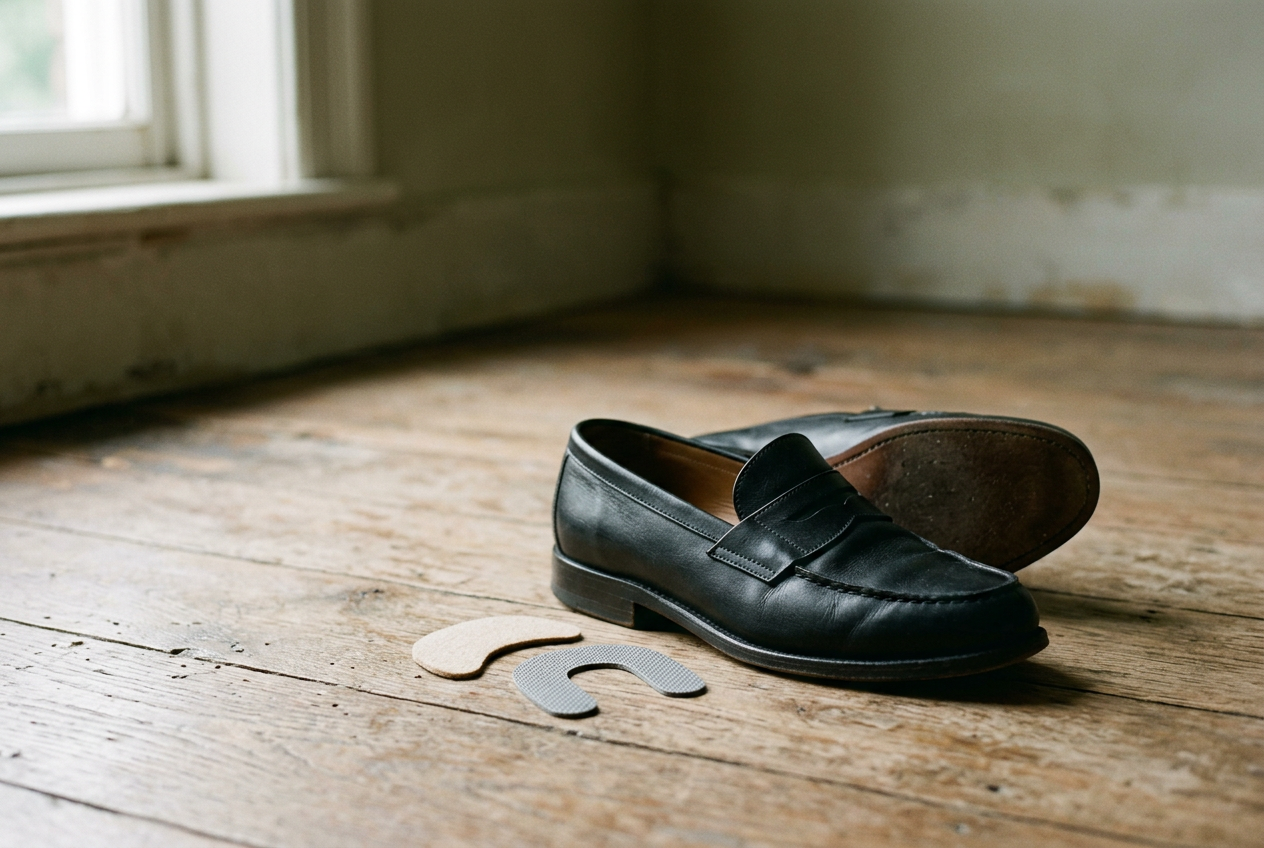
Take one ordinary fitting case: a black calfskin penny loafer with a leather lining, a firm leather sole and enough room for the toes, but a heel that rises with every step. The shoe looks correct when standing still. Walking introduces the plot.
This is unisex fit advice because the mechanics do not change across wardrobes, although size labels and width options certainly do. What matters is whether the loafer’s last, meaning the foot-shaped form around which the shoe was built, matches the length, width, instep and heel shape of the foot inside it.
Heel slip can come from excess space over the foot, excess room behind it or a shoe that is too large throughout. A tongue pad, heel grip and smaller size address those conditions differently. Treating them as interchangeable is how an otherwise handsome loafer ends up containing one squeezed forefoot and several layers of optimistic foam.
Start with the walking test
Test new loafers indoors on a clean, return-safe surface while wearing the socks or hosiery intended for them. Put on both shoes, stand normally and check that the toes can lie flat without meeting the front or pressing against the sides. The widest part of the foot should sit near the widest part of the shoe.
Walk at a normal pace, turn, stop and take a few stairs if the return rules and space allow. Watch for movement rather than expecting the heel to remain sealed in place. A stiff new leather sole may resist bending, which can lift the back of the shoe slightly before the sole develops a break, the crease where it flexes under the forefoot. That small, controlled rise can ease as the shoe bends more readily.
Normal movement feels consistent. The heel rises a little, returns to the same place and does not drag the rest of the foot forward. Poor fit feels mobile: the foot surges toward the toe on each step, the toes curl to keep the loafer attached, or the heel comes high enough to rub against the topline. Clawing is useful only if the day’s agenda includes resenting one’s shoes.
Check the black calfskin pair again. Its toes already have appropriate space, and its forefoot meets the shoe at the correct flex point. If the heel rises while the entire foot slides forward, the issue may be excess volume over the instep, the raised area along the top of the foot. That points toward a tongue pad before a smaller size.
A tongue pad reduces room over the foot
A tongue pad is a thin piece of adhesive-backed foam or felt fixed beneath the loafer’s tongue or upper vamp, the section covering the top of the forefoot. On loafers with only a short tongue, the pad may sit farther forward under the vamp, provided it remains hidden and does not create a hard edge.
The pad occupies vertical space. It presses gently against the instep, which can hold a low-volume foot farther back in the shoe without taking usable length away from the toes. This makes it the most logical first adjustment when the toe box and width feel right but the upper looks loose, wrinkles deeply or fails to keep the foot seated.
For the black calfskin loafer, fit one thin pad in a single shoe and repeat the walking test. Comparing feet is more useful than installing a thick pair immediately, because pressure over the instep can build after several minutes even when the first few steps feel secure. The aim is less movement, not a padded ridge that leaves a mark through socks.
Placement matters. Set the pad where the upper gaps over the foot, press it onto a clean lining and avoid positioning its edge against a seam. Foam compresses with wear, while dense felt tends to keep its shape longer; either can leave adhesive residue, and a dark pad may show beneath a lightly cut tongue. These are inexpensive adjustments, but removing glue from delicate leather is an unglamorous use of an evening.
Skip the pad if the loafer already presses across the instep, the foot feels numb or the tongue cuts into the top of the foot. More material cannot correct the wrong upper shape. A different last is the cleaner answer.
A heel grip uses up space behind the foot
A heel grip is an adhesive strip, usually foam, suede-like fabric or gel, attached inside the back of the shoe. It cushions the heel counter, the structured rear section that holds the heel, and fills part of the gap between foot and lining.
That sounds targeted, but the strip does more than soften rubbing. Its thickness pushes the foot forward and reduces the shoe’s usable internal length. A slim grip can help when the forefoot stays stable, the instep feels secure and a small rear gap lets the heel tap against a firm counter. It is less convincing when the whole foot is traveling inside the shoe.
Return to the calfskin pair. The toes already sit well. A thick heel grip could stop visible lift while moving those toes closer to the front, creating pressure that was absent before the intervention. The shoe would appear more secure at the back because it had become shorter in practice.
This is fit accounting, and the toes always receive the invoice.
Heel grips also raise the risk of a new rubbing point. If the top edge sits near the Achilles tendon, it can catch the sock or press against skin; if it sits too low, the heel may climb over it. Adhesives can loosen on slick leather linings as heat and moisture build. Press the grip firmly, test it indoors and remove it if the heel begins riding higher rather than settling lower.
Choose a tongue pad over a heel grip when excess room is mainly above the foot. Choose the grip when there is a localized gap behind a foot that otherwise remains planted. If both are required in substantial thickness, the shoe probably does not match the foot well enough to justify the upholstery project.
A smaller size changes more than heel hold
Sizing down reduces length. Depending on the brand’s grading and last, it may also reduce width, circumference over the instep and room around the toes. This broad change is appropriate when the loafer is plainly large throughout: the foot slides, the flex point sits ahead of the ball of the foot, the upper collapses and the toe area contains unused length.
It is a poor fix when the black calfskin pair already fits at the front. The smaller size may grip the heel because every other part has tightened too, leaving the toes against the end or forcing the forefoot into a narrower section of the shoe. Leather can soften and give slightly across pressure points, but a shoe does not gain meaningful length through break-in. Toes are not shoe stretchers with appointments afterward.
Compare the current size with the next smaller option indoors, using the same hosiery and walking route. Reject the smaller pair if the toes touch during a normal step, the little toe presses into the side, or the ball of the foot no longer aligns with the shoe’s bend. Standing clearance alone is not enough because the foot lengthens and moves forward under load.
Width deserves separate attention. A narrow heel paired with a wider forefoot often slips in loafers even when length is correct, and sizing down merely trades heel movement for forefoot compression. Look for a last with a more shaped heel, a different width or a higher vamp that holds the foot without shortening the platform beneath it.
Make the adjustment in the right order
Confirm toe room and flex position first. If those are correct and the upper gaps, test one thin tongue pad. If the instep is secure but a small space remains directly behind the heel, try a low-profile heel grip while monitoring whether the toes move forward.
Consider the smaller size only when the walking test shows excess room through the entire shoe. The black calfskin loafer with correct toe space and a low-volume instep belongs in the tongue-pad category; if that pad creates pressure without controlling movement, the better choice is another last rather than another adhesive layer.
Questions people ask
Will heel slip stop after loafers break in?
Minor lift caused by a stiff leather sole may lessen once the shoe flexes more easily. Break-in will not correct a loafer that is too long, too wide or too deep, and the upper may become looser as leather softens. Keep the pair only if the foot stays controlled during the indoor walking test.
Where should a tongue pad sit in a loafer?
Place it beneath the tongue or vamp where the shoe gaps above the instep, keeping every edge hidden and clear of prominent seams. Start with a thin pad in one shoe, then compare both feet while walking. Move or remove it if it creates concentrated pressure on top of the foot.
Can a heel grip make loafers feel too small?
Yes. A heel grip occupies space behind the foot and pushes it toward the toe, so a thick version can shorten the shoe in practice. It suits a minor rear gap only when toe room, width and instep hold are already correct. Stop using it if the toes begin touching the front.
Should loafers fit tightly when new?
They should feel secure, not restrictive. The toes need to lie flat, the forefoot should meet the shoe at its natural flex point and the instep should hold the foot without pinching. Leather may soften across the upper, but buying a short loafer in anticipation of dramatic stretching usually produces discomfort rather than precision.
One update a day
Today's fashion update, in your inbox
One fashion update each morning — no hype, no filler, just pieces worth wearing.