Fisherman Sandals Have Split. The Slim Pair Will Last Longer.
Fine leather straps and low soles are pulling the fisherman sandal toward a dress shoe. Chunky synthetic versions offer easier wear, but their trend signal is louder.
September 5, 2026 · 8 min read
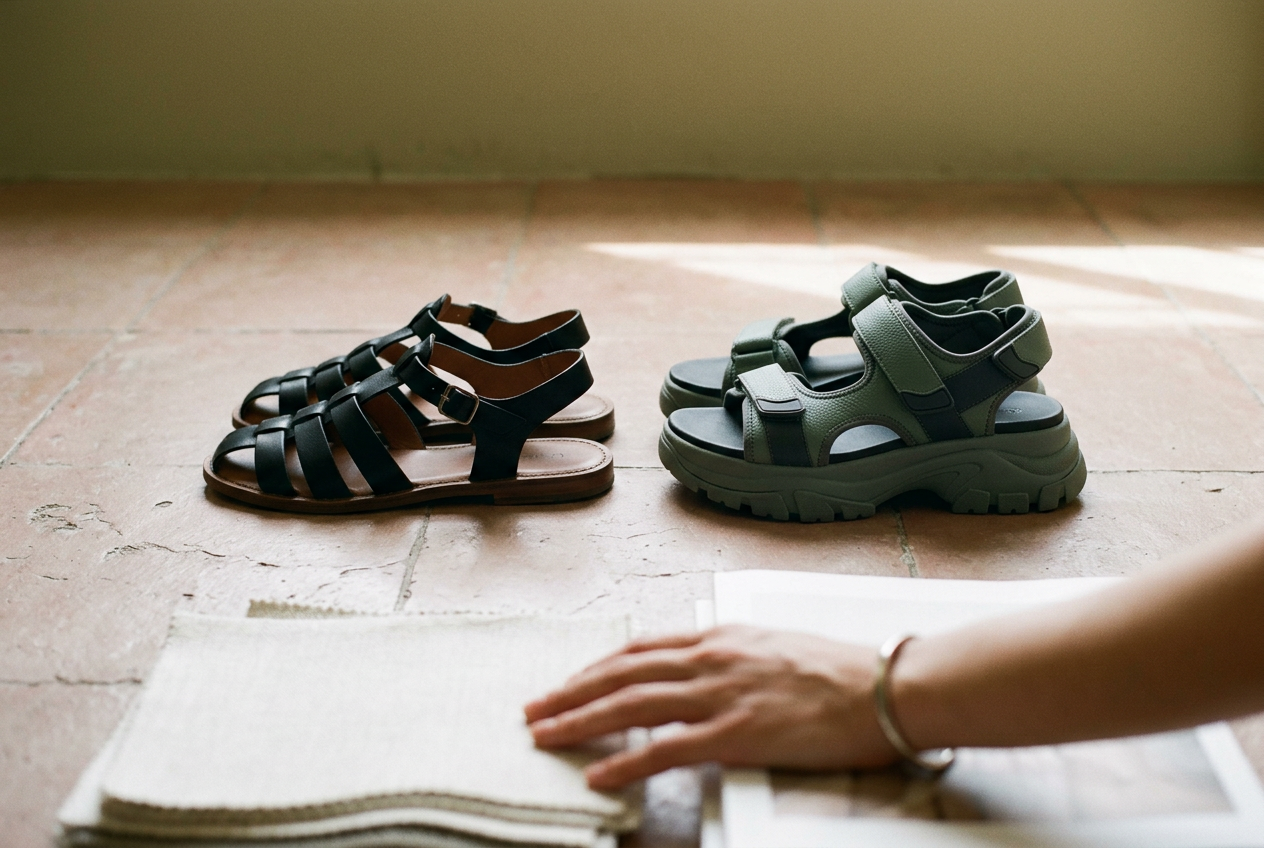
The useful comparison starts with The Row’s Fisherman Sandal in black leather. Its caged upper, meaning interlaced straps that enclose much of the foot, is recognizable from several feet away, yet the fine leather strips, restrained buckle and low rubber sole keep the shoe close to a traditional leather sandal. Nothing is puffed, exaggerated or molded to look technical.
That pair clarifies what has changed at retail. “Fisherman sandal” no longer describes one proportion. The name now covers shoes ranging from polished leather cages on nearly flat soles to bulky pairs made with synthetic straps, deep treads and enough volume to sit beside an outdoor sandal. They share a closed or semi-closed toe and a buckled strap.
Their wardrobe roles are different.
This is unisex coverage because the construction choice, rather than the department label, determines how these sandals fit and what they work with. The sizing may still be divided into women’s and men’s ranges, but anyone comparing the two branches should look past the category name and inspect strap thickness, sole height and the shape of the toe cage.
The polished branch behaves like a summer shoe
The Row pair makes the polished argument in its clearest, most expensive form. Similar ideas appear elsewhere at lower price levels: smooth or lightly grained leather, narrow straps with clean edges, a small buckle and a sole that stays close to the ground. The upper carries the design. The sole recedes.
That distinction matters when the sandal is worn with clothes that already have some structure. A low-profile fisherman can sit under straight trousers without catching the hem, and its enclosed toe gives a linen suit, long skirt or dark denim more finish than a two-strap sandal would. Black leather is the least seasonal choice. Dark brown softens tailoring, while pale leather tends to advertise summer and shows grime sooner around the toe cage.
Fine straps also create smaller points of contact. That can look elegant while feeling unforgiving during break-in, particularly where the front cage crosses the little toe or where the ankle strap meets the heel. Leather may relax with wear, but it does not guarantee width. A foot that spreads across the footbed will push between narrow straps, and the resulting pressure can be more irritating than the broad hold of a sport sandal.
Try this branch late in the day, when feet are slightly fuller, and walk down an incline if the store permits it. The heel should stay over the sole rather than sliding toward its back edge, while the toes should not press into the front weave. If the buckle needs its final hole before the leather has softened, the fit is already too loose through the rear.
The low sole brings another tradeoff. It looks quiet and bends more naturally than a thick platform, but it may offer little isolation from hot pavement or hard city sidewalks. A rubber outsole, the ground-facing layer of the shoe, gives better grip than a smooth leather one, although tread depth and cushioning still vary. This is a visual investment before it is a comfort purchase.
The utilitarian branch puts the sole first
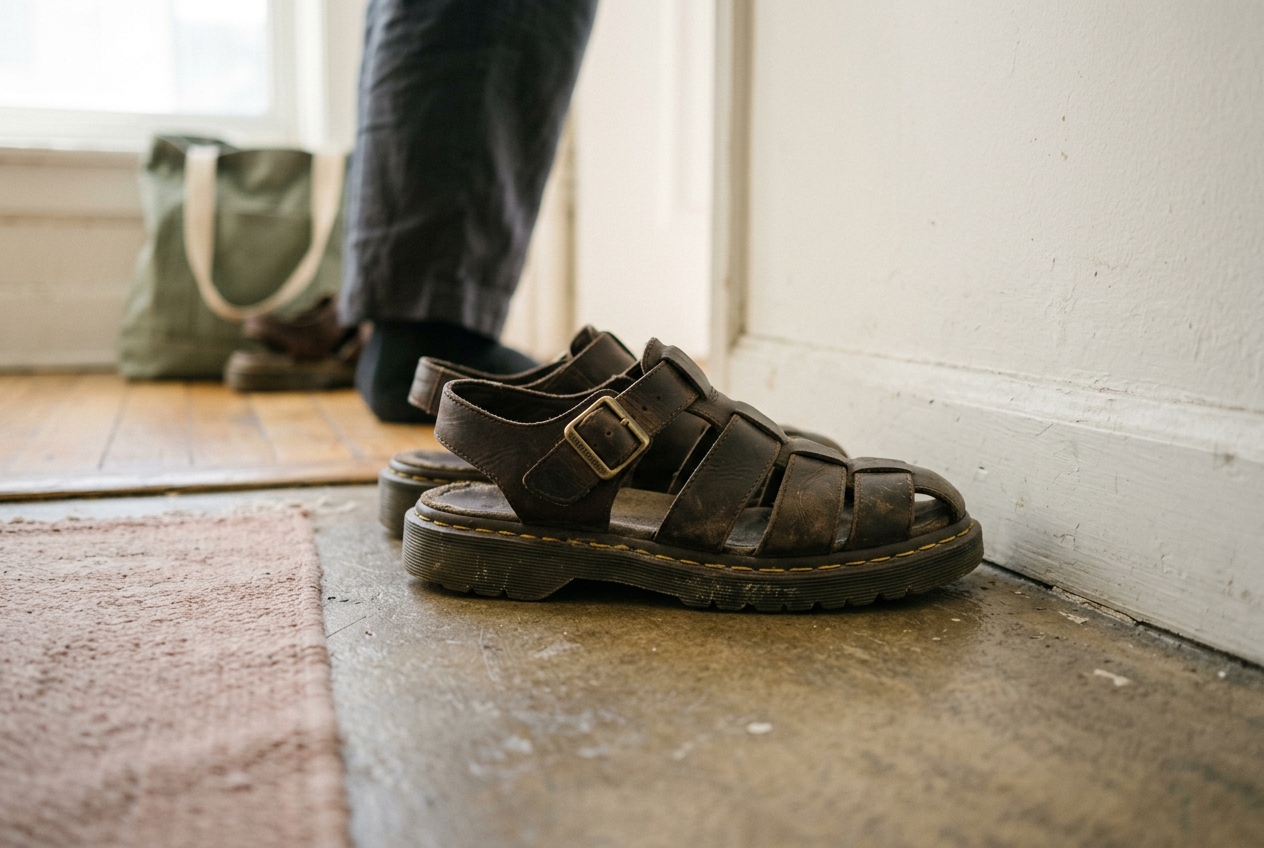
At the other end, fisherman uppers are being attached to thick rubber or foam platforms, sometimes with webbing, coated straps or molded plastic replacing leather. Dr. Martens has used the fisherman cage with its own substantial sole language, while Melissa’s long-running molded footwear shows how a closed sandal can be rendered in flexible plastic rather than assembled from separate leather pieces. Outdoor-influenced retail versions add lugged bottoms, padded straps and quick-drying materials.
A lugged sole has raised blocks designed to grip uneven ground. It adds height and physical weight, then changes the silhouette above it: straps usually need to become broader so that the upper does not look too slight for the base. The shoe stops reading as a refined sandal with toe coverage and starts reading as summer utility footwear.
That can be useful. A thicker footbed may soften impact, synthetic uppers generally ask less of the wearer around splashes, and a broad strap spreads pressure across more skin. None of those qualities should be assumed from appearance alone. Some platform soles are firm rather than cushioned, molded plastic can trap heat, and deep tread does not prevent a wet foot from slipping inside the sandal.
The fit issue here is volume. A chunky outsole lengthens the visual footprint, while a padded or molded cage occupies more space above the toes, so buying an oversized pair can leave the foot looking and feeling detached from the shoe. Check the flex point, the place where the sole bends as the heel lifts. It should sit under the ball of the foot.
If the sole folds nearer the toes, the sandal will make the wearer work against it.
This branch also carries the clearer expiration date. The fisherman cage itself has a long design history, but the combination of bulbous straps, platform depth and aggressive tread belongs to the present appetite for substantial footwear. Remove one of those signals and the shoe becomes easier to keep. Keep all of them and the result may still be appealing, though it is a trend purchase rather than a neutral basic.
The strap-to-sole ratio is the quickest test
Product names are unreliable here. A retailer can call both shoes fisherman sandals even when one belongs with loafers and the other with trail-inspired footwear. The fastest way to sort them is to ignore the label and compare the width of the front straps with the depth of the sole.
On The Row’s Fisherman Sandal, the leather cage remains visually dominant because the low base does not compete with it. A polished alternative should preserve that relationship even at a more accessible price: the straps can be substantial enough to hold the foot, but they should not look inflated, and the outsole should follow the foot rather than extending far beyond it.
For maximum longevity, look for leather straps with finished edges, an adjustable buckle, a lining that covers rough joins and an outsole that a shoe repair shop could assess without dismantling a molded unit. Finished edges are folded, painted or otherwise sealed so the raw layers are not left exposed. Edge paint can crack, but it is easier to monitor than a thin synthetic coating that peels across the whole strap.
A fully molded sandal offers a different kind of durability. Water cannot separate stitched layers that are not there, and cleaning may require little more than mild soap and a cloth. Once the footbed compresses, the plastic splits or the tread wears smooth, repair is less likely to make sense. Leather asks for more maintenance but gives a repairer more to work with, provided the upper was well assembled in the first place.
Price does not settle the choice
The polished branch stretches from high-street leather to luxury pairs costing more than many people spend on a bag. The utilitarian branch runs from molded casual footwear to designer platforms at similarly serious prices. Paying more may improve leather quality, lining and finishing, but a prestigious label cannot make an unpadded flat sole suitable for a full day of walking.
Spend according to use. For dinners, office days and trips where the sandal will alternate with other shoes, a slim leather pair can justify careful break-in because it covers the same wardrobe territory as a loafer. For wet grass, beach approaches or long days involving dust and unpredictable pavement, a washable synthetic version may earn its place faster. It will not become more polished through styling.
There is a sensible middle, although retail does not always make it easy to find: a leather cage, a lightly cushioned footbed and a modest rubber sole with visible but restrained tread. The proportions matter more than purity. This version loses some of The Row pair’s delicacy, yet it avoids the platform scale that may look dated first.
Do not pay luxury money for bonded leather, nonadjustable ankle straps or a sole that feels rigid at the ball of the foot. Bonded leather is made from leather fibers held together with binders, and its surface can deteriorate differently from a full leather strap. Product descriptions that say only “leather look” or “man-made upper” indicate appearance, not the behavior of leather.
Styling reveals which branch belongs in the wardrobe
Use the intended trousers as a fitting tool. A fine black fisherman sandal should disappear under a full-length trouser until the cage shows in motion; if the hem stacks on the buckle or catches behind a thick heel, the sandal is too bulky for that job. With shorts, the polished pair benefits from a substantial fabric such as denim or crisp cotton, which keeps it from feeling overly delicate.
The utilitarian version needs room around it. Cropped trousers, wide shorts and simple column-shaped skirts expose the whole sole, avoiding an accidental fight between a heavy platform and a narrow hem. Repeating its outdoors language with technical clothing can make the outfit feel literal, so a plain cotton shirt or unadorned dress often gives the shoe a clearer role.
Return once more to the black Row sandal before buying either branch. Cover its brand name and note what remains: narrow leather, an adjustable cage and a base that does not announce itself. Those are the transferable qualities. A less expensive pair that keeps them has a reasonable chance of surviving the trend cycle, even if its leather needs more conditioning and its buckle lacks the same finish.
The chunky synthetic sandal should be bought with equal clarity. Its easy cleaning, larger scale or underfoot padding may be the point. If the appeal depends mainly on being called a fisherman sandal, leave it on the shelf.
Questions people ask
Are leather fisherman sandals comfortable for all-day walking?
Some are, but fine straps and low soles do not provide cushioning by themselves. Check for a padded footbed, flex under the ball of the foot and enough width that toes do not press between the cage straps. A polished flat pair may suit mixed office and dinner wear better than uninterrupted sightseeing.
Should fisherman sandals fit tightly at first?
Leather can soften, but the foot should not bulge through the cage or meet sharp pressure at the little toe. The heel must stay centered on the sole without using the tightest buckle hole. Synthetic and molded straps usually change less with wear, so do not rely on them stretching into a workable fit.
Are chunky fisherman sandals already going out of style?
The fisherman upper is likely to outlast the most exaggerated soles. Platforms with broad padded straps and deep tread carry a stronger trend signal, which does not make them unusable but does narrow their wardrobe life. A modest rubber sole and quieter strap construction reduce that risk.
Can fisherman sandals get wet?
Molded plastic and many synthetic versions tolerate splashes better than lined leather, though wet feet can still slide inside them. Leather pairs should be dried away from direct heat and conditioned according to the maker’s instructions. Repeated soaking can mark the upper, stiffen straps and weaken glued components.
One update a day
Today's fashion update, in your inbox
One fashion update each morning — no hype, no filler, just pieces worth wearing.