Fisherman Sandals Are Slimmer, but Coverage Pays the Price
The fisherman sandal is losing some bulk. Thinner straps and neater soles look polished, but they expose more foot and leave less cushioning between you and the pavement.
Women's · October 22, 2026 · 8 min read
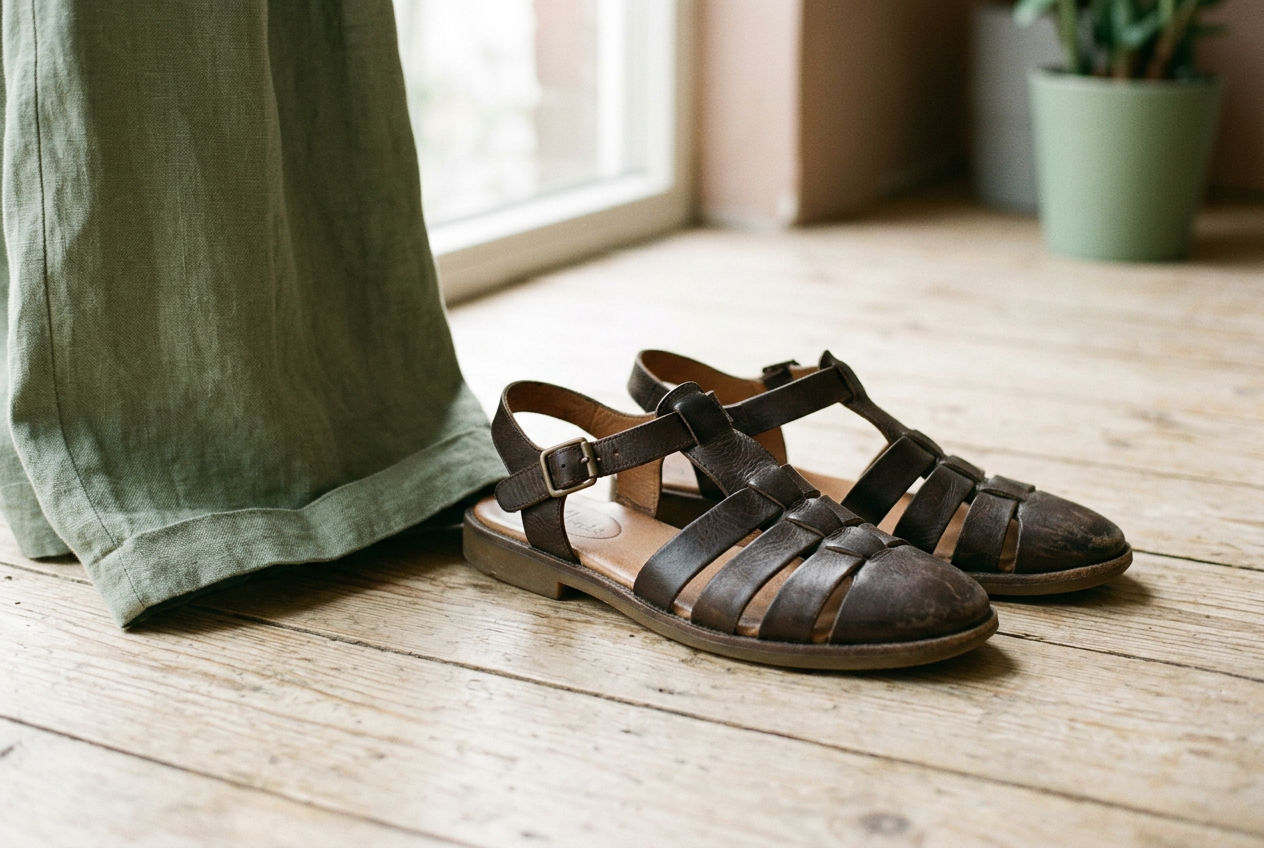
The Hereu Pescador makes a useful reference point for this shift. Hereu describes it as a T-bar fisherman sandal made in Spain from leather, and its construction keeps the familiar closed cage while removing much of the visual and physical weight associated with the style: the straps are relatively narrow, the sole sits close to the ground, and the front draws inward rather than finishing in a broad platform.
That combination now appears across the women's market, from designer leather sandals to less expensive interpretations. It does not mean the chunky fisherman is gone. Dr. Martens and other comfort-led brands still sell versions with broad straps and substantial rubber underfoot, while some fashion retailers continue to treat the silhouette as a warm-weather extension of the lug-soled shoe.
The direction is split, although the refined side is becoming easier to recognize.
This is women's coverage, particularly where tapered lasts and narrow forefoot proportions affect fit. The construction test still applies across wardrobes, but shoppers using men's or unisex sizing should not assume the same toe width or strap placement.
The straps reveal more than the styling
A traditional fisherman sandal covers the foot through a series of interlaced leather straps attached to a central strip. That center strip is the T-bar, which runs from the toes toward the ankle and helps hold the cage together. On a chunky version, broad straps and small gaps create a nearly closed upper. The effect can resemble a summer shoe rather than an open sandal.
The Pescador takes away some of that density. Its narrower leather sections leave clearer openings over the toes and along the sides, so more skin breaks up the upper when viewed from above. The sandal still has the recognizable woven structure, but it reads less utilitarian with a dress, fluid pants or a narrow skirt.
There is a practical exchange. Narrow straps provide less total contact with the foot, and pressure becomes more concentrated where each strip crosses a toe joint or the widest part of the forefoot. Soft leather may relax after repeated wear, but a strap that lands directly on a bunion or prominent joint can remain irritating even after the rest of the upper gives. Wider straps distribute pressure over more area and conceal the places where the foot presses outward.
Spacing matters as much as width. A refined pair with narrow straps set close together can retain considerable coverage, while a design with only a few widely separated strips may look like an ordinary strappy sandal with a closed toe added. For a longer styling horizon, look for a continuous cage around the forefoot rather than the sparsest possible interpretation. The cage is the identity of the shoe.
Lower soles change both proportion and comfort
The next clue is the side view. Chunkier fisherman sandals usually have a deep rubber outsole, meaning the external layer that meets the ground, sometimes with a raised rim around the upper. That construction adds visual weight and protects the leather from curbs, wet pavement and casual scuffing. It can also introduce cushioning, though thickness alone does not guarantee softness or arch support.
A refined sole sits lower and follows the outline of the upper more closely. On the Pescador, the restrained base lets the leather cage set the silhouette rather than framing it with a heavy black platform. This is why the sandal can work beside tailored trousers without pulling the outfit toward workwear.
Underfoot, less material leaves less room for foam and shock absorption. A thin leather-led sole may flex pleasantly through the ball of the foot, yet repeated walking on concrete can feel harder than it would in a molded footbed or a substantial rubber unit. Flexibility and cushioning are different properties: the first allows the shoe to bend, while the second reduces the force you feel at each step.
Check the heel before paying for refinement. A low-profile sandal can still be practical if it has a rubber contact layer, a lightly padded footbed and enough structure that the heel does not collapse sideways. Product photographs often show the first feature clearly; the other two deserve a close reading of the brand description or an in-store press with a thumb. If no padding or support is documented, assume the elegant outline is doing more work than the comfort specification.
The alternative is not necessarily a full lug sole, which has deep projections for grip. A medium-depth rubber outsole, trimmed close to the upper and finished without an exaggerated platform edge, keeps much of the neater profile while placing more material between the foot and the street. That middle construction is likely to outlast the most extreme version of either trend.
A tapered toe can reduce usable room
The newer-looking pairs often narrow toward the front. This does not always mean a pointed toe; on a fisherman sandal, the change may be a softly almond-shaped outline instead of the broad round or squared form common on heavier models. It is subtle on the Pescador, but it helps explain why the shoe looks polished even though the upper remains caged.
The fit consequence is less subtle. A tapered last, the foot-shaped form around which a shoe is built, can reduce usable width around the smaller toes even when the marked size is correct. Openings in the cage may disguise that compression because the foot remains visible, but visibility is not space. If the little toe pushes into the side strap or escapes between two straps while standing, sizing up may only make the heel strap loose.
People with a broad forefoot should prioritize the outline of the sole over the softness of the upper. Place the shoe on the floor and look straight down before fastening it. The foot should remain within the sole at its widest point, with no toe sitting on the raised edge. Leather can soften; the sole will not become wider.
A rounder forefoot also has the longer practical life. Toe shapes move in and out of focus, but a moderate round or almond front avoids looking tied to either the bulbous platform sandal or the sharply elongated dress shoe. That does not make it permanent. It makes it less dependent on one season's proportion.
Coverage is becoming decorative rather than protective
The original appeal of a fisherman sandal includes protection: the closed front shields toes more than a slide, while the cutouts release heat. As straps become finer and gaps increase, that protection turns partial. Dust enters easily, pale leather exposes dark marks around the edges, and the toe cage may not stop a chair leg or curb from finding the foot.
There is still more security than a minimal two-strap sandal offers. A buckled back strap limits heel lift, and the enclosed front reduces the gripping motion some people make with their toes in slides. On the Pescador, the T-bar also gives the upper a stable center, which matters when the surrounding straps are narrow. The design feels visually light without being structurally random.
Fit the buckle while standing. The heel strap should hold the rear of the foot without pulling the toes forward into the cage, and one practical fastening position should remain on either side of the chosen hole so that swelling or leather stretch does not leave the adjustment at its limit. A loose cage cannot be fixed by tightening only the ankle, because that transfers pressure backward while the forefoot continues to move.
The sensible buy sits between costume and minimalism
Refined leather fisherman sandals usually occupy the contemporary or designer price band, particularly when brands emphasize European production and leather construction. Chunky high-street versions can cost much less, while heritage or luxury models may cost several times the price of ordinary summer sandals. Paying more makes sense only when the leather, lining and sole construction improve with the silhouette.
For the best chance of wearing the pair beyond the current swing, skip extremely thin straps that look fragile at their attachment points and avoid a sole so flat that it offers no practical separation from hot pavement. Choose leather that bends at the forefoot without buckling sharply, a toe shape that contains the whole foot, and a rubber contact surface that a shoe repair shop could assess or replace. Those details are less visible in an outfit photograph. They determine whether the sandal remains useful.
The Hereu Pescador lands close to that middle position: recognizably refined, still built around a complete fisherman cage, and not dependent on a dramatic platform. It will not suit every foot, particularly a wide one that needs a broad toe box or someone expecting sneaker-level cushioning. Its value as a reference is clearer than its status as a universal recommendation.
A chunky pair remains the better choice for long walking days, rough sidewalks and feet that benefit from wider straps. The slimmer version works when polish, flexibility and a quieter side profile matter more. The trend is moving, but there is no need to follow it to its thinnest edge.
Questions people ask
Are refined fisherman sandals comfortable for walking all day?
They can be comfortable for moderate walking if the footbed has padding, the sole includes rubber and the straps avoid toe joints. Thin leather soles offer flexibility but little isolation from concrete, so shoppers who routinely walk for hours should favor a medium-depth outsole rather than the lowest profile available.
Should fisherman sandals fit tightly at first?
The leather may feel secure, but no strap should pinch, trap a toe or leave a deep mark during a short fitting. Slight softening is normal; meaningful width expansion is not. Check that the foot stays inside the sole and that tightening the heel strap does not push the toes into the front cage.
Do thinner straps make feet look longer?
They can, especially when paired with an almond-shaped toe and a sole trimmed close to the upper. A broad round toe and closely spaced straps shorten that impression. The effect comes from the whole outline, so judging strap width alone can be misleading.
Which fisherman sandal shape will look current for longer?
A complete leather cage, moderately narrow straps, a round-to-almond toe and a low rubber sole offer the safest middle ground. Very deep platforms and extremely sparse cages make stronger seasonal statements. The quieter construction also moves more easily between relaxed trousers, summer dresses and plain denim.
One update a day
Today's fashion update, in your inbox
One fashion update each morning — no hype, no filler, just pieces worth wearing.