Fisherman Sandals Are Basics Now. Skip the Giant Sole.
The leather cage is settling into summer wardrobes, but not every version will last. Flexible uppers and moderate rubber soles make the safest long-term buy.
September 10, 2026 · 8 min read
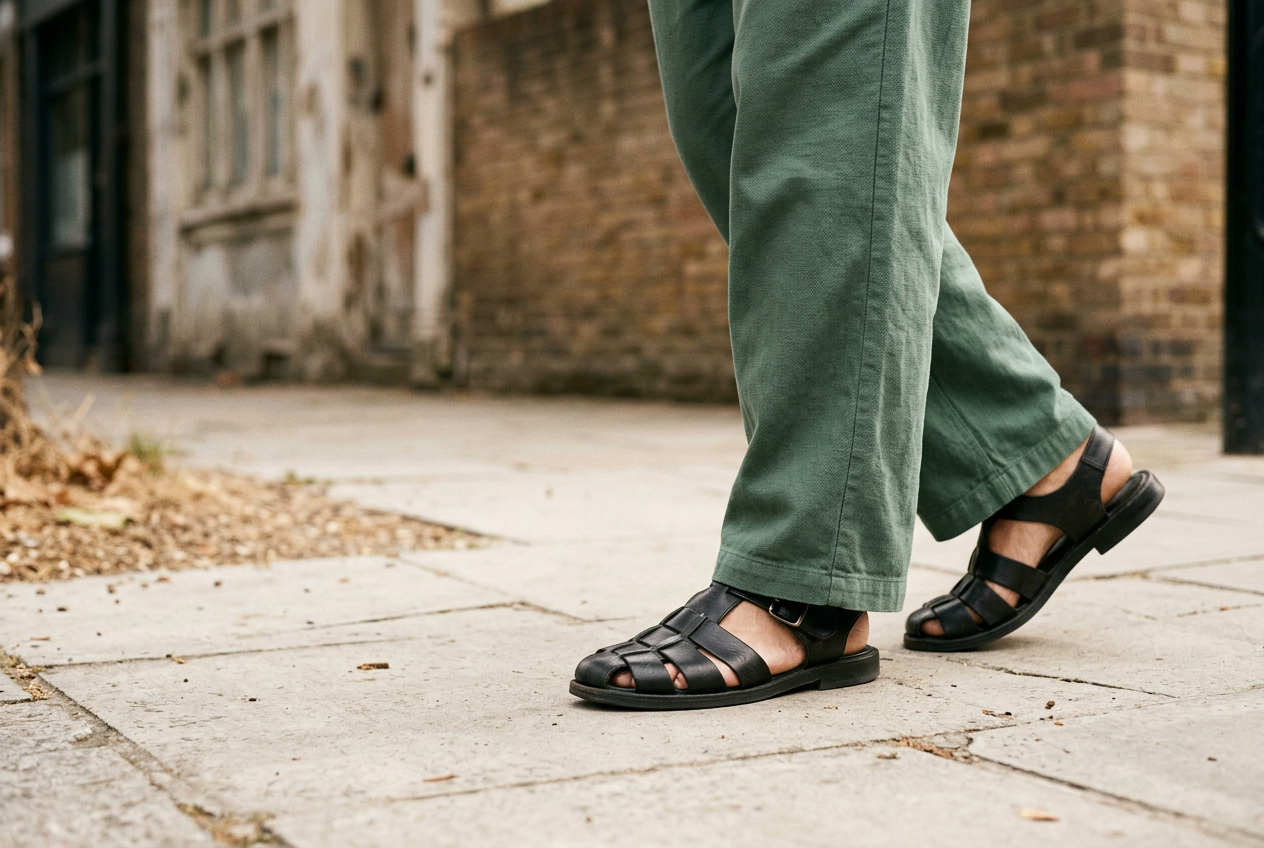
Fisherman sandals are no longer difficult to find, which changes the purchase from an experiment into a construction decision. The useful dividing line is not designer versus high street. It is whether the upper can flex around the foot without collapsing, and whether the sole supports the cage rather than turning it into a visual prop.
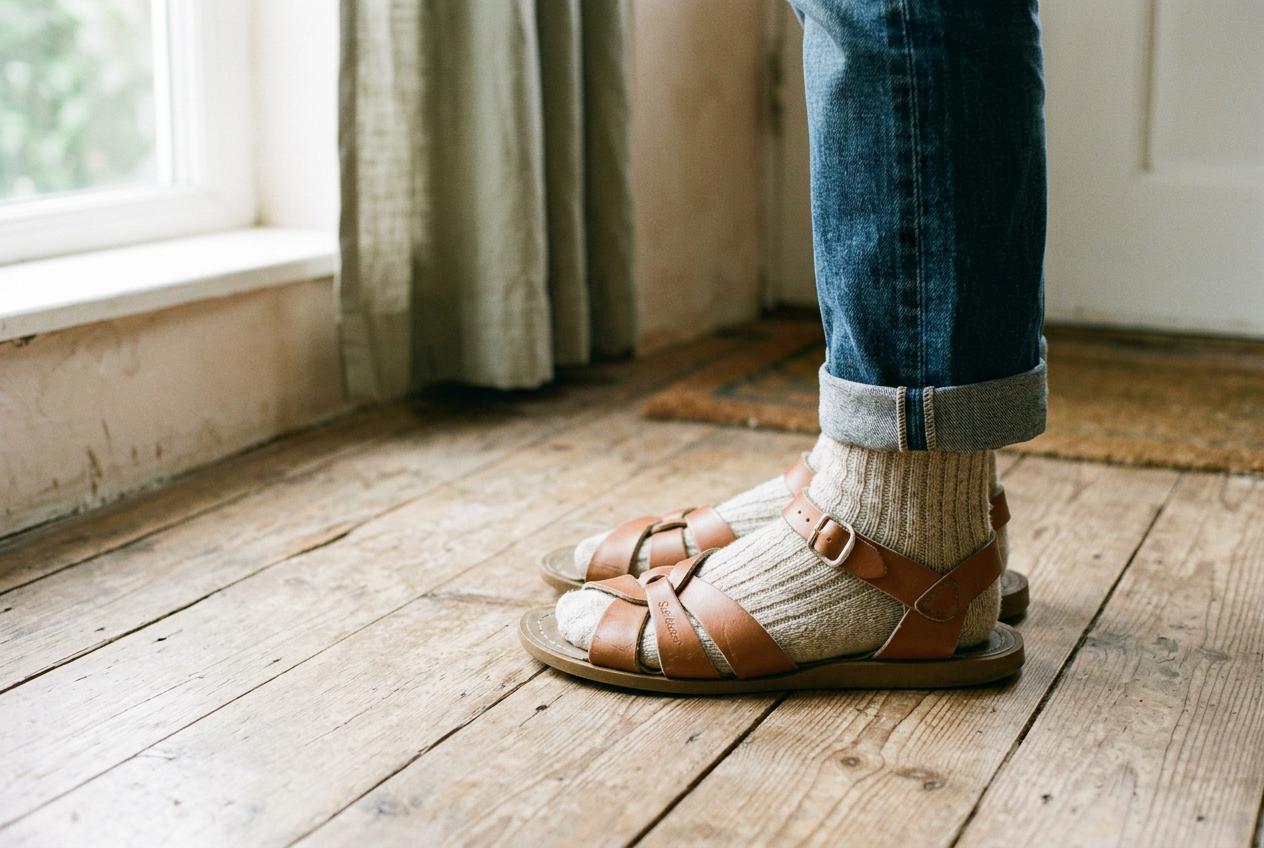
The concrete pair to keep in view is the tan Salt-Water Shark Original: interlinked leather straps, a covered toe, an adjustable ankle buckle and a low rubber sole. Salt-Water describes its leather as water-friendly and its buckle as rust resistant. Put that pair under straight jeans, ribbed socks and a plain shirt, then remove the socks when the weather warms. Nothing about the sandal depends on a particular hemline or exaggerated proportion.
That is the basic fisherman sandal beginning to emerge from the trend cycle.
The leather cage makes the strongest case
A good leather fisherman sandal holds the foot through several separate straps rather than one broad vamp, meaning the upper section that crosses the front of the foot. This spreads pressure, allows some airflow and gives the shoe its recognizable cage. It also creates more edges that can rub.
The Shark Original illustrates the tradeoff. Its smooth leather straps should gain pliability with wear, but the initial fit still matters because leather generally relaxes across the foot more readily than it lengthens. If the covered toe presses while standing, waiting for it to stretch is a poor plan. If one strap merely feels firm over the instep, gradual softening is more plausible.
Check the little-toe side first. That is where a narrow shoe last, the foot-shaped form used to build a shoe, often reveals itself, particularly when brands offer whole sizes or translate one size system into another. The widest part of the foot should sit within the edge of the sole, and the toes should not meet the front cage when walking down stairs. A heel strap that pulls the foot backward can disguise a short fit while standing still.
This is unisex coverage, and the fitting advice applies across wardrobes: ignore the gender printed above the size selector and compare the brand's foot-length chart with a pair that already fits. Anyone between sizes should prioritize toe room, then use the buckle to control heel movement. Thick socks can test the cage indoors, but they should not be used to justify a sandal that is plainly too narrow.
Construction decides whether the leather version ages into a familiar shoe or merely looks tired. Look for straps that feel substantial without being board-stiff, finished edges that do not expose rough fibers, and secure stitching or attachment points where each strap meets the sole. The outsole, the layer that touches the ground, should bend near the ball of the foot rather than folding through the arch.
A moderate rubber sole also gives the leather cage some visual continuity. The Salt-Water pair can sit with loose trousers, shorts or a below-the-knee skirt because its sole does not demand that the rest of the outfit match its scale. Black leather looks sharper; tan and dark brown tend to show scuffs less abruptly once conditioned.
Flexible synthetics solve a different problem
Synthetic fisherman sandals range from soft molded plastic to woven textile or faux-leather straps attached to foam soles. The best argument for them is practical. They tolerate wet grass, pool edges and sudden rain with less care than most leather, and many cost less than a decent pair of sneakers.
Comfort is less predictable. A soft synthetic cage can feel accommodating immediately, especially when the entire upper flexes as one piece, but a smooth plastic edge may grip damp skin and create friction at the toe openings. Heat changes the experience too. An unlined upper traps more moisture than separated leather straps, while dark molded material can become warm in direct sun.
Press the upper inward before buying. It should return without forming a sharp crease, and the points where the cage joins the sole should move without whitening or looking strained. A sandal that flexes only because the straps are paper-thin may feel easy in a fitting room yet lose its shape quickly, leaving the ankle strap to do too much work.
EVA, a lightweight foam commonly used in midsoles, can make a synthetic pair pleasantly light. It also compresses with repeated wear, particularly under the heel, and a fully molded shoe offers few realistic repair options once the tread wears smooth or the upper tears. That does not make it disposable by definition. It does make condition more important than brand recognition on resale sites.
Stylistically, matte synthetic versions with ordinary buckles and restrained soles have a reasonable life ahead. Glossy jelly finishes read more specifically as vacation footwear, which may be exactly the point, while contrast hardware and translucent colors make the trend visible sooner. Choose those details deliberately rather than paying leather-shoe money for them.
Platforms trade flexibility for presence
The platform fisherman sandal offers cushioning and height, and some versions are more comfortable on hard city pavement than a thin traditional sole. The difficulty begins when the sole becomes thick enough that the foot no longer rolls naturally from heel to toe. Weight increases, the cage pulls against the instep and the heel may lift even when the length is correct.
Platform height alone does not determine comfort. A broad base with a gently curved profile can walk better than a lower but rigid block, while a deep footbed, meaning the surface that cradles the foot, can reduce side-to-side movement. Try the pair on stairs and a sloped surface if the store permits it. A platform that feels stable on carpet may pitch forward at a curb.
Exaggerated soles also carry the clearest styling date. Retailers can change the upper color each summer, but a highly lugged, flared or sharply contrasting platform belongs to a narrower silhouette cycle than the leather cage above it. Wide trousers may balance that bulk now. A straight jean or simple knee-length skirt exposes it.
There is room for an undecided answer here. Someone who wants height, wears substantial shoes throughout the year and accepts the extra weight may get more use from a platform than from the Salt-Water model's low rubber base. It is not the safer purchase for a shopper asking which pair will look least specific in several summers.
Resale condition is more useful than listing volume
Public listings on broad marketplaces such as eBay, Depop and Vestiaire Collective show all three constructions, although raw listing counts cannot establish demand without reliable sales data. The more useful signal is what survives in wearable condition and whether the same practical shapes recur across brands and seasons.
Leather cages often reach resale with darkened footbeds, creased straps and polished buckle holes. Those marks can be acceptable. Reject cracking at the bend points, stretched or torn buckle holes, and separation where several straps meet the sole, because repair becomes awkward when one failure affects the whole cage. Ask for a direct photograph of the outsole and the inside toe, two areas that angled listing images often obscure.
A used Salt-Water Shark Original with intact strap attachments and even tread remains legible as a simple summer sandal, even if the tan leather has deepened. That aging pattern is part of the argument for practical leather. Conditioner can improve dryness and a cobbler may replace some hardware, although a glued rubber sole is not automatically economical to replace.
Synthetic pairs need closer inspection for splits, permanent deformation and smooth tread. Cleaning can improve the surface but cannot restore foam that has compressed unevenly. Platforms deserve a side-on photograph on a flat floor; if the sole rocks, twists or shows a widening glue line, the apparent bargain carries a short horizon.
Retail assortments offer a parallel clue. When the category expands, exaggerated versions multiply first because novelty helps distinguish one product page from another. The quieter leather cages remain close to older fisherman and school-sandal forms, which gives them references outside one season. Continuity does not guarantee resale value, but it does make future styling easier.
The purchase test is mostly physical
For the longest likely life, start with leather straps wide enough not to cut into the foot, a buckle with useful adjustment in both directions and a rubber sole that bends at the forefoot. Budget for gradual break-in and occasional conditioning. Expect to pay around the territory of a solid sneaker or more, with luxury branding pushing far beyond the construction benefit.
Choose flexible synthetic material when water exposure and low maintenance matter more than repairability. Keep the finish matte and the sole proportionate if styling life is a priority. A platform is worth considering when height is part of the everyday wardrobe, but cushioning should not be confused with flexibility, and a heavy pair that stays by the door has no practical longevity.
Return to the tan Shark Original test. If the sandal would still work with straight trousers and an ordinary shirt after the platform trend recedes, the cage is doing the work. If the outfit needs to be built around the sole, buy it as a seasonal statement and price it accordingly.
Questions people ask
Do leather fisherman sandals stretch?
Leather straps usually soften and give across pressure points, but the sandal will not gain meaningful length. A firm instep can improve after gradual wear; toes touching the front cage will not. Test the fit on stairs before removing tags, since the foot moves forward more clearly on a descent.
Are synthetic fisherman sandals comfortable in hot weather?
Soft synthetic uppers can feel comfortable immediately, but unlined plastic may trap sweat and grip damp skin. Look for separated straps, rounded edges and a sole that flexes under the ball of the foot. For long hot walks, a leather cage or breathable textile version is often the less clammy choice.
Are platform fisherman sandals likely to look dated?
The cage itself has a long design history, while a flared, highly lugged or contrast-colored platform belongs more closely to the current silhouette cycle. A moderate platform in the same color as the upper will usually style more quietly than an exaggerated sole, though it may still feel heavy over a full day.
What should
I check when buying fisherman sandals secondhand?
Request clear views of the outsole, inside toe, buckle holes and every point where a strap enters the sole. Creasing and a darkened leather footbed are normal wear; cracked straps, uneven foam compression and spreading sole separation are structural concerns. On platforms, confirm that both shoes stand level on a flat surface.
One update a day
Today's fashion update, in your inbox
One fashion update each morning — no hype, no filler, just pieces worth wearing.