Boat Shoes Are Back. Their Siped Soles Still Fall Short.
The renewed deck shoe looks easy with loose pants and summer tailoring. Its thin, siped outsole is less convincing when a city walk includes hard pavement, loose gravel and an unsecured heel.
August 25, 2026 · 8 min read
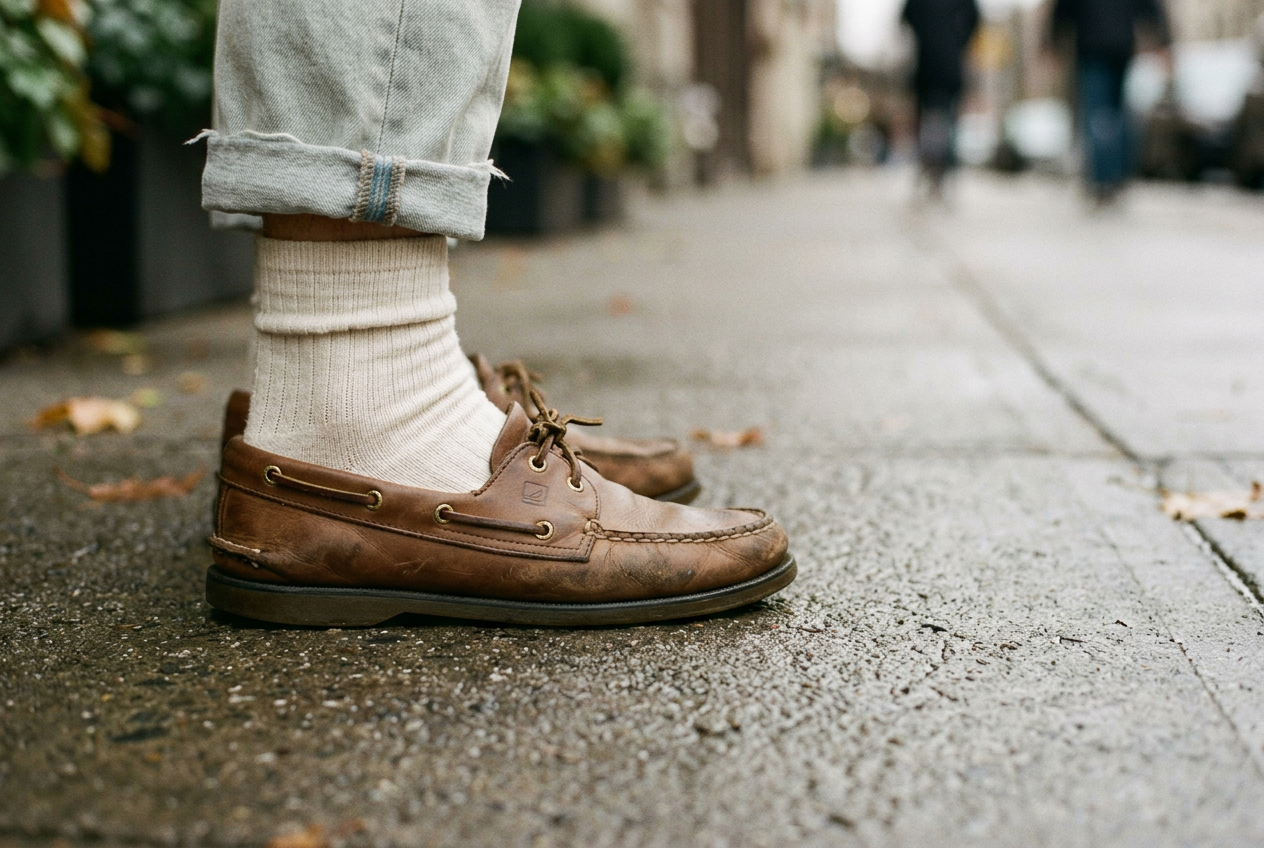
The pair at the center of this test is the Sperry Authentic Original 2-Eye, the familiar leather boat shoe with moccasin-style stitching, a wraparound rawhide lace and a thin rubber outsole. Worn for a week with loose trousers, straight jeans and shorts, it clarified the difference between a shoe that looks prepared for walking and one that remains closely tied to the surface it was designed to grip.
That surface was a wet deck. The outsole uses siping, meaning narrow cuts made in rubber so its edges can open slightly and push away water under pressure. On damp, smooth ground, those cuts have a purpose. On a long city route, however, they cannot supply the depth, cushioning or lateral stability found in a walking sneaker.
This is unisex coverage. The mechanics apply across wardrobes, although boat shoes are often split into men's and women's size ranges, and an equivalent labeled length may come with a different width or heel volume. Shop by the fit of the actual pair, rather than assuming a converted size will feel the same.
The shape has moved beyond prep
The current boat-shoe return is easy to understand without declaring a full nautical revival. Public fashion reporting and recent retail assortments have shown the silhouette moving back into view after several years dominated by loafers, clogs and narrow retro sneakers. Versions from traditional makers such as Sperry and Sebago now sit beside designer interpretations, chunkier hybrids and softened suede pairs.
What looks fresh is the low, slightly collapsed profile. The apron seam gives the toe definition without the hardness of a penny loafer, while the leather lace running around the collar interrupts an otherwise plain upper. Under wide trousers, that combination reads lighter than a thick-soled loafer and less familiar than another slim sneaker.
The classic Sperry pair kept returning to the same useful styling position during the test week: under full-length pants, with only the stitched toe and narrow edge of white rubber visible. Shorts exposed more of the shoe's traditional deckwear associations. Straight jeans made it look deliberate but ordinary. Loose, lightly tailored trousers gave it the most current proportion because the soft upper sat low beneath the extra fabric rather than competing with it.
The shift is therefore partly about silhouette fatigue. A boat shoe can replace a loafer in an outfit without carrying the same polished weight, and it can replace a sneaker without making the clothes look sportier. That does not mean it replaces either one underfoot.
Siping helps with water, not distance
The razor-cut appearance of a boat-shoe outsole encourages a broad claim about traction, but the cuts address a narrow problem. They create extra edges and routes for a film of water to disperse when rubber meets a relatively smooth surface. On the test pair, that advantage was most noticeable on damp tile and sealed pavement, where the sole felt more planted than an equally flat leather outsole would.
Dry city streets introduced different demands. Small stones pressed through the thin sole. Broken pavement made the foot work harder because there was little foam to soften repeated impact, and the shallow pattern did not bite into loose grit the way deeper lugs can. Siping also does little to stabilize a foot that rolls at the edge of a curb; the sole remains flexible and low, which feels pleasantly direct until the route becomes uneven.
The cuts are not a substitute for tread depth. They are also not an indicator of arch support, a shaped structure under the midfoot that helps distribute pressure. The Authentic Original has a more substantial feel than a completely unlined slipper, yet its underfoot experience remains much closer to a traditional casual shoe than a modern walking sneaker.
After several hours divided between sidewalks, stairs and standing, the limiting sensation was not sharp pain but accumulation. The forefoot felt more aware of the ground, then tired. That distinction matters for a buyer who can tolerate a flat shoe through lunch but expects the same pair to carry an unscheduled walk home.
For a commute with predictable surfaces and a seated destination, the classic construction can be enough. For sightseeing, all-day errands or a route over patched asphalt, a sneaker with a broader heel, a removable cushioned insole and visible outsole depth remains the more credible choice. A lugged boat-shoe hybrid can improve protection, though the thicker base changes the very slimness making the trend appealing.
Heel fit decides whether the shoe is wearable
The practical problem appeared at the back before it appeared underfoot. Boat shoes have a low collar and limited structure around the heel, while the leather upper tends to soften with wear. The wraparound lace looks adjustable, but on the Sperry pair it could only refine the hold. It could not correct excess volume in a shoe that was too loose through the rear foot.
In the usual size, the test pair left a small amount of heel movement when worn barefoot. Tightening the laces reduced it, though pulling hard enough to lock the heel also made the collar gather and increased pressure across the top of the foot. That is a poor trade. A boat shoe should bend at the forefoot without the heel rising enough to rub on every step.
Leather complicates the fitting-room decision because it relaxes. A pair that already slips when new is unlikely to become more secure after the quarters soften, so buying extra room in anticipation of swelling or a thick sock can leave the shoe unstable later. A pair that holds the heel but pinches the forefoot is not automatically correct either; the upper may give across a pressure point, but the stitched shape and rubber base will not become longer.
The useful test takes several minutes. Lace both shoes, walk quickly, climb any available stairs and make a tight turn. Pay attention to vertical heel lift rather than the normal flex of leather at the back. If the heel rises repeatedly while the laces are comfortably tied, try another width, another size or another last, the foot-shaped form around which a shoe is built.
Brand-to-brand changes matter here. Sebago's Portland and Sperry's Authentic Original share recognizable boat-shoe features, but a similar-looking upper does not guarantee the same heel pocket or forefoot width. Designer pairs may alter the toe shape further for appearance. Online conversion charts are a starting point, particularly when crossing men's and women's ranges, not evidence that the volume will work.
Socks improve the walk and alter the look
The old styling instruction was to wear boat shoes barefoot. The week with the Sperry pair made that the least practical option for repeated city use. Bare skin met the leather collar directly, heat built inside the shoe, and even modest heel movement became more noticeable once the foot warmed.
A thin no-show sock reduced friction without changing the bare-ankle appearance, but it needed a secure silicone grip and enough coverage around the heel. A very low liner slid downward and added a fold beneath the foot, which was worse than going without it. The better invisible version rose close to the collar and stayed flat under the forefoot.
A ribbed crew sock was more successful. It softened contact at the heel, filled a little spare volume and made the shoe look less like inherited resort wear, particularly with washed jeans or generous trousers. Fine-gauge cotton worked better than thick athletic terry because the latter crowded the toe box and made the low shoe look swollen around the opening.
Visible socks also broaden the season. Dark brown leather with cream, gray or faded-color socks can move through mild transitional weather, provided the forecast is not asking a low-cut shoe to resist heavy rain. Salt, dirty water and repeated soaking remain hard on leather uppers, even when the outsole itself was designed with wet grip in mind.
The sock cannot rescue a wrong size. It can manage minor looseness and protect skin, but using thick fabric to occupy a clearly oversized heel leaves the foot perched above the intended fit of the shoe.
The useful pair is not necessarily the purest one
Traditional leather boat shoes generally cost around the territory of a decent casual sneaker, while luxury interpretations can climb to several times that. The classic pair makes the stronger case when the leather, stitching and low profile are the point. Paying designer prices does not remove the mechanical limits of a thin sole unless the construction has also changed.
Before buying, turn the shoe over. Widely spaced lugs suggest better performance on debris and uneven ground, while fine siping across a nearly flat base favors smooth wet surfaces. Press the heel counter to judge how much structure it has, then bend the forefoot. A very easy bend may feel natural at first, but it also signals that the shoe will ask more from the foot over distance.
A removable insole adds options for cushioning, although inserting a thicker footbed can raise the heel and worsen slippage. The shoe needs enough internal depth to accommodate the change. If it does not, choose a model designed around more cushioning rather than forcing an insert into the classic shape.
The Sperry pair finished the week as a styling purchase with a legitimate, limited function. It worked for short commutes, dry-to-damp sidewalks and outfits that needed a softer alternative to a loafer. It did not earn the all-day role of a supportive sneaker, and the siped outsole never promised that it would.
The trend makes sense if the intended route is part of the purchase decision. For ordinary city walking measured in a few controlled stretches, a well-fitted pair with socks is reasonable. If “ordinary” means hours on foot, subway transfers, rough pavement and whatever the day adds, the boat shoe is still the second pair, not the only pair.
Questions people ask
Are siped boat-shoe soles good on wet pavement?
They can improve contact on smooth, damp surfaces because the narrow cuts create edges and help move a thin layer of water. They are less useful on loose gravel, mud, deep puddles or broken pavement, where tread depth and a broader, more structured outsole matter more.
Should boat shoes slip at the heel?
A small amount of leather flex is normal, but the heel should not lift repeatedly during a quick walk or on stairs. If tightening the laces causes pressure across the top of the foot before the heel feels secure, the shoe's size, width or last is probably wrong for you.
Should boat shoes be worn with socks?
For city wear, socks make the shoe easier to tolerate by reducing friction and absorbing moisture. Choose a secure no-show liner for a bare-ankle effect or a fine ribbed crew sock for a more current look; thick athletic socks can overcrowd the low-volume upper.
Are boat shoes comfortable enough for all-day walking?
Classic thin-soled versions suit moderate walking on predictable surfaces, but siping does not add cushioning, arch support or protection from rough ground. For an all-day route, choose a lugged or cushioned hybrid, or keep the boat shoe for the destination and travel in a walking sneaker.
One update a day
Today's fashion update, in your inbox
One fashion update each morning — no hype, no filler, just pieces worth wearing.