Belt Sizing Starts at the Buckle, Not the First Hole
A belt’s hole count tells you almost nothing about fit. Measure from the buckle to the hole you use, then check how the retailer treats buckle length and sizing.
September 7, 2026 · 7 min read
A five-hole belt can look reassuringly adjustable on a product page. The useful detail is hidden in the size diagram: the distance between the buckle and the middle hole, which may be measured differently from one retailer to the next.
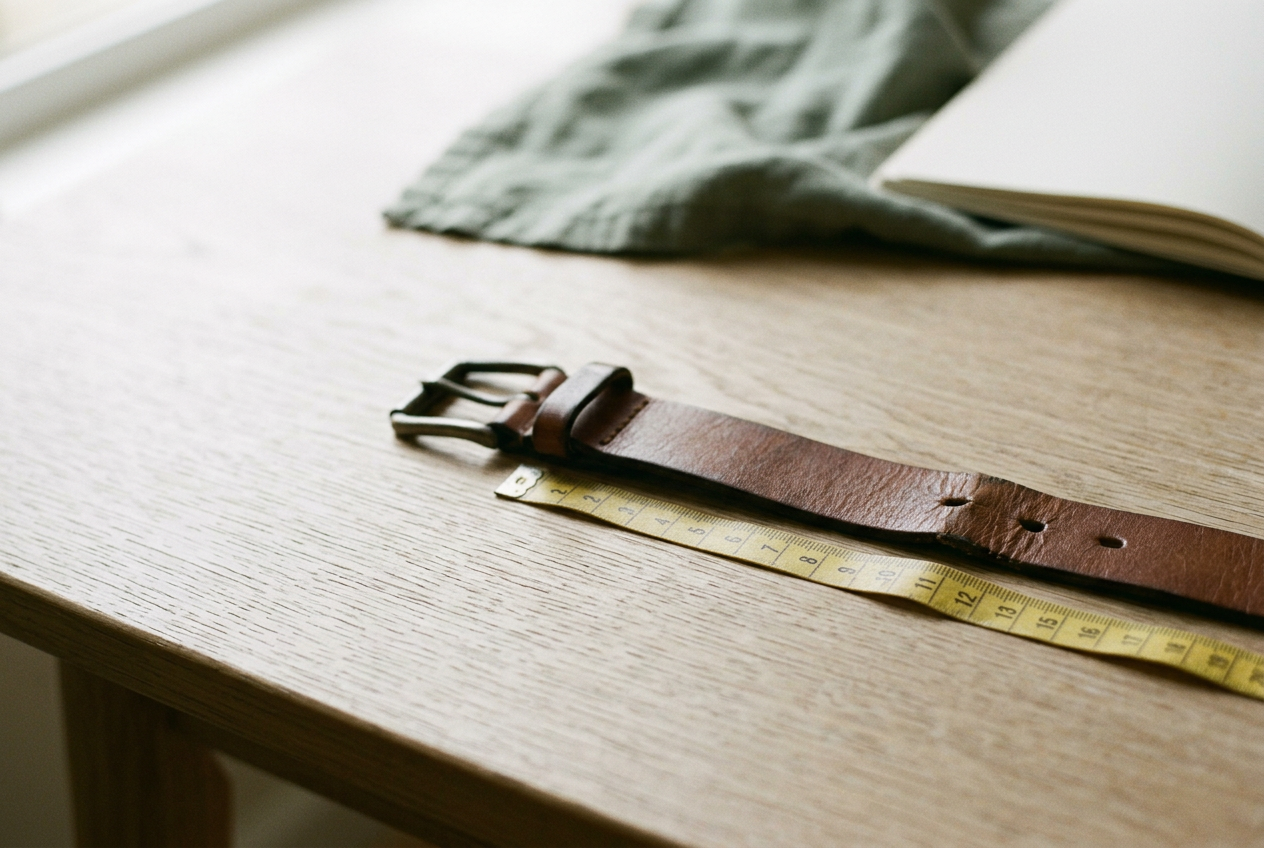
Keep one concrete example in mind. It is a 30 mm brown leather belt worn with mid-rise straight-leg jeans, and its buckle tongue sits in the third of five holes. That third hole is the working hole, meaning the hole used for a comfortable, secure fit. Its position matters.
The other four holes only provide room for changes in clothing, body circumference and styling.
This is unisex advice. Belt construction works the same way across wardrobes, even though retailers may divide products into women’s and men’s departments or use different relationships between clothing sizes and belt sizes.
Why counting holes does not tell you the size
Holes are adjustment points, not a standardized measuring system. Two belts can each have five holes while placing their middle holes at different distances from the buckle. Their spacing can differ too. One maker may leave a long section of leather beyond the last hole, while another trims the end close enough that the tail barely reaches the next belt loop.
Measuring the whole belt from buckle tip to leather tip is no better. That number includes parts that do not wrap around the body, including the projecting buckle frame and the unused tail. It can make an ornate buckle belt appear much larger than a plain tongue-buckle style even when both close at the same circumference.
The brown reference belt illustrates the problem. Its third hole is comfortable, but knowing that it has two tighter holes and two looser holes will not help you replace it. You need the distance from the buckle’s functional anchor point to that third hole. You also need to know whether the new retailer measures from the same point.
Start with a belt that already fits
Lay the belt flat without stretching it. Leather can curve after wear, so smooth the strap against a table rather than pulling it straight under tension. Identify the hole with the clearest crease or tongue mark if you cannot remember which one you use.
Now consult the prospective retailer’s measuring diagram. Many conventional leather belts are sized from the buckle fold, the point where the strap wraps around and attaches to the buckle, to the middle hole. Other diagrams begin at the buckle tongue or another marked point. Follow the drawing rather than assuming the printed size describes total length.
Measure your existing belt from the equivalent point to its working hole. Keep the tape along the center of the strap. Do not include the loose leather tail, and do not measure to the nearest hole merely because it produces a familiar clothing size.
For the brown belt, the useful measurement ends at the third hole because that is where the tongue sits with the mid-rise jeans. If a retailer’s size chart gives buckle-to-middle-hole measurements, the closest match should place the new belt near its central adjustment. That leaves a tighter hole for a dress or high-rise trousers and a looser hole for a thicker waistband.
A belt that fits only on its final hole is the wrong target for an online order. It may close, but there is no room for a change of rise, a tucked sweater or the way firm leather softens and settles after repeated wear. The tail can also become too short to sit securely through the leather loop beside the buckle.
Measure your body at the clothing, not the label
An existing belt gives the most direct comparison, but body measurement is useful when buying a first belt or changing where it will sit. Put on the trousers, jeans or dress you expect to wear. Thread a flexible tape through the belt loops and hold it as snugly as you want the finished belt to feel.
Do not measure bare skin at the narrowest part of the waist unless that is exactly where the belt will sit. Fabric adds thickness. A tucked shirt adds more, while a heavy denim waistband behaves differently from a fluid dress because the belt must hold the rigid layers rather than rest against the body.
Keep the tape level and breathe normally. It should touch the waistband without digging into it. Record that circumference, then compare it with the retailer’s buckle-to-hole measurements. The goal is usually to land near the middle adjustment, not to force the body number into a small, medium or large category.
Trouser size is only a fallback. A labeled waist can differ from the garment’s measured waistband, and fashion trousers may sit above or below the point implied by the label. The familiar instruction to buy a belt a size larger than pants can work within one brand’s system, but it is too blunt for comparing several retailers.
Read the retailer’s convention before choosing a size
A number printed inside a belt can describe several things. It may refer to the buckle-to-middle-hole distance, a suggested body measurement or a clothing-size range. A centimeter size may look more exact than small, medium or large, yet precision is useless if the starting point is unclear.
Look for a diagram showing both ends of the measurement. Check whether the listed length stops at the center hole, the first hole or the leather tip. If the product page provides only total length, compare that figure with another belt only when the buckle construction, number of holes and tail allowance are also closely matched.
Letter sizing needs extra caution. A medium belt may cover several holes across a broad range, but the chart should reveal which body or garment measurements the brand assigns to it. Choose the size that places your measurement around the center of that range. If two sizes overlap, use the retailer’s stated belt measurement and your preferred tail length rather than defaulting to the larger one.
A missing diagram is a practical reason to pause. Contact customer service for the buckle-to-center-hole distance, or choose a retailer that publishes it. Ordering several sizes and returning the misses costs time, may incur shipping fees and still leaves the buckle question unresolved.
Buckle length can change the result
The buckle is not decorative dead space. On a standard tongue buckle, the important closure point is where the tongue pivots and enters the hole, so a product diagram that starts there can account for the hardware cleanly. A retailer that measures only the leather strap may not.
This becomes more important with detachable or plate-style buckles. The distance between the strap attachment and the hook or tongue can vary, which changes the closed circumference even when the leather section remains the same length. Swapping a compact buckle for a longer one may therefore shift the working hole.
Large buckles also change how the belt sits. A long frame occupies more space across the front of the body and moves the leather tail farther to one side, sometimes preventing it from reaching the first trouser loop neatly. On the brown reference belt, a compact buckle lets the tail pass through the leather loop and into the jeans loop without bunching. Matching only the strap measurement would miss that detail.
If you plan to change buckles, measure the complete working setup after the new hardware is attached. For belts sold with fixed buckles, use the brand’s own reference points and avoid transferring a size number from a visually similar design.
Trouser rise changes where the belt closes
Rise is the distance from the crotch seam to the top of the waistband, and it determines where trousers sit on the torso. A high-rise waistband often circles a narrower part of the body than a low-rise one, though the difference depends on body shape. The same belt may move one or more holes between them.
That is why the brown belt’s third-hole fit belongs to its mid-rise jeans. With higher trousers it may close on a tighter hole. Over low-rise denim, it may need a looser one, and the remaining tail will shorten as the working circumference grows.
Measure each main wearing position if the belt must work across several rises. Compare the smallest and largest results with the retailer’s hole range, not merely its nominal size. A belt whose holes cover both measurements can do the job, provided each setting leaves enough tail to pass through the buckle’s leather loop.
Width matters at this stage too. Measure the inside height of the trouser loops and compare it with the listed strap width. A thick 30 mm leather belt may technically pass through a narrow loop but scrape at the edges, while a wider casual belt may not enter at all. Fit around the body is irrelevant if the strap cannot move cleanly through the garment.
The online ordering check
Use the existing-belt measurement first. Confirm the retailer’s start and end points, then choose the size that puts your working circumference near the middle hole. Check the buckle style, strap width and usable tail before placing the order.
If you have no reliable belt, measure over the actual clothing at the intended rise. Treat pants size as supporting information only. When the chart omits its measuring convention, the belt is not worth guessing on unless returns are free and convenient.
Questions people ask
Should a belt fit on the middle hole?
The middle hole is the best starting target because it leaves adjustment in both directions. It is not a rule for every outfit, but an online order that arrives already using the tightest or loosest hole offers little flexibility for different trouser rises, tucked layers or normal changes in fit.
Can I order a belt using my jeans size?
Only if the retailer explicitly links its belt sizes to that jeans measurement. Clothing labels do not reliably describe the waistband’s finished circumference or where it sits, so measuring a well-fitting belt or taking a tape through the actual belt loops gives a more dependable result.
Does a larger buckle require a larger belt?
Not always. A conventional buckle-to-hole measurement may already account for the hardware, while a leather-only measurement may not. Detachable and plate buckles need closer attention because changing the distance between the strap attachment and closure point can move the working hole.
How should
I measure for belts worn at different rises?
Measure over each waistband where the belt will sit, using the clothing and any tucked layer you normally wear. Choose a hole range that includes both circumferences while keeping them away from the extreme ends, then confirm that the leather tail still reaches the loop at the loosest setting.
One update a day
Today's fashion update, in your inbox
One fashion update each morning — no hype, no filler, just pieces worth wearing.