Barrel-Leg Jeans Have Split. One Version Needs Different Shoes.
The strongest barrel jeans bow visibly at the knee and alter an entire outfit. Softer versions taper gently enough to take the place of an ordinary straight or tapered pair.
Women's · August 13, 2026 · 7 min read
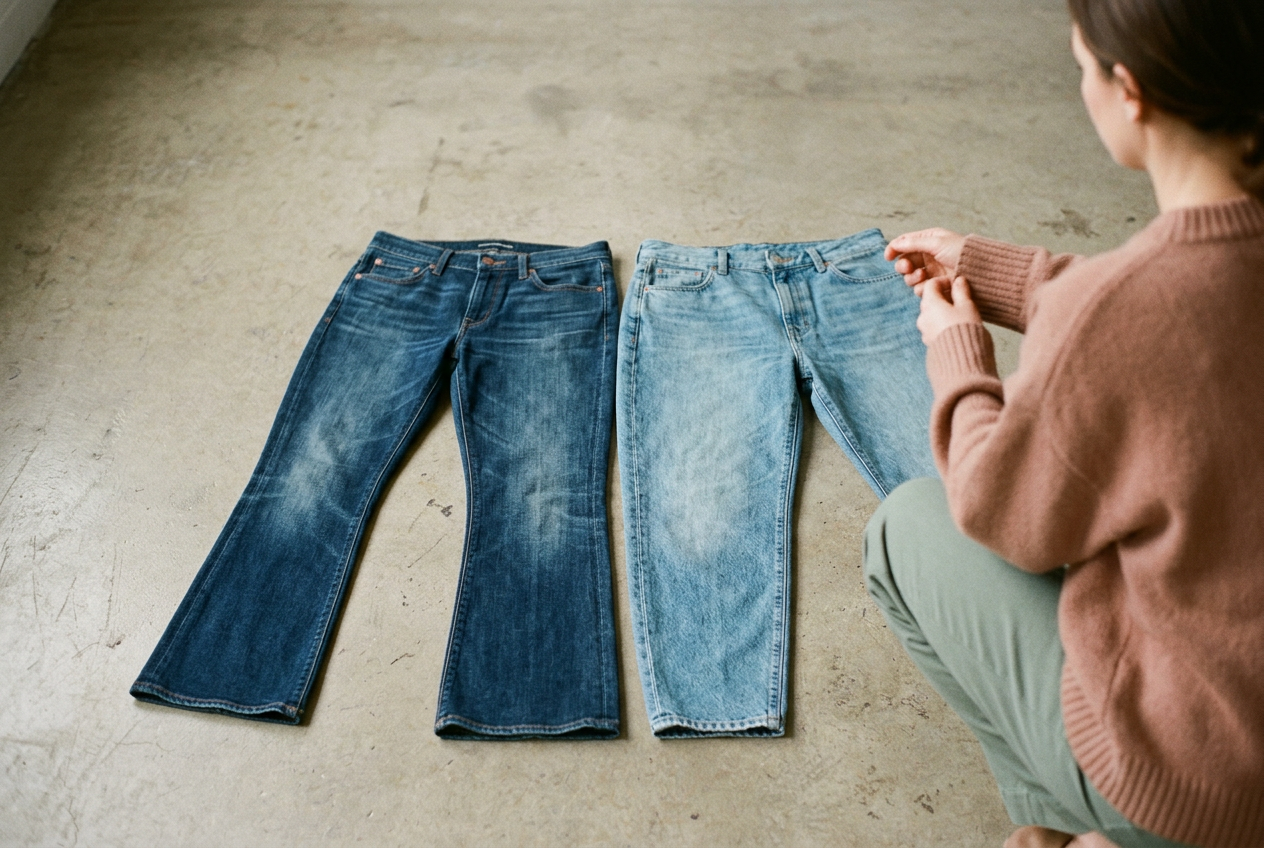
The Citizens of Humanity Horseshoe Jean is the useful reference point for understanding the split. Its leg does not merely narrow toward the ankle; it moves outward from the hip, holds visible space around the knee and then returns inward, creating the curved outline that made barrel jeans look new in the first place.
That outline is now only one branch of the category. Retailers are also calling much gentler jeans “barrel,” including pairs whose outer seams barely bow and whose hems are close to those of familiar tapered jeans. Levi’s Cinch Barrel, Madewell’s Darted Barrel-Leg styles and Gap’s High Rise Barrel Jeans occupy different points along this widening spectrum, depending on wash and season. The label on the product page no longer tells you how much shape will arrive in the fitting room.
This is women’s coverage, and the practical distinction matters because the strongest curved versions change the proportion between jacket, jean and shoe. The softer ones can slide into a wardrobe without asking for that renegotiation.
The side seam reveals the real shape
A barrel leg is a trouser shape that expands away from the body before tapering back toward the hem. The easiest way to assess one online is to ignore the styling and trace the outer seam in the straight-on product image.
On the Horseshoe Jean, that seam describes a conspicuous arc. There is daylight between the leg and the body around the lower thigh and knee, while the hem turns back toward the ankle. Even without a tucked shirt or a cropped jacket, the outline remains legible. This is the dramatic version: the jean supplies its own architecture rather than following the wearer’s leg.
A softly tapered barrel jean behaves differently. The outer seam may leave the hip at a slight angle, but much of the apparent fullness comes from a relaxed thigh rather than a strongly curved pattern piece. By the time the seam reaches the knee, it has begun a gradual inward path. Seen without the “barrel” product name, the pair could pass for a roomy carrot jean or an updated tapered jean.
Levi’s Cinch Barrel is a useful middle case. Its shape is loose and rounded, but the cinchable waistband and relaxed top block, meaning the area from waist to upper thigh, contribute heavily to the silhouette. It can look more directional than a standard taper without producing the pronounced horseshoe outline of the Citizens pair. Madewell’s darted versions create shape through folded and sewn wedges in the fabric, called darts, rather than relying only on an extreme side-seam arc.
The distinction survives styling. A curved seam remains curved under a long coat. A soft barrel can lose much of its identity once a shirt or sweater covers the waistband and upper hip.
Knee volume is where the drama sits
Hem taper gets most of the attention, but knee volume determines whether the jean changes an outfit. On a true horseshoe shape, extra fabric is distributed around the knee rather than hanging as a straight wide leg. The side profile may show the fabric standing away from the shin, especially in rigid denim.
Rigid denim, meaning denim with little or no stretch fiber, supports that volume and preserves the drafted curve. It also makes the fit less forgiving when the knee or calf lands somewhere the pattern did not anticipate. A curved pair can look crisp in one size and collapse into diagonal folds in the next, not because either size is universally wrong but because the fullest point of the jean has shifted relative to the wearer’s leg.
The Citizens Horseshoe is again the clear benchmark. Its generous middle section makes a fitted knit, short jacket or compact shirt look noticeably smaller above it. That can be the point. With a long oversized blazer, however, volume collects through both the torso and knee, and the shoe has to provide enough visual weight to finish the line.
Madewell’s Darted Barrel-Leg Jean offers a less emphatic route. A knee dart can angle fabric outward without requiring the entire leg panel to swing into a broad curve, so the result reads as shaped rather than simply loose. Gap’s barrel offerings tend to be worth checking wash by wash and image by image: some presentations show a recognizable bowed leg, while others sit closer to a relaxed taper. The category name covers both.
This is also where soft denim can mislead. A drapier or stretch-blend fabric may photograph with a rounded outline when carefully arranged, then settle closer to the body during wear. If the product page shows the jean only in motion or at an angle, the back view and flat product shot are more useful than the most styled image.
Rise changes where the curve begins
Rise is the distance from the crotch seam to the top of the waistband. On a high-rise barrel jean, the waistband establishes a narrow starting point before the leg expands, which makes even moderate knee volume look deliberate. The shape reads from waist to ankle.
The Horseshoe Jean uses that long vertical setup to its advantage. Its roomy leg does not appear to begin abruptly at mid-thigh; the high waist, relaxed hip and bowed seam work as one continuous silhouette. This is why sizing down solely to sharpen the waist can backfire. Pulling the upper section too close may flatten the intended volume at the hip, add strain across the fly and make the curve begin lower than the pattern intended.
A softly tapered pair is less dependent on this high-rise effect. If its knee volume is restrained, a mid-to-high rise can sit under an untucked sweater much like an ordinary jean. That makes it easier to substitute for a familiar tapered cut, particularly for someone who does not want every top shortened or tucked to expose the waistband.
Look at the side view for the fit quirk that front-facing images conceal. Excess fabric below the seat can push the curve backward, while a very close hip fit can pull the outer seam toward the body and erase it. The useful size is the one that lets the seam follow its planned route, even if the waistband then needs a belt or a small alteration. A barrel jean is unusually sensitive to that tradeoff.
Hem width decides whether your shoes still work
The hem is the practical dividing line. A narrow opening that stops above the shoe exposes more of the foot and can make a delicate ballet flat, slim loafer or low-profile sneaker look balanced. A wider hem with substantial knee volume may hover around the upper, leaving a small shoe visually detached from the jean.
The Horseshoe Jean’s inward sweep puts attention on whatever sits beneath it. That does not mandate a heavy shoe, but it makes the choice conspicuous. A substantial loafer, clog, boot or sneaker can answer the jean’s volume. A fine sandal can work through contrast, though the outfit will look intentionally fashion-led rather than neutral.
Soft barrel jeans ask less. If the hem is close to one on a tapered jean already in your closet, and if it falls at a similar point on the ankle, the same sneakers and loafers should transfer without much thought. That is the version to buy when “barrel” sounds appealing but replacing the rest of an outfit does not.
Length matters as much as circumference. A curved jean that ends cleanly above the shoe preserves the inward turn of the seam. Extra length can pool at the ankle, obscuring the taper and turning a controlled horseshoe into a baggy jean with an unexplained bulge at the knee. Petite shoppers may need a dedicated shorter length rather than a simple hem, because removing too much fabric from the bottom can widen the new opening and reduce the final curve.
A fitting-room test that takes one minute
Stand naturally before judging the waist. Check whether the outer seam travels outward and returns, then turn sideways to see whether the knee volume sits beside the leg or collapses behind it. Finally, place the jean over the shoe you wear most. If the hem catches on the upper, the intended shape will change every time you walk.
For the dramatic option, look for a clear arc like the Citizens Horseshoe, supported by firm denim and enough room through the middle of the leg. Accept that tops and shoes will become more visible decisions. This pair earns its higher premium-brand price band only if that curve is what you want; paying more for a shape that you plan to suppress under long layers makes little sense.
For an everyday replacement, choose the quieter retail interpretation: restrained side-seam curvature, moderate knee room and a hem similar to your existing tapered jeans. A mall or high-street version may be the better trial purchase, provided the denim holds the shape rather than falling straight. The word “barrel” is less important than the path of that seam.
I am undecided about the middle ground. A lightly bowed jean can be useful, yet some examples charge a trend premium while delivering nearly the same outline as a relaxed taper. If the curve disappears under an ordinary crewneck sweater, compare it directly with the retailer’s tapered fit before buying.
Questions people ask
Are barrel-leg jeans the same as tapered jeans?
No. Both narrow toward the hem, but a true barrel jean first expands around the thigh or knee, creating a visible outward curve. A tapered jean generally follows a steadier inward line. Softer barrel styles blur the distinction, so the front-view side seam is more reliable than the product name.
Which barrel-leg jeans work with shoes I already own?
Choose a softly tapered pair whose hem width and ankle length resemble jeans you already wear successfully. Low-profile sneakers, loafers and ballet flats are easier beneath that restrained shape. Strong horseshoe jeans place more emphasis on the shoe and may work better with a substantial sole or a deliberately delicate contrast.
Should I size down in barrel-leg jeans?
Do not size down merely to make the waistband look sharper. A smaller size can pull the hip and thigh inward, flattening the curve the jean was cut to create. Fit the seat and the position of the knee volume first, then use a belt or consider a waistband alteration if the top edge remains loose.
Can petite shoppers shorten barrel-leg jeans?
A small alteration may work, but removing substantial length changes the hem circumference and can weaken the inward taper. Look first for a petite or shorter inseam in which the knee shaping has also been repositioned. The fullest part should sit near your knee, not several inches below it.
One update a day
Today's fashion update, in your inbox
One fashion update each morning — no hype, no filler, just pieces worth wearing.