Barrel Jeans Are All Over Resale. The Moderate Curve May Last.
New barrel jeans now cover more rises and lengths, while resale is filling with first-wave versions. The useful dividing line is no longer trend versus classic, but wearable curve versus costume volume.
Women's · August 27, 2026 · 7 min read

The pair I kept returning to while comparing new retail with resale was a black Madewell Darted Barrel-Leg Jean offered secondhand. Its front darts, stitched folds that remove fabric and redirect volume, push the leg outward below the hip before the denim narrows toward the ankle. Photographed flat, it looked controlled. Without a side view or complete measurements, its relationship to an actual body remained uncertain.
That uncertainty is the barrel jean problem in miniature. The silhouette is easy to identify and difficult to buy from a thumbnail, particularly secondhand, because two pairs labeled barrel leg can differ more from each other than a straight jean and a slim straight. One may have a gentle bowed seam and a full-length hem. Another places a wide arc at the knee, crops above the ankle and uses a high waistband to exaggerate the whole effect.
This is women's coverage, and the relevant fit issue is not whether the leg looks fashionable in isolation. It is whether the waistband, hip and curved outseam cooperate once the wearer sits, walks and chooses shoes.
New retail is broadening the shape
A trend starts to look durable when retailers stop repeating one recognizable version and begin solving for different bodies and wardrobes. Current assortments reviewed for this piece show that change. Madewell has used darts to form the leg. Free People's Good Luck jean puts mid-rise in the product name and leans into a loose, rounded shape.
Citizens of Humanity's Horseshoe Jean represents the more pronounced end, with a leg that curves outward before returning sharply at the hem.
The rise, meaning the vertical distance from the crotch seam to the top of the waistband, now varies enough to matter. Early barrel jeans were strongly associated with a high rise, which gave the curve a long starting point and made a tucked shirt feel almost compulsory. Mid-rise versions reduce that vertical emphasis. They can sit more easily under an untucked knit or jacket, though a low-slung waistband may also let a heavy curved leg pull downward during wear.
Length has diversified too. A cropped barrel jean exposes the ankle and makes the taper obvious, but the hem can stop at the widest part of the lower calf on a shorter wearer. Full-length versions soften the outline because the curve has more distance in which to open and close. They also work with loafers, low-profile sneakers and ankle boots without leaving a strip of leg that must be styled deliberately.
The black Madewell pair sits near the useful middle. Its dart creates shape without requiring a dramatically oversized hip, while the dark wash makes the seam architecture less conspicuous than it would be in pale, rigid denim. That does not make it timeless. It does make it easier to wear after the most amplified horseshoe versions have started to look attached to a particular season.
Resale abundance needs to be read, not counted
Secondhand marketplaces now return plenty of barrel, balloon and horseshoe jeans, but those labels are often mixed. A seller may call any tapered wide leg a barrel. Marketplace search results therefore overstate the supply of true bowed-out jeans, while also hiding suitable pairs listed only as relaxed or tapered.
Availability alone cannot tell us that owners are abandoning the silhouette. Resale supply grows when a trend sells widely, when buyers miss on fit and when wardrobes are cleared for ordinary reasons. Barrel jeans are unusually prone to the second explanation. A label size and waist measurement do not reveal where the leg reaches maximum width, and that point can determine whether the jean looks gently sculpted or as if the knee has landed several inches too low.
The outseam, the outside-leg line running from waistband to hem, is the measurement and visual clue most resale listings neglect. On a conventional straight jean, an outseam length gets the buyer most of the way toward understanding where the hem will land. On a barrel jean, the buyer also needs to see the curve side-on and know the knee placement. A flat front photograph can make a deeply bowed seam look almost straight.
That was the limitation of the black Madewell pair. The darts were visible and the overall length could be estimated against the garment's proportions, but a buyer would still need the rise, inseam and side profile before making a sound decision. The missing information costs time if returns are unavailable, and it can erase the price advantage of buying used if the pair must immediately be relisted.
Price is another noisy signal. Barrel jeans span mass-market denim through premium labels, while secondhand asking prices can overlap with discounted new stock. A used pair is not automatically the budget choice once shipping, marketplace fees and the risk of a nonreturnable fit are considered. The better resale value lies in a clearly measured pair made from sturdy denim, not merely the cheapest recognizable silhouette.
Fabric decides whether the curve holds
Rigid cotton denim supports the barrel outline and develops wear marks around the lap, knee and pocket edges. It also makes poor curve placement harder to ignore. If the widest part of the leg hits below the wearer's knee, firm fabric can stand away from the calf rather than collapsing into a more forgiving line.
Denim with a small amount of stretch feels easier at the waistband and when sitting, but repeated wear may relax the knee and soften the taper. Very lightweight denim drapes rather than holds a barrel, which can be comfortable yet closer in appearance to a loose tapered jean. Neither result is inherently worse. The buyer needs to decide whether the architectural curve or the roomy fit is the point.
For secondhand shopping, the care label deserves as much attention as the front photograph. Cotton content gives a first clue about structure, while puckering along the curved side seam can show how the fabric has responded to washing. Inspect the inner thighs, knees and hem as well. A cropped pair may have a clean hem because it avoids shoe contact; a full-length pair can show abrasion that changes how neatly the leg closes at the ankle.
The moderate Madewell shape benefits from fabric with enough body to keep the darts crisp. If those darts flatten and the knees bag, the jean loses the feature that separates it from an ordinary tapered leg. That is a repair-resistant failure. A loose hem can be restitched, but restoring a stretched knee or collapsed curve usually requires more alteration than a secondhand bargain justifies.
The fit variety is real, with one weak point
There is now enough variation in rise and length for barrel jeans to persist. The weak point is curve placement. Retail size charts commonly help with waist, hip and inseam, yet they rarely state where the outseam reaches its maximum width. That missing dimension matters across heights and also across sizes, because grading a pattern, meaning adjusting it proportionally between sizes, does not guarantee that the curve lands at the same visual point on every wearer.
A practical fitting starts at the side seam. The leg should begin moving outward below the fullest part of the hip, reach its widest point around the knee area, then return without gripping the calf. Sit down. If the waistband lifts away at the back while the front presses into the abdomen, sizing up may only enlarge the hip; a lower rise or less rigid denim is the better alternative.
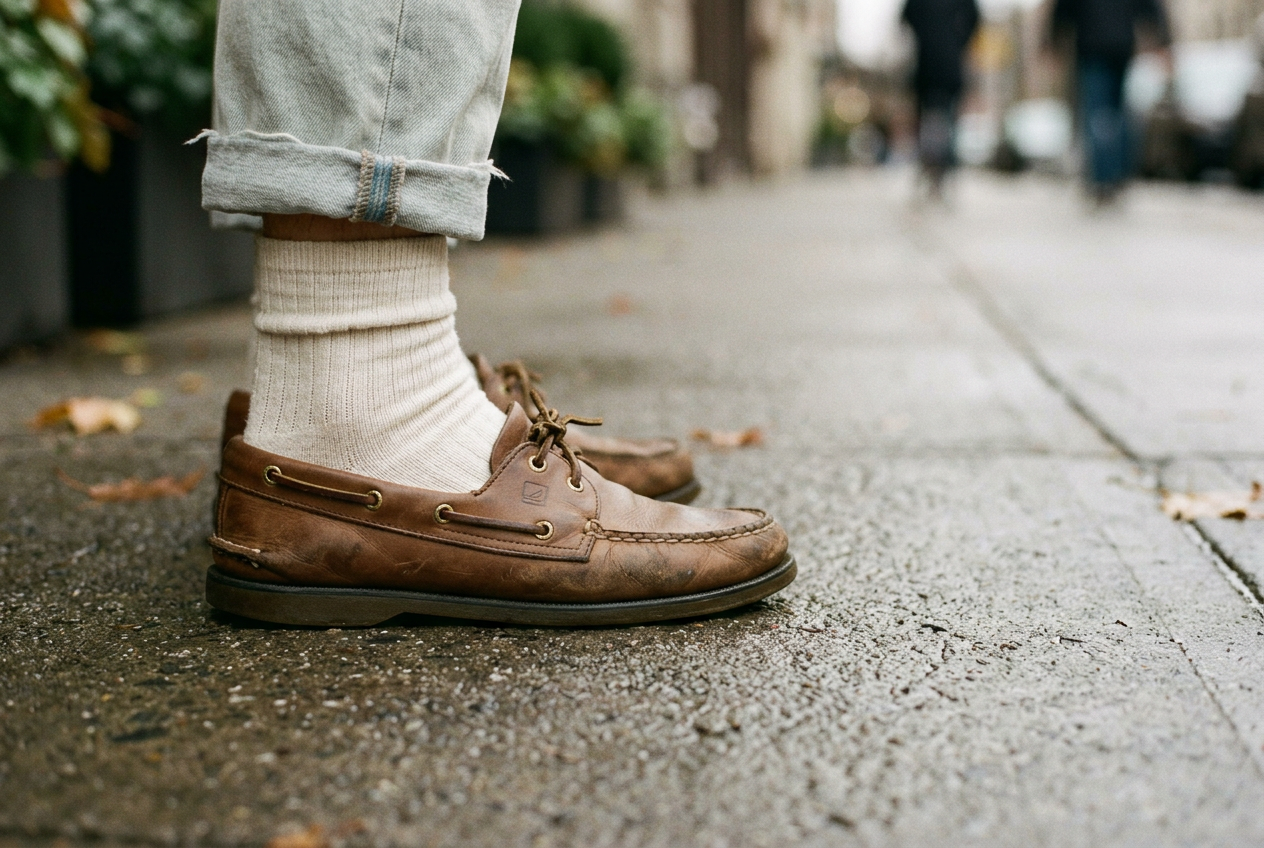
Next, test the hem with the shoes already in the wardrobe. A cropped barrel works cleanly when there is a deliberate gap above a loafer, slim sneaker or close ankle boot. A hem that nearly touches a bulky shoe can bunch inward and interrupt the taper. Full length offers more flexibility, provided the denim does not stack heavily over the foot.
For resale, ask for the front rise, inseam, hem opening and a side-on photograph. Compare those measurements with a pair already owned rather than with the body alone. A laid-flat waist can reveal whether the jean will close; it cannot show how much vertical room the wearer needs through the seat.
Durability at the center, saturation at the edge
The barrel leg no longer looks like a single novelty, but its most exaggerated version does look crowded. Deep horseshoe curves, very high waists and abrupt cropped hems are easy for retailers to copy and easy for resale searches to surface. They are also the pairs most dependent on exact proportions.
I would buy a moderate barrel jean if it offered a rise I already know works, a clearly photographed side seam and a hem compatible with at least two existing shoe shapes. I would not pay a premium for an extreme curve without trying it on, and I would skip any nonreturnable resale listing that supplies only the tagged size.
The black darted pair remains a plausible keeper, not proof of permanence. Its case improves with one missing photograph: the jean hanging or worn from the side, showing exactly where that outseam leaves the body and where it comes back.
Questions people ask
Are barrel-leg jeans still in style?
Yes, but the category has split. Moderate versions with several rise and length options look more durable than sharply curved, highly cropped horseshoe jeans. The useful test is whether the pair behaves like wearable denim across multiple outfits, rather than whether its outline is immediately recognizable as a trend.
How should barrel-leg jeans fit at the ankle?
The leg should narrow without gripping the calf or collapsing onto the shoe. A cropped hem needs a clear, intentional gap above the footwear, while a full-length hem should meet the shoe without heavy stacking. If the fabric bunches inward, try a shorter inseam or a gentler curve.
What measurements should
I request when buying barrel jeans secondhand?
Ask for the front rise, inseam, hem opening and laid-flat waist, plus a side photograph that shows the complete outseam. If possible, request the garment's width around the knee area. Tagged size alone cannot tell you where the curve will sit or whether the taper will reach your ankle.
Is rigid or stretch denim better for barrel jeans?
Rigid cotton denim holds a pronounced curve and keeps darts looking crisp, but it is less forgiving when the rise or knee placement is wrong. Denim with some stretch improves sitting comfort and waistband tolerance, though it may relax at the knee. Choose according to whether structure or ease matters more.
One update a day
Today's fashion update, in your inbox
One fashion update each morning — no hype, no filler, just pieces worth wearing.