Barrel Bags Are Rising. Their Rounded Ends Lose Packing Space
The cylindrical handbag has moved beyond designer and vintage references into wider retail assortments. Before buying, check whether its curved ends suit the rectangular objects you carry.
Women's · October 20, 2026 · 8 min read
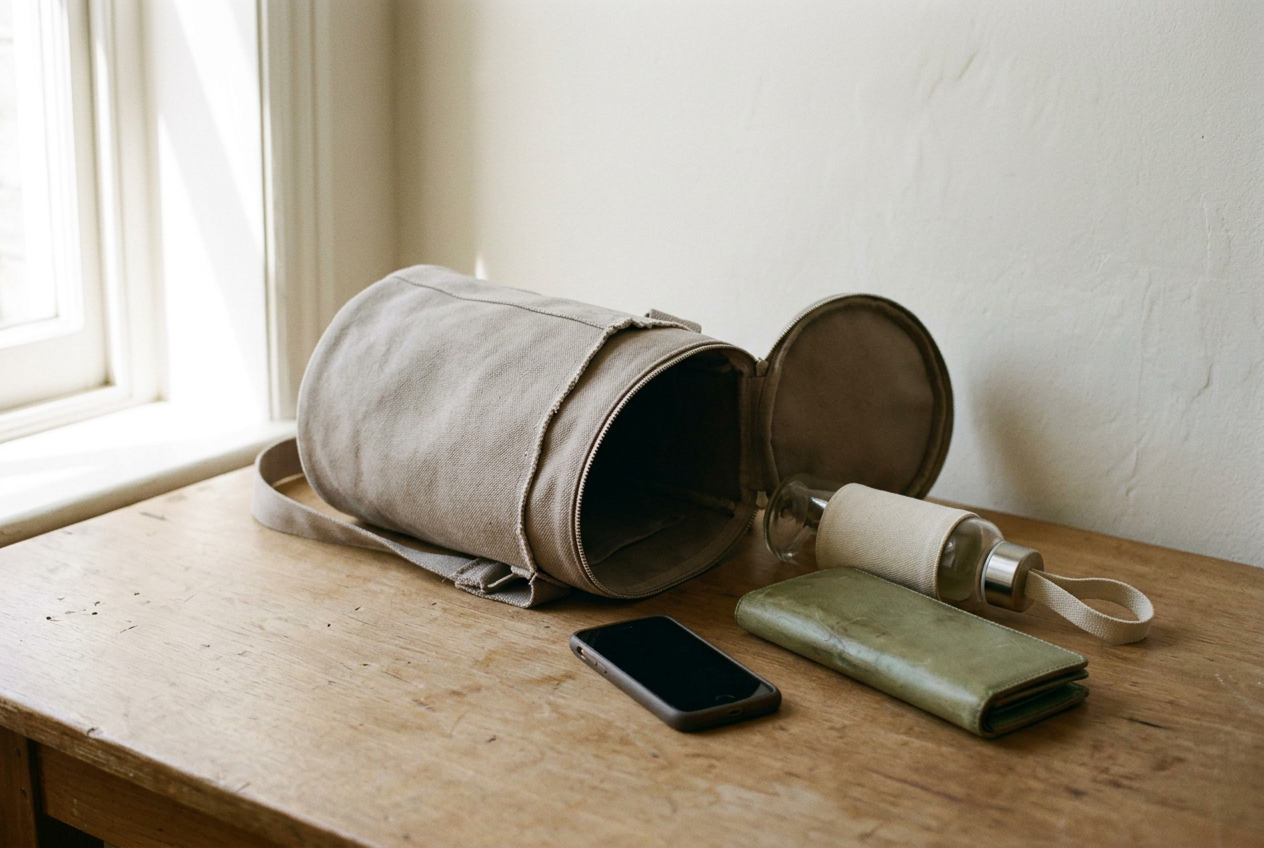
The useful reference is a vintage Louis Vuitton Papillon 30, the coated-canvas cylinder with circular leather end panels, rolled handles and a zipper running along the top curve. It is an unusually clear version of the barrel idea: not a rectangular handbag with softened corners, but a tube that asks every object inside to accommodate its geometry.
That distinction matters now. Barrel bags and their close bowling-bag relatives have spread from luxury collections, archives and resale listings into department-store and mass-market assortments, where the shape appears in leather, suede and polyurethane-coated synthetics. Some are nearly perfect cylinders. Others quietly flatten the base or stretch the body into an east-west shape, meaning the bag runs wider than it is tall, to make the trend easier to carry.
This is women’s coverage, although the packing mechanics apply to any wardrobe. The question is less whether the barrel looks current, which it does, than whether the version in front of you can hold the objects that make up an ordinary day.
The cylinder escaped the archive
The Papillon is useful because it reveals what newer bags often soften. Its circular end panels create a consistent visual line from the side, while the coated canvas, a fabric covered with a protective synthetic layer, helps the body retain its tubular shape. That structure gives the silhouette its point. It also preserves the packing problem.
Recent retail interpretations occupy several price bands. Designer versions remain luxury purchases, vintage examples vary widely by condition and provenance, and contemporary leather versions can cost roughly what a good pair of shoes costs. Synthetic versions sit lower. Price alone does not settle usefulness: a firm, expensive cylinder may waste more interior space than a moderately priced bag with a flattened base and a little give.
The widening assortment is the stronger trend signal. A shape becomes relevant to everyday shopping when retailers start translating it rather than merely displaying its most exact designer form. That is happening with the barrel. Handles get longer, detachable straps appear, bases become subtly level and full circular ends turn into D-shaped panels with a flatter lower edge.
Those edits can look minor online. In use, they determine whether the bag behaves like an accessory or a container.
The rounded end is the issue
A rectangular phone wants a flat wall. In the Papillon 30 silhouette, the wall curves away above and below the cylinder’s widest point, so a phone placed lengthwise can slide toward the center or rest at an angle. A fitted interior slip pocket can solve that, provided the pocket is long enough and does not sit directly under the zipper teeth. Without one, retrieving the phone may require moving everything above it.
The same geometry affects a long wallet, e-reader or small notebook. These objects may fit according to the bag’s published maximum width, yet that measurement usually describes the broadest internal span, not the usable width at the bottom. A flat item pushed down meets less room than the exterior dimensions suggest. It may lean diagonally, taking up space that would otherwise hold smaller objects.
A bottle presents the opposite problem. Its round body is compatible with a cylindrical bag, but only if the bag has enough diameter and the remaining contents stop the bottle from rolling. In a structured barrel with no flat base, an upright bottle is unstable. Laid horizontally, it can become the object that must come out before anything underneath it is accessible, and a loose cap threatens the entire contents rather than an isolated bottle sleeve.
The Papillon 30 makes this easy to see. Its long zipper gives a generous opening at the center, but the opening narrows toward each circular end, creating pockets of space that are useful for soft items and frustrating for rigid ones. A scarf can compress into an end. A hard glasses case may lodge there and block the zipper path.
Capacity figures cannot explain this well. Volume counts empty air, including the slim crescents around a wallet or power bank that are difficult to use. A barrel can therefore have enough nominal capacity for a daily carry and still feel full early.
Material changes the answer
Coated canvas holds a clean cylinder and tolerates light weather better than many untreated suedes, but it has limited willingness to stretch around an awkward object. Firm leather behaves similarly at first, especially when the end panels are reinforced. It may relax with wear, although buying a bag on the assumption that it will deform in the right places is an uncertain plan.
Soft leather changes the calculation. A lightly structured barrel can settle against the body and develop a flatter resting surface once loaded, gaining usable room at the cost of the crisp silhouette that made it appealing. Suede often slouches sooner and shows pressure from corners more readily; a notebook or phone can leave a visible line if it presses against the nap, the raised surface fibers that give suede its texture.
Synthetic versions deserve inspection rather than automatic dismissal. A polyurethane-coated body can be light and inexpensive, but sharply folded areas near the zipper and handle attachments carry more stress when the bag is overpacked. The problem is mechanical: forcing a flat object into the curved end pushes outward on seams that were designed to preserve the circle.
Lining matters too. A loose fabric lining can bunch beneath a bottle or swallow small items at the ends, while a bonded lining, one attached closely to the outer material, makes the interior easier to read. Neither creates more space. One merely makes the available space less irritating.
Run the carry-list test before paying
Start with the largest rigid object you carry most days. For many readers that will be a phone, but a long wallet, e-reader or glasses case may set the real limit. Place it at the bottom rather than holding it across the open top. If it fits only diagonally, notice what part of the bag it blocks and whether the zipper closes without pressure.
Add the bottle next, if one belongs in your normal carry. Do not substitute a smaller display prop or assume you will remember to use a different bottle every morning. Set the bag on a counter after packing it. A barrel that rolls onto its side, tips toward a heavy end or cannot sit without leaning will behave the same way at a café, under a desk and in a restroom.
Then try to retrieve the phone with one hand. This catches a failure that dimensions miss: the phone technically fits, but the narrow zipper opening or the bottle across the center turns a routine action into unpacking. Rolled handles can also fall over the opening, while a short shoulder strap may hold the bag too close to the body for the zipper to travel freely.
Check the handle drop, the distance between the top of the bag and the underside of its handles, with the coat or jacket you expect to wear. Many compact barrels are designed primarily for the hand or forearm. A detachable crossbody strap adds options, though a full cylinder may roll outward against the hip because it lacks a broad, flat back panel.
Finally, remove everything and inspect the ends. If the circular panels are already bulging, the chosen size does not suit that carry list. Moving up one size may help, but only until the bag becomes long enough to knock against the body or heavy enough that the narrow handles become uncomfortable.
The better barrel may be less barrel-shaped
For a light carry, the pure cylinder remains persuasive. The Papillon 30 format works best when its contents are mostly small and compressible, with perhaps one rigid object positioned along the center. It is less convincing as a mobile office or as the only bag for a day that includes a water bottle.
A modified barrel offers a practical compromise. Look for a flattened base, end panels that are rounded only above the midpoint and an interior pocket that holds the phone vertically. Feet can protect the underside, but they do not create stability unless the base between them is broad enough to meet the surface.
A bowling bag is the nearby alternative. It keeps the arched top and short-handle attitude while using a wider base and more rectangular end panels, which suit flat objects better. A small Boston bag, a structured top-zip holdall with a level base, gives up more of the barrel’s graphic side view but usually packs with less negotiation.
The trend is not an automatic skip. It asks for a narrower match between bag and owner than its apparently roomy exterior suggests, and the most faithful version may be the least useful. If the Papillon-like cylinder is the look you want, buy it for a light carry rather than asking the shape to become a rectangular tote.
Questions people ask
Do barrel bags hold as much as rectangular bags?
Not necessarily, even when their exterior measurements look similar. Circular ends leave narrow areas above and below flat objects, while the usable width at the bottom can be smaller than the bag’s widest published measurement. A barrel works efficiently with soft contents but loses space around phones, notebooks and long wallets.
Can a water bottle stand upright in a barrel bag?
Only if the bag has enough height and a base that has been flattened or reinforced. In a true cylinder such as the Papillon 30 silhouette, a bottle is more likely to lean or roll. Test the filled bag on a level counter, and make sure the bottle does not block access to the zipper pocket.
Is leather better than coated canvas for a barrel bag?
Leather is not automatically better. Soft leather can conform around rigid objects and rest more comfortably against the body, but it may lose the clean cylindrical line. Coated canvas keeps the shape and handles light weather well, though its structure makes curved dead space harder to reclaim.
What should
I buy instead if I carry several flat items?
Choose a bowling or Boston bag with a level base and more rectangular end panels. You can retain the rounded top and short handles while gaining walls that accommodate a phone, e-reader or long wallet. In the store, place your largest item flat at the bottom before judging the size.
One update a day
Today's fashion update, in your inbox
One fashion update each morning — no hype, no filler, just pieces worth wearing.