Soft Totes Are Replacing Work Bags, but Laptops Pay the Price
The lighter, collapsed tote is easier on the shoulder than a rigid work bag. Its weak points are laptop protection, base sag and the tendency to turn useful storage into one deep pile.
Women's · October 14, 2026 · 7 min read
The work tote is loosening up. Across current designer and high-street assortments, bags that fold at the sides, puddle slightly at the base and tuck under an arm are taking space from the firm, compartmented styles that hold an upright rectangle even when empty.
That change can look like a matter of silhouette. In use, it changes where the weight lands, whether a laptop takes the first impact when the bag meets the floor, and how long it takes to find a key beneath a cardigan. A soft tote can be the kinder commuter bag. It can also be a thin shell around expensive equipment.
This is women’s coverage, though most of the construction advice applies beyond one wardrobe. The central case is the Longchamp Le Pliage Original L, a familiar zip-top tote made from lightweight recycled polyamide canvas with leather handles and trim. It is useful here precisely because it is not a new trend object. It shows what a collapsed tote has long done well, and what newer, more expensive versions still have not solved.
The benchmark bag
The Le Pliage folds for storage and carries almost none of the empty-bag weight associated with a structured leather work tote. Its coated canvas body gives way around the contents, while the zip and snap-fastened leather flap provide more closure than many open-top fashion totes. There is no padded laptop compartment, and the base does not stay flat by itself.
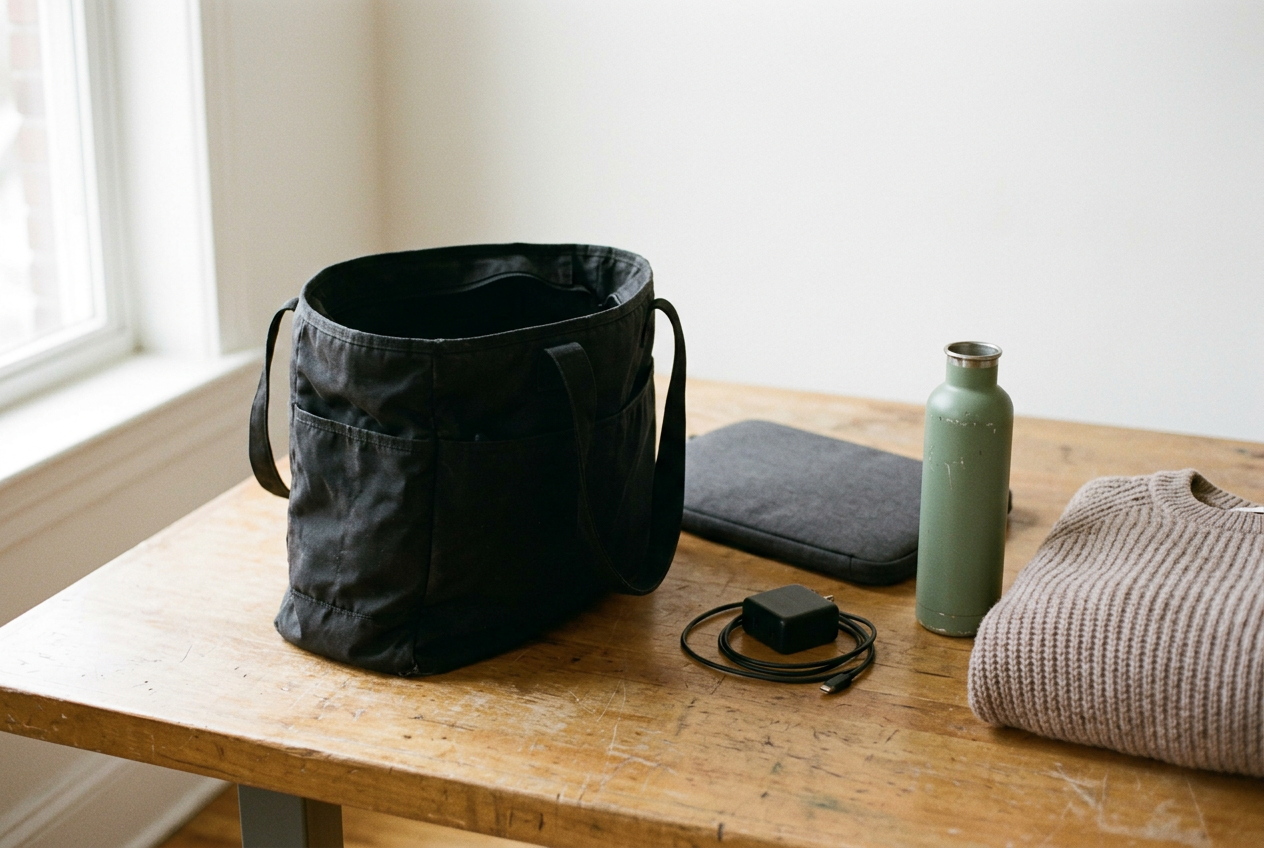
For the hands-on load check, the bag carried a 13-inch laptop inside a separate padded sleeve, a compact charger, a filled water bottle, a small pouch and a light knit. That is an ordinary workday load rather than a stress test. The laptop established the bag’s back wall, the bottle pulled one corner down, and the knit filled the remaining space without adding much weight.
The result explains the appeal of the broader shift. With the handles over the shoulder, the canvas folded around the body instead of holding the arm away from the ribs, and the bag itself added little to the load. Set down, however, it slumped toward the bottle. The laptop sleeve stopped the computer from scraping against the charger, but it could not stop the whole bag from tipping.
That distinction matters. Softness can improve carrying comfort while reducing stability at rest.
Why the silhouette is loosening
A rigid work bag needs material to keep its shape. Leather may be thickened or bonded to another layer; fabric can use interfacing, meaning a hidden stabilizing layer attached behind the outer material; bases often include a board, feet or both. Dividers, reinforced handles and substantial hardware add more weight before a laptop goes in.
A collapsed tote removes some of that architecture. Supple leather, suede, nylon and coated canvas can all produce the look, though they behave differently. Nylon usually gives the largest weight saving and tolerates light rain better than untreated suede. Soft leather feels substantial but can stretch around a laptop’s corners.
Suede grips clothing rather than sliding cleanly against it, and its exposed surface demands more care around wet sidewalks, coffee and dark denim dye.
The softer outline also fits the current preference for bags that look relaxed rather than administrative. Yet the practical gain is real: when a bag compresses under the arm, it occupies less lateral space on transit and does not force the shoulder into the slightly raised position caused by a wide, rigid top edge.
Laptop protection moves inside the bag
A rigid bag is not automatically protective. Many firm leather totes still have an unpadded central compartment, leaving a computer close to hard hardware and exposed edges. What structure does provide is distance from the ground and some resistance to crushing.
In the Le Pliage, protection came from the separate sleeve. A useful sleeve needs padding on both broad faces, a closure that prevents the laptop from sliding out when the tote tips, and coverage around the lower corners. A thin felt envelope prevents scratches but does little for impact. The sleeve should also fit closely; excess room lets the computer build momentum inside it before the bag hits a surface.
This arrangement has one advantage over a sewn-in compartment. The sleeve can move between bags, and it can be replaced when its foam compresses. The penalty is bulk. A thick sleeve consumes interior space and can make a medium soft tote feel smaller than its measurements suggest, especially when the opening narrows or the zipper sits below the full width of the bag.
Placement matters too. Keep the laptop against the side that rests nearest the body, with the charger in a separate pouch toward the opposite side. A metal plug pressed against an unprotected screen is a predictable failure, not bad luck. If the tote has no closure, the sleeve itself needs one.
Base sag is the deciding construction detail
The most revealing test happens before purchase: place the loaded bag on a flat surface. A useful soft tote may relax, but its base should not fold into a narrow V around the heaviest object. That shape concentrates pressure at laptop corners, sends a bottle rolling inward and makes the bag harder to pack consistently.
A gusset, the panel that creates depth between the front and back, helps only when its material and seams can resist the load. A broad gusset cut from very soft leather can still collapse. Look for a doubled base, closely spaced stitching at the lower corners and a subtle insert between the lining and outer material. None needs to make the bag rigid.
An aftermarket base shaper can flatten the Le Pliage and similar totes, but it changes the proposition. The insert adds weight, prevents the bag from folding as designed and may create a hard edge that shows through thin fabric. A removable organizer has the same tension: pockets improve retrieval, while its boxed walls turn a collapsed tote back into a structured one from the inside.
For a bottle, use a leak-resistant container and keep it upright beside a pouch or sleeve. An internal bottle loop is better, though still uncommon in fashion-led totes. Feet are less important than they appear. They protect small points on the base, but they do not prevent the material between them from touching the floor once the bag sags.
Shoulder comfort depends on more than low weight
The softer tote’s strongest case is comfort, provided the handles are right. Handle drop, meaning the space between the top of the bag and the center of the handle, must leave room for a coat without forcing the bag into the armpit. Too much drop allows a heavy tote to swing and pull away from the body.
Width counts. Narrow rolled leather handles can dig into the shoulder even when attached to a featherweight nylon body, and the pressure becomes pronounced once a laptop and water bottle are added. Flat straps spread the load better, although very wide straps may bunch against a tailored jacket. Check the underside for stiff seams or edge paint, the sealed finish along a leather edge, because either can rub through a thin shirt.
The Le Pliage’s light body cannot cancel an overloaded interior, but it does avoid spending part of the shoulder’s tolerance on the bag itself. That is the clearest reason to choose this category. Someone carrying a laptop for a short commute, then leaving it at a desk, gains more than someone walking for hours with paperwork, tech accessories and lunch.
Who gains, and who still needs structure
The soft tote suits commuters who use a small laptop, already own a good sleeve and prefer one adaptable compartment. It also works for people who switch between work and nonwork use, since removing the sleeve returns the bag to an ordinary shopping or weekend shape. Nylon and coated canvas are the practical entry point, often costing roughly what a decent pair of sneakers does; soft leather moves into investment territory without guaranteeing better organization.
People who carry loose documents, camera equipment, medical supplies or more than one device still benefit from structure. A semi-structured alternative is often enough: choose a bag with a reinforced base and padded laptop wall, but flexible side panels that soften against the body. This keeps the useful part of the newer silhouette without asking a thin lining to manage every object.
A soft leather tote is not automatically worth the premium. Inspect the handle anchors, because a large unstructured body invites overpacking, and look for reinforcement extending beyond the visible attachment points. If the handles are fixed to a small patch of unsupported leather, the surrounding material may distort long before the leather itself wears out.
How to make the decision in store
Bring the equipment you carry, including its sleeve. Put the laptop in first, add a filled bottle if the retailer permits it, then close the bag rather than judging an open display sample. The top should meet without pulling around the computer’s corners. Lift it onto the shoulder while wearing the outer layer used for commuting.
Next, set it down. Watch whether the laptop stays vertical, whether the base folds sharply and whether the bag falls toward its hardware. Reach for keys without looking. If that requires unloading the knit and charger, budget for a small organizer or accept that this is a light-day bag.
Finally, remove everything and lift the empty tote. The gap between its empty weight and loaded weight is part of what you are buying. With the Le Pliage, that gap is favorable, but the separate sleeve remains nonnegotiable and the base remains unsettled. A heavier semi-structured tote may be the better tool if it replaces an organizer, sleeve and repeated repacking.
Questions people ask
Are soft tote bags safe for laptops?
They can be, but the bag itself may supply little protection. Use a close-fitting padded sleeve with corner coverage and a secure closure, then carry the laptop against the side nearest your body. A tote with a reinforced base and zip top offers a safer starting point than an open, single-layer leather sack.
How can I stop a soft tote from sagging?
Pack the broadest item flat against one side and keep dense objects upright rather than scattered across the base. A removable base shaper or organizer can help, but either adds weight and changes the collapsed silhouette. If the unloaded base already creases into a sharp V, an insert may not be a satisfying fix.
Is nylon or soft leather better for a work tote?
Nylon usually wins on empty weight, light-rain tolerance and price, while soft leather offers a richer surface and may age attractively if the handles and base are reinforced. Leather does not guarantee laptop protection. Check the lining, lower seams and handle anchors rather than treating material alone as a measure of durability.
Who should keep using a structured work bag?
Keep the structure if you carry paper files, multiple devices, fragile equipment or a load that must remain upright when set down. A semi-structured bag with flexible side panels can reduce bulk without losing a stable base. The better choice is the one that works before organizers and inserts are added.
One update a day
Today's fashion update, in your inbox
One fashion update each morning — no hype, no filler, just pieces worth wearing.