Barrel Bags Are Back. Some Barely Open Wide Enough.
The cylindrical bag has returned from luxury labels to the high street. Its real value depends less on the curve than on whether the zipper exposes what is inside.
Women's · September 29, 2026 · 8 min read
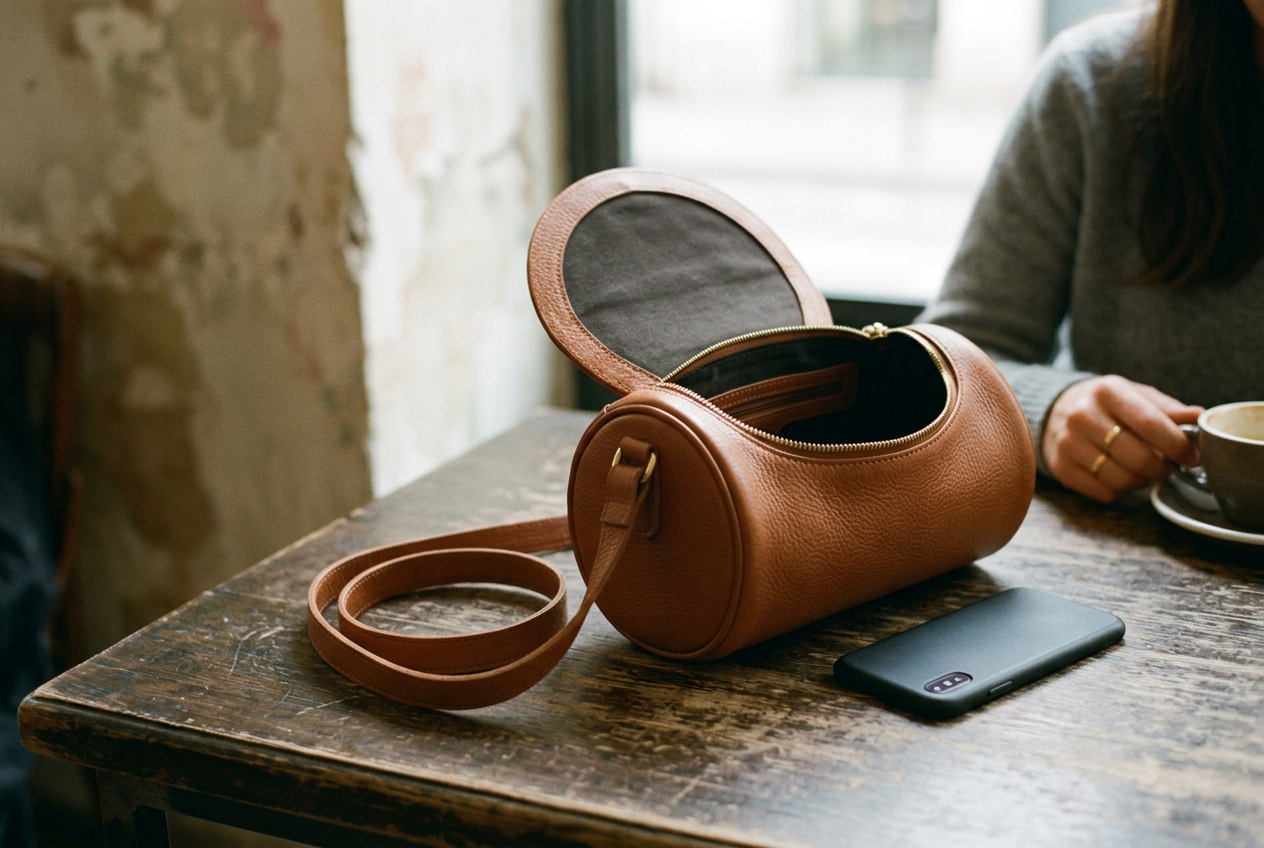
The useful place to start is Coach’s Barrel Bag 20 in leather, a compact design with circular end panels, a zippered top and a detachable shoulder strap. It is recognizably a barrel rather than a rectangular bag with rounded corners, yet the body has enough structure and a narrow resting surface to avoid behaving like loose luggage.
That distinction matters. The Barrel Bag 20 captures the appeal of the revival, particularly when carried under the arm or crossbody: the curved ends interrupt the run of boxy shoulder bags, while the short handles give it some of the composure of a small top-handle style. The same construction creates its main limitation. A bag may be long enough for a phone, cardholder, sunglasses case and keys, but the useful opening is only the section released by the zipper, not the full internal length suggested by the exterior.
This is women’s coverage, although the mechanical test applies to any cylindrical bag. The question is not whether the shape looks current. It does. The question is whether a hand can enter, turn and retrieve something without unloading half the contents.
The cylinder has spread beyond one price tier
The return is visible in several related shapes rather than one standardized design. Coach names the barrel directly. The Row’s 90s Bag uses a slim tubular leather body, while Alaïa’s Le Teckel stretches the idea into an east-west bag, meaning a bag that is wider than it is tall. Contemporary and high-street assortments have also made room for compact bowling bags, whose curved top lines and rounded ends deliver much of the same effect with a broader base.
These are related, not interchangeable. A true cylinder places more of its capacity at the sides and lower curve. A bowling bag usually has a flatter bottom, a wider central opening and enough vertical space to see past a sunglasses case. Le Teckel is elongated and comparatively shallow, which makes objects easier to arrange in a single layer even though the profile remains narrow.
The Row’s 90s Bag is closer to a tube, with a slim opening that suits a deliberately reduced load.
The price ladder also changes the decision. High-street versions tend to sit around the cost of an everyday shoe purchase, contemporary leather bags move into the several-hundred-dollar bracket, and luxury examples cost several times that. Expensive leather can improve the hand feel and finish, but it cannot correct an opening that is too short for the wearer’s hand or daily phone. Geometry survives the upgrade.
Coach’s Barrel Bag 20 sits in the useful middle of this discussion because it neither disguises the cylinder nor pushes it to an extreme. Its rounded end panels remain visible, the zipper follows the upper span, and the detachable strap lets the bag sit against the body rather than requiring constant hand carry. It is also compact enough that poor access would be felt quickly.
The zipper length decides how much capacity is real
Online dimensions describe the outside. They do not show how much of that space can be reached in one movement, and a barrel bag can lose practical capacity when its zipper stops well before the end panels or when stiff leather prevents the opening from spreading.
Use an informal opening ratio: compare the usable zipper opening with the full length of the bag. This is not a manufacturer’s measurement. It is a shopping check. A zipper that travels across most of the top gives the hand room to approach items from above, while a visibly shorter one forces larger objects through at an angle and leaves pockets of space near the rounded ends.
The phone test is the quickest version. A current phone in its case should pass through the opening without scraping both sides, then lie flat without needing to be rotated into place. Product dimensions alone cannot promise that. If the bag is available in a store, put the phone in, close the zipper, open it again and remove the phone with one hand.
Permission should be requested before placing personal items inside a display bag.
Coach’s Barrel Bag 20 appears to give the zipper a substantial share of the top line, which is better than a decorative opening centered on an otherwise long body. Its structured leather still limits how far the sides can fall away. That tradeoff keeps the silhouette crisp, but it means the opening should be judged with the bag zipped nearly closed as well as fully open; daily frustration often arrives when the wearer tries to reach keys through a small gap instead of opening the zipper end to end.
Soft leather changes the equation. It can flex around a hand and make a narrow zipper feel more forgiving, though an unstructured cylinder may collapse around its contents and become harder to search. Coated canvas usually holds the tube cleanly and weighs less, but rigid edge binding can make the opening feel smaller. Nylon is the easiest to compress and pack, at the cost of the precise, polished curve that is driving the trend.
Interior visibility is a construction issue
A barrel bag encourages objects to settle along its lowest point. If the lining is dark and the opening is narrow, a black cardholder can disappear under a sunglasses case even when the bag is not full. The problem is less about overall size than line of sight.
Look at retailer photographs showing the bag open, not only styled on a model. A light or contrasting lining improves visibility. A single slip pocket can keep a cardholder upright against the wall, while a bulky central divider may consume the most accessible section of a small cylinder. Interior organization is useful only when the opening lets the hand reach it.
The Coach bag’s compact scale suggests a restrained packing plan: phone laid lengthwise, slim cardholder, keys in an interior pocket if the version provides one, and one small soft item filling the curve. A hard glasses case may fit yet dominate the opening, turning everything beneath it into a second layer. That is the moment when a slightly less fashionable bowling bag becomes the better purchase, because its taller opening allows the case to sit beside other objects rather than on top of them.
This is also where long east-west bags earn some practicality. Alaïa’s Le Teckel spreads possessions across its length, so fewer items need to stack, although reaching the far ends can still require a hand to travel sideways through the opening. The silhouette looks generous from the front. Its depth remains the constraint.
Rounded bags need somewhere stable to land
A pure cylinder wants to rotate. Handbag makers control that behavior through a flattened base, structured seams, hardware feet or a lower panel that creates a narrow resting strip. A gusset, meaning the side or bottom panel that gives a bag depth, can also turn a visually round bag into something more stable than its profile suggests.
Coach’s Barrel Bag 20 is not a loose tube. The lower construction gives it a resting point, but the circular ends still place weight differently from a broad rectangular base. If a phone slides toward one side, the bag may lean when placed on a café table or car seat. A detachable strap adds another source of pull when it hangs over an edge.
The in-store check takes seconds. Set the empty bag on a flat counter with the strap released, then place a phone inside near one end and set it down again. A small lean is normal. A bag that rolls onto its side, twists the handles or tips whenever the contents shift will demand attention throughout the day.
Inspect the base afterward, because a narrow landing strip also concentrates wear in one area.
A bag does not need to stand upright to be useful. Soft shoulder bags rarely do. The difference is expectation: structured barrel bags look like objects designed to hold their form, so repeated rolling feels like a construction compromise rather than relaxed slouch.
The best version is slightly less cylindrical
For daily use, the strongest barrel bag is often one that cheats. A flattened bottom makes it stable. A zipper extending close to both ends reveals more of the interior, and a pale lining reduces searching without altering the exterior. Modest depth is preferable to an extremely narrow tube unless the intended load is genuinely limited.
The Coach Barrel Bag 20 clears much of that test on paper and in official product imagery, particularly for someone carrying a phone, small wallet and compact personal items. It is less convincing as a one-bag answer for a long day that requires a large glasses case, portable charger, cosmetics pouch and other rigid objects. Its value lies in being a real bag with a trend-forward outline, not in offering the capacity its exterior length seems to promise.
Before paying luxury prices, repeat the opening test with the exact size and material under consideration. Leather stiffness varies, miniature versions can preserve the look while losing hand access, and a long zipper is of little help if tall handles block the wrist. If access remains awkward, choose a bowling bag with rounded shoulders and a flat base. The trend signal stays intact, while the morning search for keys gets shorter.
Questions people ask
Are barrel bags practical for everyday use?
They can be, provided the zipper runs across most of the top and the base has a flattened resting area. Compact barrel bags work best with a reduced load arranged in one layer. They become frustrating when rigid cases stack over smaller objects or the hand cannot reach the rounded ends.
What should fit through a barrel bag’s opening?
At minimum, your phone in its usual case should enter and leave without scraping the zipper teeth or requiring both hands. If sunglasses are part of the daily load, test their case too. Exterior length is less important than the opening created when the zipper is fully released.
Is a bowling bag more useful than a true barrel bag?
Usually, yes. A bowling bag keeps the rounded top and compact proportions but tends to offer a broader base, greater interior visibility and a wider opening. A true barrel has the sharper trend value; the bowling version is the safer choice for someone who carries several rigid items.
How can I stop a barrel bag from rolling over?
Pack heavier items near the center rather than against one circular end, and place the shoulder strap on the same surface instead of letting it pull over an edge. If the empty bag already rolls during an in-store test, packing will not fully correct the underlying base construction.
One update a day
Today's fashion update, in your inbox
One fashion update each morning — no hype, no filler, just pieces worth wearing.