A Belt Size Is the Middle Hole, Not the Strap Length
The number on a belt often measures from the buckle to its middle hole. Here is how to translate that figure when your only references are jeans, a tape measure or a secondhand listing.
September 20, 2026 · 8 min read
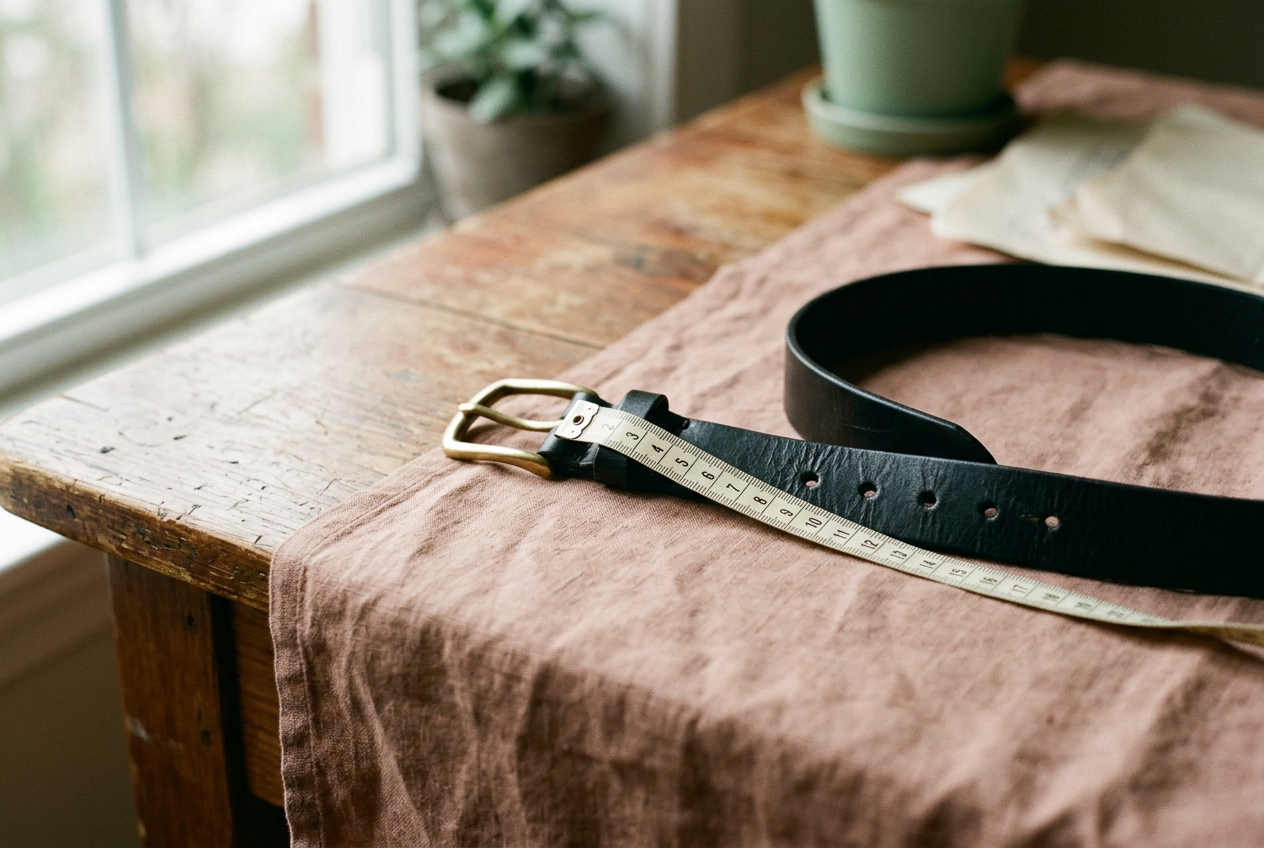
Consider a black bridle-leather belt marked 90, with a prong buckle and five holes, worn through mid-rise jeans. That 90 usually means 90 centimeters from the working point of the buckle to the center hole. It does not mean a 90-centimeter waist, and it does not describe the belt’s full end-to-end length.
This is the line in the size chart that matters: measure from the buckle prong to the middle hole. Once that instruction is clear, most belt-sizing confusion comes from comparing it with a different kind of number.
The following method is unisex. Bodies and clothing cuts vary, but the mechanics remain the same across women’s and men’s wardrobes.
Start at the buckle, not the end
On a conventional prong belt, the prong is the metal pin that passes through a hole. The useful measurement begins where that prong meets or pivots at the buckle and ends at the chosen hole, because those are the two points that close around the body.
Brands may draw the starting point at the prong pivot, the inside edge of the buckle or the place where the prong rests. Follow the brand’s diagram if it provides one. A plaque buckle, meaning a solid front plate that hooks into the strap, can use a different reference point, so the written size alone is not enough.
Our 90-centimeter belt converts to about 35.4 inches from the buckle’s working point to its middle hole. Its total length must be longer because leather continues past the holes to form the tip, while the buckle itself may or may not be included in a retailer’s end-to-end measurement.
The middle hole gives the wearer room in both directions. On a five-hole belt, two holes can tighten the fit and two can loosen it, though the distance between them depends on the maker. Landing near the center also leaves a balanced length of leather beyond the buckle and through the keeper, the small loop that holds the free end against the strap.
Measure the path the belt will take
The most reliable sizing tool is a belt that already fits in the same position. Fasten it at the hole you use, remove it and lay it flat without stretching. Measure from the buckle’s working point to that hole. The result is the middle-hole size to look for, even if the old belt carries a different stamped number.
Match like with like. A slim dress belt worn at the natural waist does not reliably size a broad trouser belt that sits lower, and a soft braided belt can stretch in ways that a dense leather strap cannot.
Without a reference belt, put on the trousers you intend to wear and pass a flexible tape through the belt loops. Overlap it where the buckle would close, keeping the tape snug rather than tight. A nonstretch cord works too: mark the overlap, remove the cord and measure it flat. This captures the actual belt path over the waistband, which is more useful than measuring bare skin.
Do not pull in your stomach or compress the waistband. Sit down once before recording the figure. A measurement that works only while standing at attention will put pressure on the abdomen and may pull the buckle downward after an hour.
Choose the brand size whose middle-hole measurement comes closest to your result. If the tape lands between two offered sizes, decide which adjustment you are more likely to need. A belt for low-rise jeans, heavier trousers or winter layers needs room to move outward. One worn mostly at the natural waist over a thin dress may fit better on the shorter option, provided the remaining holes still cover your measurement.
A trouser size is not a belt measurement
A tagged trouser waist is a shopping category, not a dependable circumference. The waistband may measure differently from the label because of brand grading, intended ease, stretch or the position where the trousers are designed to sit. The same tagged size can also trace a different path on high-rise tailoring than it does on low-slung denim.
This is where the black 90-centimeter belt can fail despite apparently correct arithmetic. Pairing a trouser tag with a similarly numbered belt assumes both numbers describe the same body line. They often do not.
If trousers fit well and a direct body measurement is impractical, button them and measure along the inside of the waistband, following its curve rather than pulling it straight. This gives a useful check, but threading tape through the loops while wearing the trousers remains better because the body rounds the waistband and changes how it sits.
Never double a quick straight-line measurement across a strongly curved waistband and treat the result as exact. That shortcut flattens a shaped piece of clothing, losing some of the length built into its curve.
Rise changes the answer
Rise is the distance from the crotch seam to the top of the waistband. It determines where trousers sit, and that position can alter the needed belt length even when the wearer and clothing size remain unchanged.
A high-rise waistband usually closes nearer the natural waist. Mid-rise jeans sit lower. Low-rise trousers may fasten around a fuller part of the upper hip, increasing the belt path enough to move the buckle by one or more holes.
For our 90-centimeter belt, the center hole might align cleanly with mid-rise jeans while low-rise pants force the prong toward an outer hole. That is not evidence that the belt has been labeled incorrectly. It is being asked to circle a different part of the body.
Measure each intended wearing position if the belt will move between them. A belt bought for jeans may still work over a dress, but a belt styled over a blazer or coat needs its own measurement taken over that garment. The extra fabric matters, particularly where pockets, seams or overlapping fronts build thickness beneath the strap.
Thick leather consumes a little more length
A tape measure lies almost flush against clothing. A thick belt does not. Its working layer sits slightly farther from the body, and stiff leather resists folding closely around the sides and through the buckle.
The neutral line, meaning the layer within the strap that neither stretches nor compresses as it bends, travels around a larger curve than the belt’s inner surface. In an ideal circular model, the extra path is roughly the strap thickness multiplied by pi. A 4-millimeter strap could therefore add about 13 millimeters, or roughly half an inch, before buckle construction and body shape enter the calculation.
That is not a reason to add half an inch to every order. Soft leather can conform closely, while thick bridle leather may retain a broad curve and feel shorter in wear. Buckle geometry also changes the closure point. The useful rule is narrower: when a tape measurement falls between sizes and the belt is unusually thick or rigid, the longer size deserves more consideration.
No correction is needed when copying a well-fitting belt of similar thickness and construction, because its buckle-to-hole measurement already reflects how that kind of strap behaves. This is another reason the existing-belt method beats converting from a waist label.
Width is a separate issue. A wide strap may not pass through every loop, but width alone does not determine the buckle-to-hole size. Check the loop opening before buying a broad belt, especially for tailored trousers with compact loops.
Total length is not safely convertible
Online and secondhand listings often provide only “total length.” That phrase may include the buckle, exclude it or measure to the end of the leather from an unexplained starting point. The amount of strap beyond the last hole also varies by design, so subtracting a standard allowance is guesswork.
Ask for the distance from the buckle prong to the middle hole. If the belt has an even number of holes or added holes, request measurements from the prong to the hole that shows the most wear and to the nearest original holes on either side. A clear photograph of the tape beside the strap helps confirm where the seller started.
Also ask whether the belt was measured flat and whether the buckle is original. Replacing a buckle can shift the working point, while a leather strap that has taken a curved set may appear shorter when forced flat. An elongated, softened hole can change where the prong settles under tension.
Buying solely from total length is only sensible when returns are easy or the price leaves room for alteration. Punching another hole can rescue a near fit, but it may produce an awkwardly long or short tip, and a hole placed too close to an existing one weakens that section. A leather repair shop can match the original hole shape more neatly than a household awl.
For the black 90-centimeter belt, the purchase decision should still return to one number: buckle working point to intended fastening hole. The stamp, trouser tag and total length are supporting information.
Questions people ask
Should my belt fit on the middle hole?
Ideally, yes. The middle hole gives room for changes in rise, clothing thickness and ordinary fluctuations in fit, while keeping the tip proportioned through the keeper. A neighboring hole is not a failure, but buying a new belt that closes only on its tightest or loosest hole leaves little useful adjustment.
How much bigger should a belt be than my pants size?
There is no dependable fixed amount because a pants size may not equal the waistband circumference, and different rises place the belt around different parts of the body. Measure through the loops while wearing the pants, then match that result to the brand’s buckle-to-middle-hole measurement.
Can I calculate belt size from total length?
Only if the listing explains exactly what total length includes and provides the buckle length plus the distance from the final hole to the tip. Without those details, designs leave different amounts of leather at each end. Ask for a direct prong-to-middle-hole measurement rather than relying on subtraction.
Do
I need a larger size for a thick leather belt?
Possibly, if your tape measurement falls between sizes. Thick, rigid leather sits farther from the body and resists tight curves, so it can feel shorter than a thin, supple strap with the same nominal measurement. Copying the buckle-to-hole length of a similarly constructed belt avoids that uncertainty.
One update a day
Today's fashion update, in your inbox
One fashion update each morning — no hype, no filler, just pieces worth wearing.