Your Nickel-Free Necklace May Still Have Nickel in the Clasp
A chain’s metal label may say nothing about its clasp, connecting rings, internal spring, or solder. Check the necklace component by component before calling it nickel-free.
September 12, 2026 · 8 min read
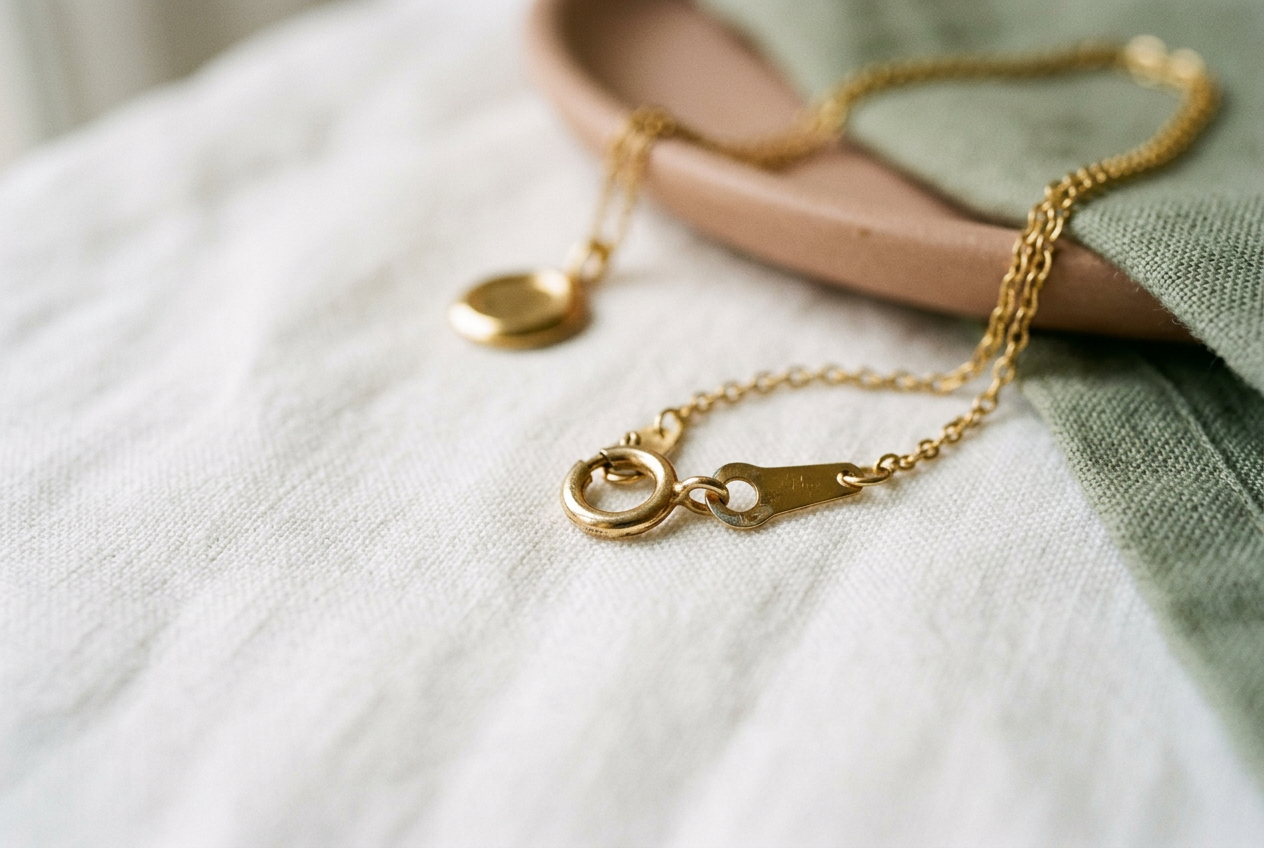
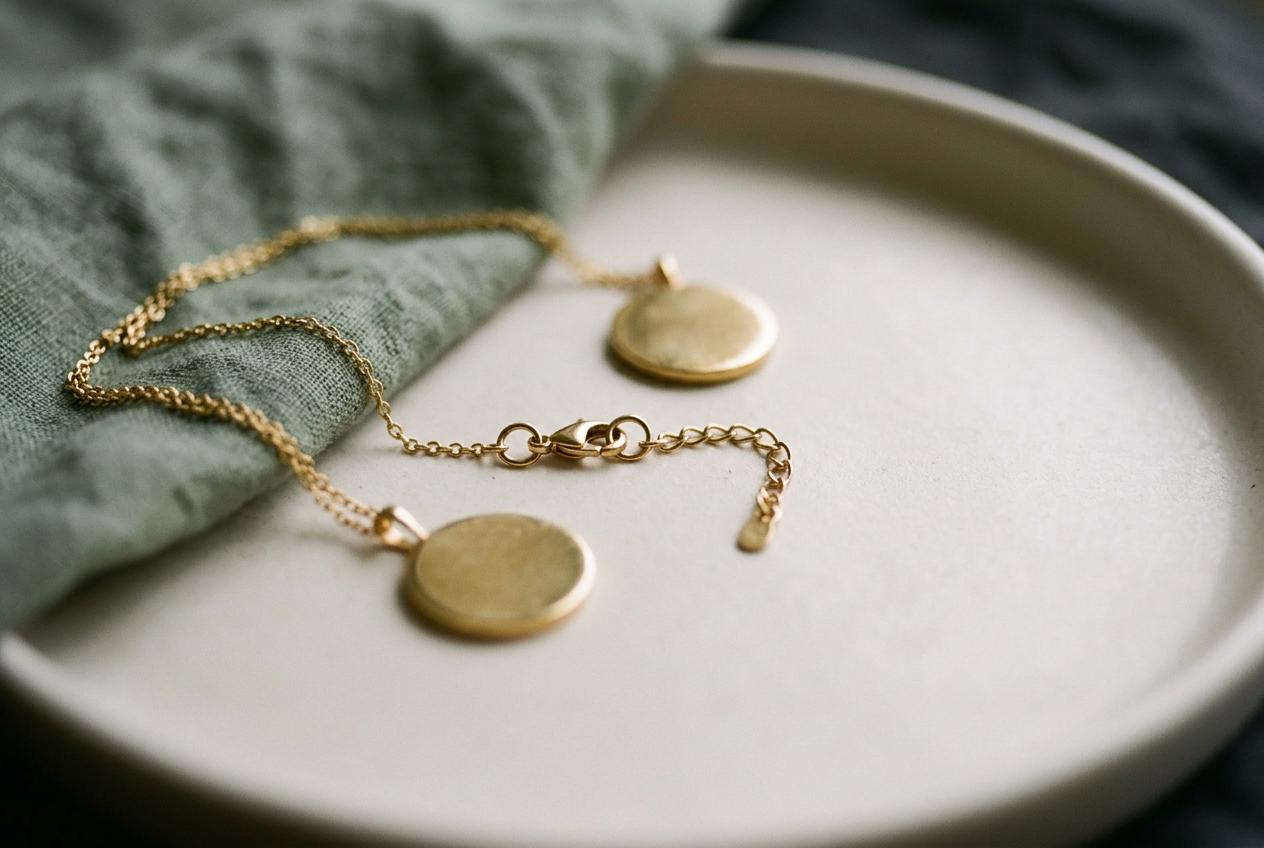
Start with a 16-inch gold-vermeil pendant necklace laid flat on a white cloth. The chain has a sterling-silver core under gold. At one end sits a spring ring, meaning a round clasp opened by pulling a small lever; at the other, a jump ring, the loop that receives the clasp. A tiny soldered joint closes part of the assembly.
The product page may describe the necklace broadly as gold vermeil, which means a legally specified thickness of gold over sterling silver in the United States. That sounds precise. It still may not describe the spring inside the clasp, the jump ring, the solder joining an end tab, or a base-metal finding added during assembly.
This is the necklace to keep returning to. It rests against the collarbone, but the clasp migrates toward the nape during wear, where sweat and friction can keep the smallest components in direct contact with skin. If irritation appears after a week of daily wear, the chain may be innocent.
This is unisex coverage. The mechanics do not change with the department where a necklace is sold, though chain length, pendant weight, neck size, and how closely the clasp sits against skin will change the amount of contact.
A broad metal label has limits
A 925 stamp means the sterling-silver item is at least 92.5 percent silver. It does not identify every element in the remaining alloy, certify the entire finished necklace as nickel-free, or report how much nickel could migrate from the surface during wear. Sterling silver is commonly alloyed with copper, but the stamp alone does not prove that copper is the only addition.
Solid gold needs the same scrutiny. Yellow and rose gold are usually alloyed with metals such as copper and silver, while some white gold alloys use nickel to create a paler color. Palladium-alloyed white gold is an alternative, though it tends to cost more. Solder can have a different formula from the gold parts it joins, so a solid-gold description is useful but incomplete unless the brand extends its nickel statement to the solder and findings.
The word hypoallergenic is broader still. It is not a metal recipe, and it does not tell a shopper whether a company means no intentionally added nickel, a finished piece that passed a release test, or only a low likelihood of reaction. A precise claim names the alloy, covers all components, and explains the testing standard when testing supports the statement.
The distinction matters in the United States, where there is no national consumer-jewelry nickel-release restriction equivalent to the European Union’s REACH limit for items intended for direct and prolonged skin contact. A necklace compliant with European nickel-release rules is not necessarily made with zero nickel; it is designed to remain below the applicable release limit when tested.
Follow the necklace from chain to closure
Begin with the chain. Find the base metal rather than stopping at the color. Gold plated is incomplete without the substrate, since plating can cover brass, steel, silver, or another alloy. Gold vermeil identifies sterling silver beneath the gold, while gold-filled describes a mechanically bonded gold layer over a base metal and follows a different construction standard.
Neither phrase, by itself, accounts for separately attached findings.
On the 16-inch test necklace, the vermeil chain is the best-documented section. Its surface can still wear at high-friction points, particularly where links rub the pendant bail, but its composition is easier to evaluate than the moving clasp. Ask whether the material statement applies to the chain alone or to the finished necklace.
Inspect the clasp body and what sits inside it. A spring ring needs an elastic internal part to snap shut, and that spring may be stainless steel even when the visible shell is sterling silver or gold. Stainless steel commonly contains nickel, although nickel release varies with grade, finish, corrosion, and exposure. A lobster clasp, the teardrop-shaped closure operated by a lever, usually has the same hidden-spring issue.
The spring is enclosed when the clasp is new. That reduces direct contact, but it does not turn a mixed-metal assembly into a single-alloy component, and gaps around the lever can admit moisture, perfume residue, or cleaning solution. For a reader with a strong nickel sensitivity, a brand should address the internal mechanism rather than describing only the clasp shell.
Trace every connecting ring. The jump ring beside the clasp often receives more rubbing than a central chain link because the clasp rotates across it throughout the day. It may be soldered closed, welded, or left with a narrow opening. A plated base-metal ring can look identical to the surrounding vermeil until its coating thins at that seam.
Check the ring attaching the pendant as well. A bail, meaning the fitting that suspends a pendant from its chain, may come from a different supplier than the chain. The necklace can therefore combine a well-specified chain with a pendant fitting documented only as gold tone or metal alloy.
Look for soldered joins. Solder is the lower-melting alloy used to connect metal parts without melting the main component. Silver solders often combine silver with copper and zinc, while gold solders are formulated to match different colors and karats; exact recipes vary, and older or specialized solders can introduce additional metals. A retailer that promises nickel-free construction should be able to confirm that its solder falls under that promise.
On the test necklace, the smallest soldered point may sit where the chain meets its end tab. It can be hard to see without magnification. It is still part of the skin-contact surface once the clasp turns toward the neck.
Read documentation before relying on price
A useful product page separates the chain, pendant, clasp, and coating, then states whether the nickel-free claim covers the complete piece. Public material guides from brands can add information, but a collection-wide statement is only helpful when the necklace is clearly included and replacement chains or third-party pendants have not changed its construction.
Customer service should be able to answer in writing whether the clasp contains a stainless-steel spring, whether the jump rings share the chain’s alloy, and whether solder is included in the nickel-free specification. That answer is more valuable than a generic assurance that the necklace is suitable for sensitive skin.
Do not use price as a proxy. A costly pendant can arrive on a standard findings chain, while a modest sterling necklace may have unusually thorough component documentation. If sensitivity is the priority, spend first on a clearly specified closure and skin-contact assembly rather than a heavier pendant or thicker decorative plating.
A 925 mark is not a shortcut. Neither is a magnet: some stainless steels are magnetic, some are not, and a nonmagnetic result does not establish that an item is nickel-free. At-home dimethylglyoxime tests, which use a chemical indicator to detect nickel released at the surface, can flag some exposed nickel but may miss metal sealed beneath intact plating. They also cannot predict how a finish will behave after months of rubbing.
The clasp can be changed, with tradeoffs
A jeweler can replace the spring ring and adjacent jump ring without replacing the whole necklace. Request a documented nickel-free finding and ask what solder or joining method the repair requires. For solid yellow gold, that may mean paying for both a small gold component and bench labor; it is still usually a narrower intervention than replacing a well-made chain.
A hook clasp or toggle clasp can remove the concealed steel spring from the design. The fit changes. Hooks need enough tension and overlap to stay closed, while toggles depend on the bar remaining across its ring and can be less secure on a very light chain. Threaded barrel clasps avoid a spring but take longer to fasten, particularly with limited hand dexterity.
Titanium is appealing when the grade is documented, yet ready-made fine-necklace clasps in titanium are less common and may not match a delicate gold chain. A custom solution adds labor and can look more utilitarian. Magnetic converters deserve caution because their housings, coatings, and magnets introduce another set of materials that must be identified.
For the 16-inch vermeil necklace, the most practical repair is often a documented clasp assembly that includes the receiving ring, not a new clasp clipped onto the existing unknown jump ring. Replace the contact system. Keep the chain.
If redness, itching, or blistering persists after the necklace is removed, stop wearing it and seek medical guidance rather than repeatedly coating the hardware and testing it against skin. Allergic contact dermatitis can outlast the exposure that triggered it.
Questions people ask
Can 925 sterling silver contain nickel?
Sterling silver must contain at least 92.5 percent silver, but the stamp does not identify every metal in the remaining portion or cover separately attached findings. Copper is a common alloying metal. Ask whether the finished necklace, including its clasp spring, rings, and solder, is documented as nickel-free.
Does nickel-free mean there is absolutely no nickel?
Not always. A brand may mean no intentionally added nickel, while a regulatory claim may refer to nickel release staying below a test limit. Look for language covering the finished piece and its components, then check whether the company names an alloy specification or testing method.
Can a jeweler replace only the irritating clasp?
Usually, provided the chain is sound and the replacement finding suits its link size and strength. Ask the jeweler to replace the adjacent jump ring too, confirm the new clasp’s internal mechanism, and identify any solder used. A springless closure may reduce unknown materials but can alter security and ease of fastening.
Will clear nail polish make a necklace clasp safe?
A clear coating can create a temporary barrier, but friction at the lever, ring, and neck wears it unevenly. It also makes later inspection harder and may introduce its own irritants. For an everyday necklace, replacing the uncertain findings is a more durable choice than recoating them whenever the finish chips.
One update a day
Today's fashion update, in your inbox
One fashion update each morning — no hype, no filler, just pieces worth wearing.