Woven Bags Moved Downmarket. The Construction Still Matters.
Leather weaving has become a broad retail texture rather than one luxury signature. The cheaper versions can work, but embossing, synthetic strips and real interlacing fail in different ways.
September 16, 2026 · 8 min read
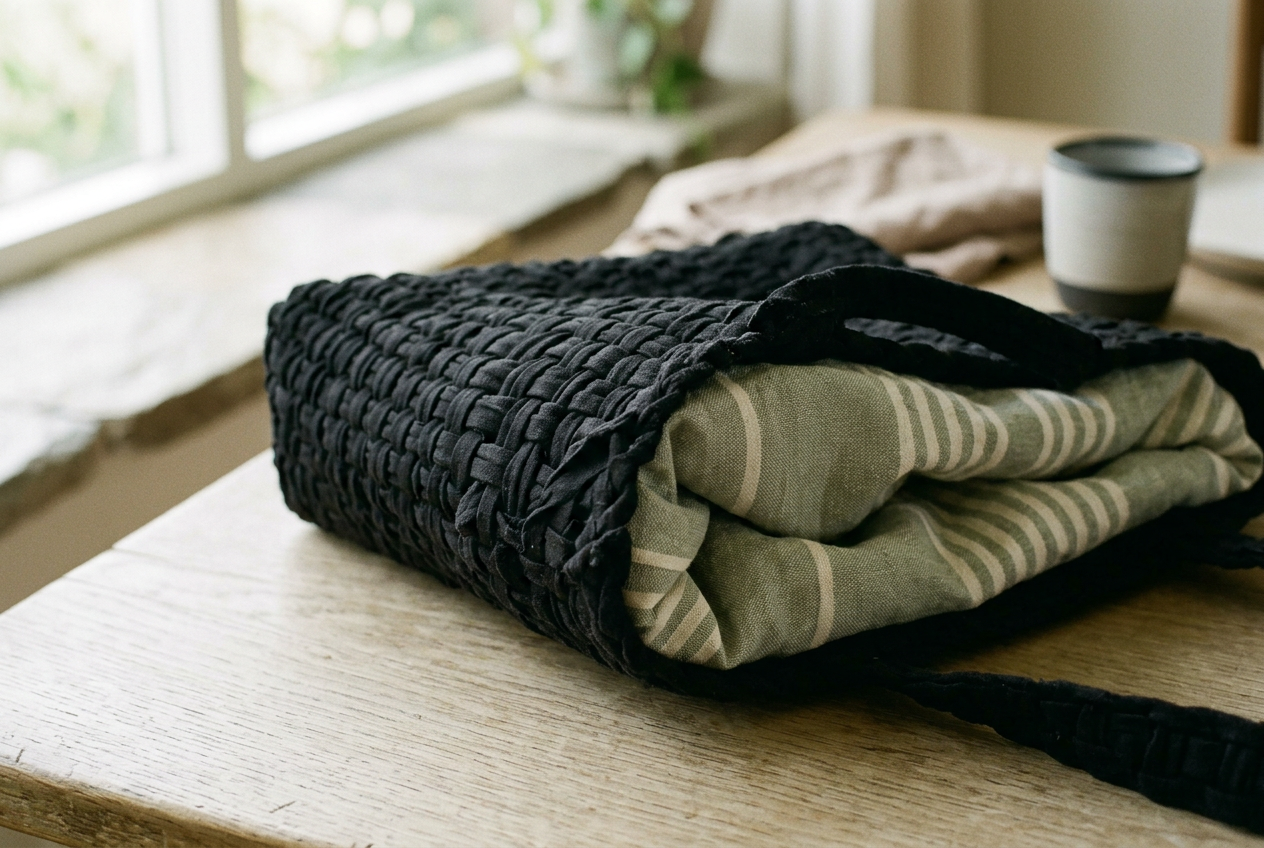
The useful place to judge a woven bag is its lower front corner. On a black, checker-pattern tote, that corner takes the weight of a water bottle or laptop, rubs against clothing and reveals whether the texture comes from separate strips or a flat sheet pressed to resemble them. It tells you more than the front panel ever will.
That corner is also where the current expansion of the woven-bag trend becomes legible. Bottega Veneta’s intrecciato, meaning leather strips interlaced to form a surface, remains the obvious luxury reference point, but the pattern now travels through contemporary labels, mall retailers and inexpensive marketplace listings in constructions that may look closely related on a phone screen. They are not closely related in use.
This is unisex advice. Scale and strap length vary across women’s and men’s departments, but the material test remains the same for a compact crossbody, a work tote or a soft clutch.
A real weave moves before it fails
True interlaced leather has openings between individual strips, even when the weaving is tight or attached to a supporting layer. Look along the top edge or inside a pocket opening: one strip should pass over another, then disappear beneath the next. A printed shadow or pressed groove cannot reproduce that change in level.
The chief advantage is movement. Narrow strips can shift slightly against one another when a bag bends, which helps a soft pouch collapse without forcing one large leather panel into a hard crease. On the lower corner of our black tote, the weave should spread by a small amount under pressure and settle when released. A dense weave backed with fabric will move less, while an unlined or lightly backed construction may relax more visibly.
That flexibility does not mean automatic durability. Thin lambskin can abrade where the strips cross, and a cut edge with weak finishing may become fuzzy before the rest of the bag looks worn. Wide strips create fewer intersections and a calmer surface, but each exposed span offers more room for a key ring, bracelet or rough table edge to catch it. Very narrow strips distribute the visual interruption, although repairing one deep inside a dense panel takes more labor.
Run a fingertip diagonally across the surface, then lightly brush a folded cotton handkerchief over the corner. The point is not to attack the bag in a store. You are checking whether a strip already sits higher than its neighbors, whether dry edge paint feels sharp and whether ordinary fabric catches without pressure. Pay particular attention where the weave enters a side seam, because trimmed strips sometimes end there with little material left for a repairer to secure.
Real weaving has the best repair potential of the three constructions, not necessarily an easy repair. A leather specialist may be able to rethread or anchor a lifted strip when enough intact material remains, and a damaged handle can sometimes be treated separately from the body. Replacing a strip across an entire panel is a different proposition: color matching, thickness and the over-under sequence all matter, so labor can erase the financial logic of repairing an inexpensive bag.
The investment case is strongest when the leather feels substantial without being board-stiff, the strip edges are clean, and stress points such as handle tabs attach to an internal structure rather than to a few exposed crossings. The luxury premium may also pay for leather selection, pattern cutting and handwork, but a familiar woven appearance by itself proves none of those things.
Embossing gives texture without loose parts
An embossed woven surface starts as a continuous sheet, usually leather, coated leather or a synthetic material, which is pressed with grooves that imitate crossing strips. Turn back to the lower corner. If every apparent strand merges into one uninterrupted piece at the seam, and the valleys do not open when the surface bends, the weave is visual.
That sounds like the inferior answer, yet embossing solves a real problem. There are no separate strips to lift, and a smooth pressed panel slides past knitwear more cleanly than a dimensional basket weave. For a commuter who carries a bag beside a loose cardigan, or anyone tired of checking whether a ring has entered an open crossing, an honest embossed finish can be more useful than poorly executed interlacing.
Structure depends on the base material. Full-grain leather, meaning the hide’s outer surface remains intact, can retain its own grain under a shallow pattern and may soften with wear. Heavily coated leather feels more uniform and resists minor marks, though deep creases can expose a pale line in the finish. A synthetic embossed sheet may hold a crisp shape at first because its textile backing or foam layer supplies stiffness; once the surface film separates, however, the basket pattern can peel in connected flakes rather than wear one strand at a time.
Press the corner inward with two fingers. A good embossed panel should curve without turning white at the fold, crackling or keeping a sharp dent. Inspect the high points of the pattern, where color loss will appear first, and look closely at piping and seam allowances. Embossing is low-snag, but it cannot conceal weak assembly.
Repairability is limited in a different way. A leather specialist can recolor scuffed leather or reinforce a split from behind, yet cannot lift and replace an individual strand because no strand exists. Synthetic delamination, the separation of a surface coating from its backing, is harder to reverse neatly over a large area. Adhesive may stop a small lifted edge; it rarely restores the molded pattern invisibly.
This is the construction I would consider in the middle or lower price bands when the bag needs to tolerate public transit, winter sleeves and regular placement under a desk. It should cost less than comparable true woven leather. If a retailer charges mainly for the resemblance while obscuring the material description, the texture is not earning its price.
Synthetic strips need scrutiny at the edges
The third category is a genuine weave made from synthetic strips. Polyurethane-coated strips and other plastic-based materials can create real depth, so they are not embossed imitations, but their aging pattern differs from leather. Some are woven over fabric; others form most of the body and gain shape from a lining, baseboard or bonded backing.
At first handling, synthetic strips may look exceptionally even. Their thickness, color and cut width can remain consistent across the panel, and a wipeable finish suits a pale summer bag better than delicate leather. The question sits underneath. Flex the lower corner and watch whether the strips move independently or pull against a glued backing as one rigid plate.
If adhesive is already visible through the gaps, heat and repeated bending have an obvious place to work.
Snagging can be pronounced when the strip edges are stiff. Leather edges tend to compress and soften, while a cut synthetic edge may stay thin and sharp; once nicked, its coating can lift from the woven textile core. A scarf, an open-knit sweater and raised jewelry are useful reference points when you test by touch. Smooth outer strips do not guarantee a smooth top rim, where many bags expose their cut ends.
Repair prospects range from modest to poor. A loose strip can sometimes be tucked back and secured, but a split coating cannot be conditioned back into place, and heat damage may affect several neighboring crossings. An independent repair shop may also decline work when an adhesive test could discolor the material or when stitching would perforate a coating that is already unstable.
Price changes the verdict. At roughly the cost of a casual seasonal accessory, a well-lined synthetic weave can deliver the dimensional look without pretending to be permanent. At a price approaching quality leather, vague labels such as “vegan leather” are not enough. Look for a specific material disclosure, inspect the corner and decide whether you are paying for design or merely for the shadow pattern.
The store test takes three minutes
Start at the lower front corner and identify the construction before considering color. Look for a real over-under sequence, then check whether the same structure continues around the side or stops at a seam. Some bags combine a woven front with plain side panels, which can be sensible because it reduces bulk, but the product description should not lead you to expect a fully woven body.
Next, open the bag and find its backing. A lining that floats separately allows the outer weave some movement; a backing bonded directly to every strip adds stability but may make local repair harder. Neither arrangement is automatically better. A work tote needs its handles and base to transfer weight into reinforced sections, while a soft evening bag can depend more heavily on the woven shell.
Brush fabric across the top edge and corner, bend the panel once, and release it. Leave any bag that shows whitening, audible crackling, exposed adhesive or a raised strip before purchase. Those are existing faults, not character waiting to develop.
Finally, read the material line literally. “Leather bag” can describe a product with leather trim and a synthetic body, depending on how the listing is written; “woven effect” usually signals appearance rather than interlacing. Product photos of the interior, side seam and top rim carry more evidence than a straight-on image.
The trend is broad enough now that no one has to buy the luxury reference to get woven texture. Still, the lower corner keeps the decision honest: movement favors real strips, uninterrupted grooves favor embossing, and a rigid grid attached to visible backing asks the most of your trust.
Questions people ask
How can
I tell whether a woven leather bag is really woven?
Follow one apparent strip across the surface. In a true weave it alternates over and under neighboring strips, with visible changes in height; an embossed panel remains one sheet, and its grooves stay closed when you gently bend a corner.
Do woven leather bags snag clothing?
They can, especially when a strip sits proud, its edge finish has dried or wide gaps expose corners. Lightly brushing cotton across the top rim and lower corner before buying gives a better indication than rubbing the flat center panel.
Is embossed leather a bad substitute for woven leather?
No. It has less depth and cannot be repaired strand by strand, but its continuous surface usually catches less on knitwear and can suit daily commuting. It becomes poor value when its price relies on the woven look rather than sound leather and assembly.
Can a damaged synthetic woven bag be repaired?
A repairer may secure one loose strip or reinforce a small split from behind. Peeling coatings and widespread separation from a bonded backing are difficult to restore neatly, so check whether the likely repair cost makes sense beside the bag’s original price.
One update a day
Today's fashion update, in your inbox
One fashion update each morning — no hype, no filler, just pieces worth wearing.