Slouchy Bags Are Replacing Rigid Minis. Check the Base First.
Soft bags have gained capacity, but usefulness depends on what keeps that capacity under control. A nylon crescent shows where slouch works and where it becomes clutter.
September 12, 2026 · 8 min read
The rigid mini bag has not disappeared, but its limitations are harder to overlook now. A precise little rectangle looks polished until a sunglasses case will not fit, the top handle occupies one hand, or the open flap catches against a phone packed to the edge. The softer alternative gives rather than refuses.
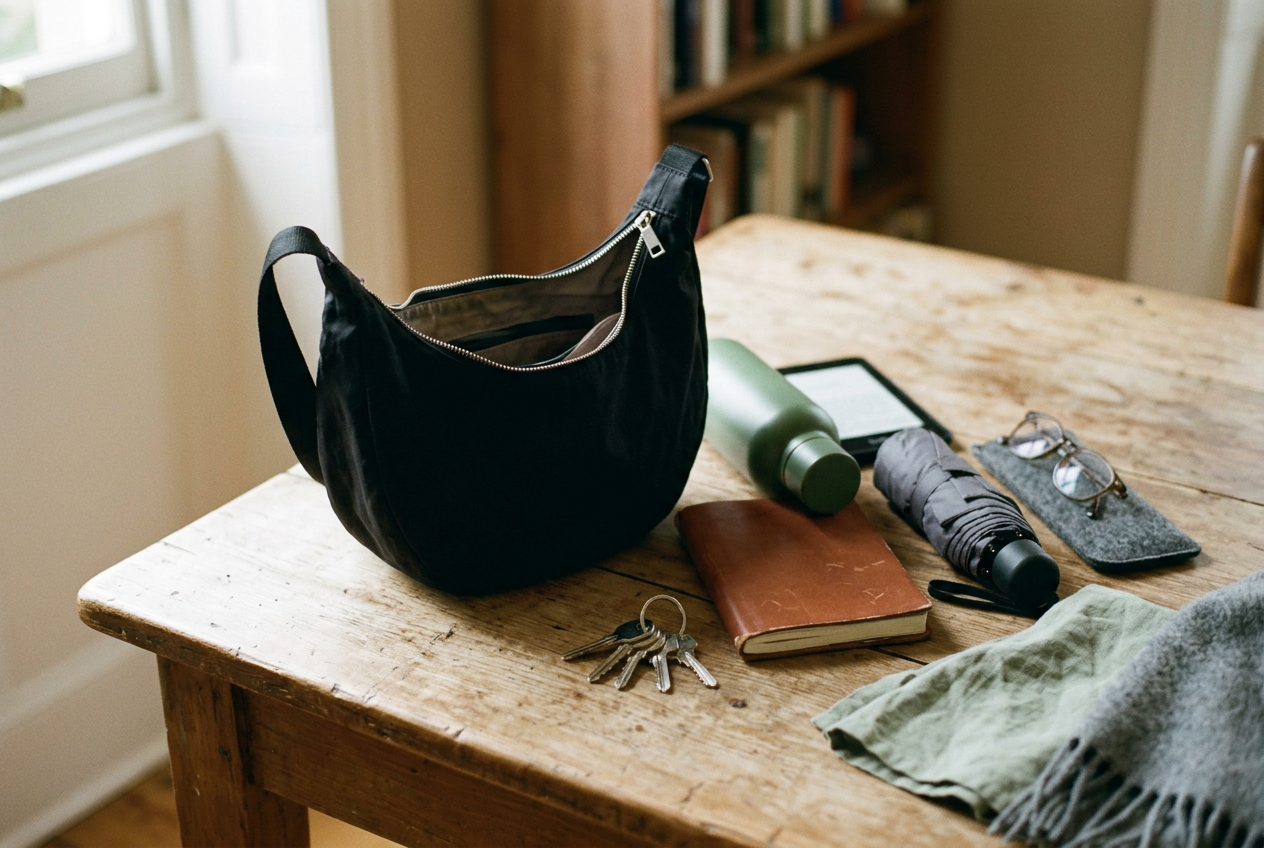
The useful reference point for this shift is the BAGGU Medium Nylon Crescent, a curved zip-top bag made from recycled heavyweight nylon. It sits at the accessible end of the market and has none of the visual ceremony of a framed leather mini, yet its shape explains why pliable bags are rising: the shell bends around the contents, the strap adjusts across a broad range, and the bag can rest close to the torso instead of projecting from it.
This is unisex coverage. The construction advice applies across women’s and men’s wardrobes, while the adjustable crossbody format also avoids much of the body-specific fit trouble found in short, fixed shoulder straps.
Capacity is only useful when it stays manageable
For the everyday-capacity test, I loaded the BAGGU crescent with a phone, compact wallet, hard sunglasses case, keys, small water bottle, charger, paperback, and a soft pouch. Everything fit without asking for a packing sequence. That freedom is the clearest improvement over the rigid mini, which may advertise depth while losing usable space to stiff corners, a narrow mouth, or hardware mounted inside the opening.
The crescent did sag. The bottle and keys migrated toward the lowest part of the curve, pulling the bag into a deeper arc, while the paperback created a temporary flat plane against one side. Nothing spilled because the zipper closed across the full opening, but finding the keys meant moving the pouch and feeling along the bottom rather than reaching toward a fixed corner.
That is the distinction worth making. A soft bag can carry more while becoming less legible inside. The failure is often organization, not capacity.
With the same load, a rigid mini usually preserves its outline and keeps objects in roughly the position where they were placed, although getting them through the opening can become a separate negotiation. A slouchy bag accepts the load, then rearranges itself around whatever is heaviest. Readers who switch between glasses, medication, earbuds, chargers, and work access cards may gain room while losing time.
The practical correction is modest. Put dense loose items in one zipped pouch, keep the phone in an interior slip pocket when one is provided, and place a bottle upright beside a flat object rather than dropping both into an empty shell. An organizer insert can help, but a thick felt version defeats the point by adding bulk and turning a pliable bag into a padded box.
Look at the floor before the silhouette
Base reinforcement matters more than a bag’s product photograph suggests. A reinforced base is an extra layer or firmer panel at the bottom, added to stop weight from pulling the shell into a single low point. It need not feel rigid. Even thin bonded material can spread the load enough to keep a water bottle from making the bag hang like a pendulum.
The BAGGU crescent does not rely on a hard floor, so its curve becomes more pronounced as dense objects settle. That is acceptable in a nylon crossbody whose intended shape is already relaxed. The same behavior is less convincing in a large leather tote with carefully finished handles, particularly when the middle drops below the corners and makes the entire bag look overloaded at ordinary capacity.
Check the base with the bag empty. Press upward from underneath, then release it. A useful soft base should recover some shape or show a distinct panel between the outer material and lining. If the floor feels identical to the side walls, expect the contents to determine the silhouette.
That may be the look you want, but it should be a choice rather than a surprise.
Also inspect the gusset, meaning the side or bottom panel that creates depth. A wide gusset adds theoretical capacity, although an unsupported one can fold inward and consume its own space. Piping around the base, where a narrow cord or folded seam defines the edge, can offer enough resistance to keep a bag upright without making it look formal.
A bag does not need to stand independently to work. It should, however, remain easy to set down without the contents forcing the opening toward the table or floor.
Suede, leather, and nylon slouch differently
Suede gives this trend its richest surface. The nap, which is the raised texture on the material, absorbs light and makes folds look deliberate rather than crushed. It also picks up friction marks, holds dust, and reacts poorly to an unnoticed leak. On pale suede, a dark denim waistband can transfer color where the bag rubs at the hip.
A suede slouchy bag is best for someone willing to brush the surface, store it filled with tissue or a soft insert, and avoid carrying an unsealed bottle. Look for a base with feet or a darker reinforced panel, because the soft finish should not sit directly on every café floor and transit platform. Protective spray can reduce risk, but it will not make suede indifferent to weather.
Leather varies more than the category name implies. Temper describes how firm or supple a hide feels. Soft-tempered leather develops folds quickly and conforms to the body, while firmer leather can preserve a rounded base even when the upper section slouches. A full leather lining may improve structure but adds weight before anything goes inside; a tightly woven textile lining is often the more practical compromise.
Nylon is the least precious and, in a bag like the BAGGU crescent, the easiest to live with. The brand identifies the material as machine washable, which changes the cost of carrying it through summer heat, public transit, and travel. Nylon can still look untidy when overfilled, and its smooth interior gives heavy objects little resistance, so the lowest point becomes crowded first.
Material thickness alone does not settle quality. Thin nylon with bound seams, meaning the raw seam edges are enclosed with tape, may outlast thicker fabric whose lining pulls away at the zipper. Soft leather can age well if the stress points are reinforced, while expensive suede can become frustrating when an unprotected base takes the first mark.
The lining and closure decide whether slouch becomes spill
A dark lining hides stains. It also hides black earbuds, a key fob, and the cap of a lip product at the bottom of a deep bag. Light gray, tan, or patterned lining gives better contrast without looking dirty after one makeup leak. Pull the lining outward if possible and check whether it is anchored at the base; a completely loose lining can rise with your hand and wrap around small objects.
Pocket placement matters more than pocket count. One secure pocket near the upper edge is more useful than several shallow compartments collapsing into the center, especially in suede or soft leather bags whose walls fold when the bag is set down. The BAGGU crescent’s broad zip opening remains accessible while worn across the body, which helps offset the migration happening below it.
A full zipper is the safest closure for commuting and travel, though it can interrupt the uninterrupted folded shape that makes soft bags appealing. Magnetic snaps preserve the slouch and open with one hand, but a single central snap leaves gaps at both sides. Drawstrings contain the opening without flattening it, then demand two hands when tightened firmly.
Test a closure with the bag filled, not while it is displayed empty. Soft sides can bow outward and pull a zipper into a curve, while a magnet that meets easily on the shelf may separate once a sunglasses case presses against the opening. If the closure works only when the bag is half empty, the advertised capacity is beside the point.
Spend according to the likely failure
At the mass-market end, roughly below the price of a decent pair of sneakers, nylon offers the clearest value. It tolerates folding, weighs little, and does not ask the owner to protect a delicate surface. Check zipper stitching and strap anchors, since these will usually fail before the fabric loses its appeal.
Soft leather moves into the price territory of a good coat and climbs quickly with size, hardware, and brand. Paying more makes sense when the base is reinforced, the lining can withstand abrasion, and the strap attachment spreads pressure over a broad patch. A costly bag with raw interior suede and one small magnetic snap may be beautiful, but the premium has not bought much everyday control.
Suede is the least settled investment. Its current softness looks persuasive with loose tailoring, denim, and summer dresses, yet the care burden rises with scale because a larger bag contacts more clothing and more surfaces. I would spend cautiously unless the color, reinforced floor, and closure suit the way the bag will be carried.
The BAGGU crescent remains a useful benchmark because its relaxed shape does not pretend to behave like a briefcase. It sags under concentrated weight, but its zipper contains the load, the adjustable strap keeps the bag close, and washable nylon makes ordinary wear less consequential. More expensive slouchy bags should improve on at least one of those mechanics rather than offering softness alone.
Questions people ask
How do
I stop a slouchy bag from sagging too much?
Choose a bag with a distinct base panel or piping around the bottom, then place dense objects in a compact pouch instead of letting them collect at one point. A thin organizer can distribute weight, but thick felt inserts add bulk and may erase the relaxed shape you bought.
Is suede practical for an everyday slouchy bag?
Suede can work if the base is protected, the color will tolerate rubbing, and you are prepared to brush and store it with support. It is a poor match for leaking bottles, wet commutes, or dark denim that may transfer dye onto a pale surface.
Are slouchy bags secure enough for commuting?
A full zipper is the most reliable option because it closes the gaps created when soft sides fold or bow outward. Magnetic snaps are quicker but often leave open corners, while drawstrings depend on being tightened fully. Test the closure with your normal load inside.
Should I replace my rigid mini bag?
Replace it only if its opening or fixed capacity regularly prevents you from carrying what you need. Keep it if you value quick visual organization and rarely carry more than a phone, wallet, keys, and glasses. For greater capacity, check the slouchy alternative’s base and closure before retiring the mini.
One update a day
Today's fashion update, in your inbox
One fashion update each morning — no hype, no filler, just pieces worth wearing.