Washable Silk Still Might Mean Hand Wash Only
A washable silk shirt can still demand a sink, special detergent, and a day of drying space. The sewn-in label tells you whether the upkeep suits your budget and routine.
September 3, 2026 · 8 min read
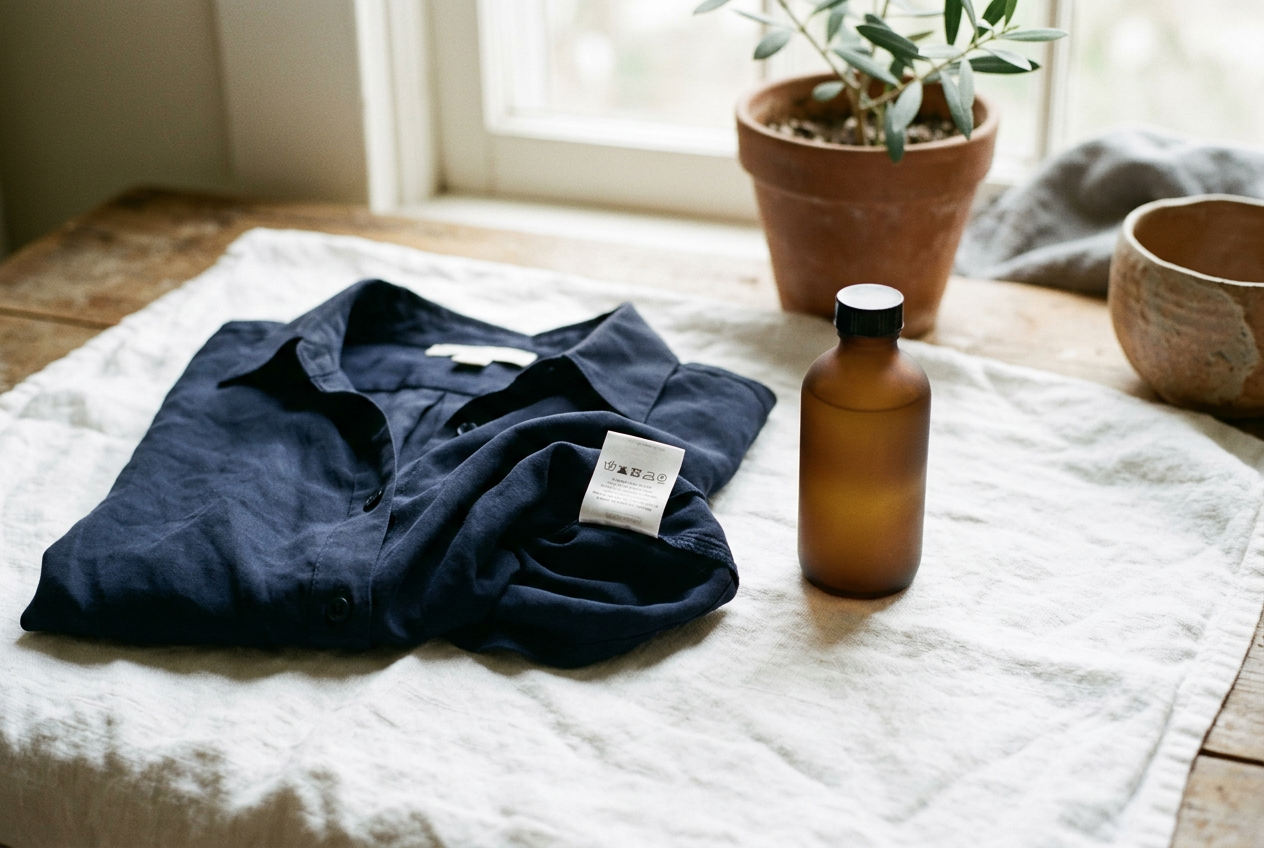
Take a navy 100 percent silk button-front shirt with washable printed on its hangtag. Turn the side seam inside out and the useful information appears: hand wash cold, wash separately, use mild detergent, do not wring, lay flat to dry, cool iron. The shirt can go in water, but it is not ordinary laundry.
That distinction matters at the register. Washable often sounds like permission to add a garment to the weekly machine load, yet brands use the word for silk that requires anything from hand washing to a cold delicate cycle. Sometimes the practical message is merely that routine dry cleaning is unnecessary. None of those claims tells you how much handling the particular shirt will tolerate.
The sewn-in care label does. Under the US Federal Trade Commission care-label framework, clothing manufacturers and importers must provide at least one safe method for regular care and have a reasonable basis for that instruction. The label does not promise that every other method will fail, but it gives the method the maker supports. A broad claim on a product page should never overrule a narrower instruction sewn into the garment.
This is unisex care advice. Silk shirts, dresses, skirts, pajamas, and linings may be cut for different wardrobes, but the fiber faces the same basic risks from detergent chemistry, temperature, and friction.
Washable describes a category, not a routine
Silk is a protein fiber, meaning its long structural molecules resemble those found in hair rather than the cellulose structure of cotton. It can be strong for its weight, but wet cleaning may alter its surface, color, dimensions, or drape when the finish and construction are not designed for it.
A hand-wash label on the navy shirt means full immersion is allowed under controlled conditions. It does not mean scrubbing the collar, leaving the shirt to soak through lunch, or twisting it into a rope. The realistic cost is a sink session, clean towels or a drying rack, and enough space to let the shirt dry away from direct heat.
A machine-wash label gives more freedom, although the qualifying words matter. Cold and delicate point to lower temperature and reduced drum movement. A mesh laundry bag limits snagging and keeps sleeves from winding around other garments, but it cannot correct a hot cycle, a strong detergent, or an overloaded machine. If the label says wash separately, color transfer or abrasion is a concern even when the machine setting is right.
Some silk carries instructions such as dry clean or hand wash, giving two supported routes. Dry clean only is different. If a product page calls that garment washable, the conflict needs clarification before purchase; absent a corrected label or written product-specific guidance, budget for professional cleaning or leave it on the rack.
The navy shirt returns us to the real buying decision. Its hand-wash label makes the washable claim accurate, but only in the broadest sense. For someone who already hand washes knitwear, that may add little effort. For someone using a shared laundry room with no clean sink and no place to lay a wet shirt flat, it is a recurring care cost.
The detergent can do damage before the cycle does
Enzymes, detergent ingredients that break down particular types of stains, help remove food and body soils from everyday laundry. Protease targets protein, which is useful on many stains but a poor match for a protein fiber when a silk label calls for a gentle product. A detergent labeled for delicates or specifically suitable for silk should also be checked for enzyme guidance rather than trusted because its bottle looks mild.
Standard heavy-duty detergent creates another problem: it is formulated for harder-working loads, where stronger cleaning and longer rinsing make sense. Too much product can be difficult to rinse from a hand-washed shirt, leaving the silk stiff or dull. Household soap, dish liquid, and shampoo are not dependable substitutes; their formulas serve different surfaces and may include ingredients or acidity levels that the garment maker has not approved.
For the navy shirt, the label's mild-detergent instruction belongs in the purchase calculation. If the appropriate detergent will be used for one garment only, add that bottle and the storage space to the shirt's effective cost. If several silk pieces share the same instructions, the expense spreads more reasonably across the wardrobe.
Stain removal is where washable silk most often stops feeling convenient. Rubbing one mark concentrates friction and may disturb the surface enough to leave a pale patch. Spotting with water can also produce a ring, particularly on darker colors or fabrics with a visible finish. Blot promptly with a clean white cloth, check the label, and resist improvising with an aggressive stain treatment just because the garment can be immersed.
Heat and agitation change more than size
Heat can shrink silk, set some stains, disturb applied finishes, and make color loss more obvious. Cold on a care label therefore means the wash temperature, not a suggestion to compensate with a warm rinse. A tumble dryer adds both heat and movement, which is why washable silk frequently still requires line drying or flat drying.
Agitation is the mechanical movement that flexes and rubs fabric during washing. In a machine, the silk presses against the drum and neighboring clothes while buttons, zippers, and textured fabrics create harder contact points. That friction can roughen a smooth surface, weaken stressed seams, or produce a faded look along folds before the whole shirt appears worn.
Construction affects the outcome too. A loose silk shirt has room for a small dimensional change, whereas a closely fitted blouse may become tight across the back after modest shrinkage. A bias-cut garment, meaning the pattern pieces run diagonally across the cloth, can lengthen or distort while wet if it hangs from narrow straps. Silk blended with elastane, viscose, or another fiber must be cared for as the complete fabric, not according to silk rules alone.
The navy button-front shirt is comparatively straightforward because it can dry flat with its placket aligned and collar reshaped. Even then, wringing would crease and torque the seams. Pressing water out between towels is slower than a machine spin, but it follows the label's central bargain: less force in exchange for a better chance of preserving the finish.
Read the label before checking the price
Pull the care label out while the garment is still on the rack. If shopping online, look for a product-level care section rather than relying on a collection name such as washable silk. Public care pages from brands that sell silk, including Eileen Fisher, Quince, and LILYSILK, show why the distinction matters: guidance can vary by fabric and product, so the individual garment instruction remains the controlling document.
First identify the permitted wash route. Hand wash means sink access and active handling. Machine wash cold on delicate means checking whether your machine offers a genuinely low-action cycle; an older top-loader with a central agitator may treat the shirt more harshly than a front-loader. Dry clean only turns each wear-and-clean cycle into an outside service cost.
Then read the drying line. Lay flat requires a clean horizontal surface and often a towel underneath. Line dry needs a hanger or rail that will not mark the shoulders, plus enough airflow to prevent the garment sitting damp. No tumble dry removes the fastest option, which matters if the shirt is expected to reenter rotation the next morning.
Finally, check whether the garment's design makes the stated care practical. Dark dye increases the stakes of washing separately. Pleats may need reshaping. A silk lining inside a structured jacket cannot be treated like an unlined shirt even when both fiber-content labels say silk.
Covered buttons, shoulder pads, interfacing, and contrast trim can make a water-safe fabric part of a garment that still needs professional care.
This is the budget-versus-investment test that a hangtag cannot perform. A higher-priced silk shirt is not automatically easier to maintain, and a lower-priced one is not economical if its care routine keeps it unworn. Compare the label with the alternative you would really buy: a silk-cotton blend that tolerates machine washing, a cupro shirt with similar fluidity, or polyester satin that trades silk's hand for simpler laundry.
For the navy shirt, the decision is plain. Buy it if cold hand washing, a silk-suitable detergent, and flat drying already fit the household routine. Skip it if washable was supposed to mean throwing it into a mixed load and moving it directly to the dryer.
The first wash should stay conservative
Follow the exact label on the first wash rather than testing the limits immediately. Close buttons that might snag, turn the shirt inside out if the instructions permit, and wash it without rough garments. Keep immersion brief, move it gently through the water, and rinse at a similar cool temperature so that the fabric does not face an abrupt temperature change.
Do not wring. Support the wet shirt as it leaves the sink, press out water without twisting, then place it on a towel and restore the collar, cuffs, and placket to their intended shape. A cool iron may recover some smoothness, but the label's temperature limit still applies; high heat can create shine or scorching that another wash will not remove.
Pay attention to what changes. Slight wrinkling is normal care work. Persistent dye loss, seam puckering, a papery hand, or a shirt that no longer meets cleanly at the buttons signals that the routine is too harsh or the garment is not performing as expected under its labeled method. Keep the receipt and photograph the label before washing if return or quality policies may matter.
Questions people ask
Does washable silk always go in a washing machine?
No. Washable means the garment has a supported water-cleaning method, which may be hand washing rather than machine washing. Use a machine only when the sewn-in label allows it, and follow every qualifier, including cold water, delicate cycle, separate washing, or a mesh bag.
Can
I use regular laundry detergent on washable silk?
Only if the garment label and detergent guidance support that use. Many everyday detergents contain enzymes or are formulated for hard-working loads, while silk commonly calls for a mild, silk-suitable product. Check the ingredient or use directions, measure sparingly, and rinse well rather than assuming every liquid detergent is gentle.
Does cold water prevent washable silk from shrinking?
Cold water lowers the risk, but it cannot guarantee zero shrinkage. Agitation, drying heat, fabric finish, and garment construction also affect the result. Follow the complete label, reshape the piece while damp, and do not put it in a dryer unless tumble drying is explicitly permitted.
Is washable silk cheaper to own than dry-clean-only silk?
It can be, particularly if several garments share one detergent and drying setup. Hand washing still costs time, space, and attention, while machine-washable silk may require separate loads. For the navy shirt, the cheaper option is the one whose labeled routine you will follow rather than postpone.
One update a day
Today's fashion update, in your inbox
One fashion update each morning — no hype, no filler, just pieces worth wearing.