Small Hoops Need More Room Than Their Inner Diameter Suggests
A hoop can clear the earlobe and still scrape the ring beside it. Measure the lobe first, then use outer diameter to leave breathing room between piercings.
November 24, 2026 · 8 min read
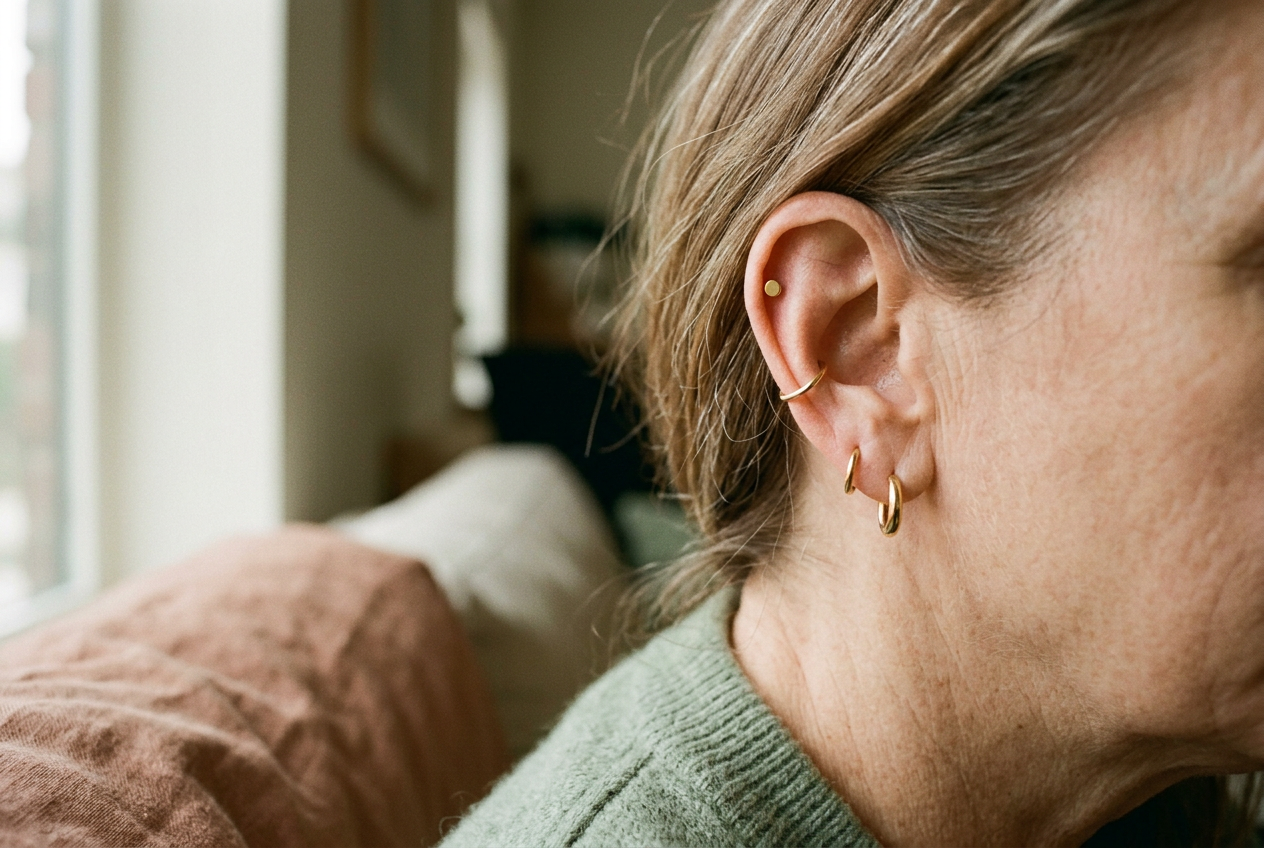
The useful measurement on a small hoop is hidden inside it. Inner diameter, meaning the distance across the open center of the closed ring, tells you whether the hoop can pass around the earlobe without pinching. It does not tell you how much space the whole earring occupies beside another hoop.
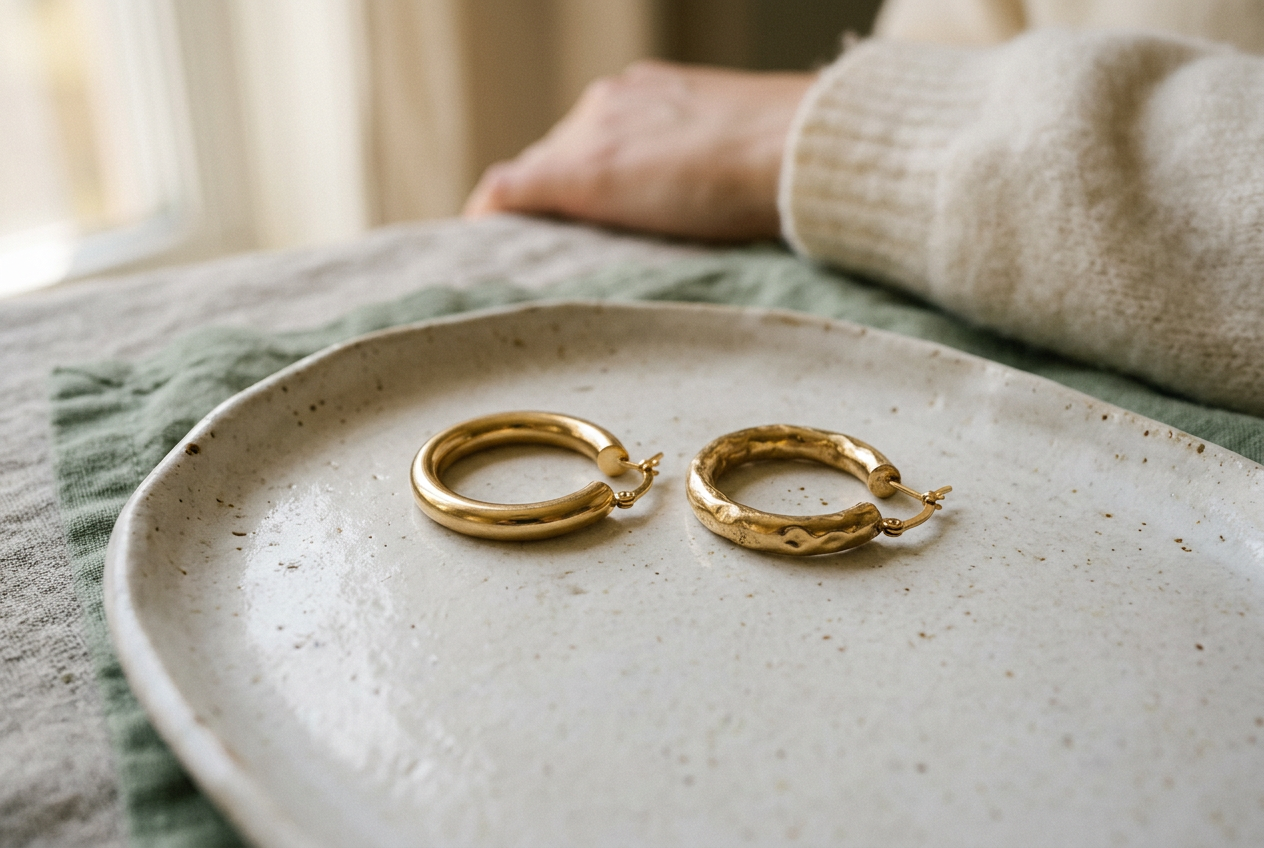
That distinction decided the reference stack for this walkthrough: three plain round clicker hoops in solid 14k yellow gold, with 8 mm, 6 mm, and 5 mm inner diameters. A clicker is a hinged hoop whose narrow post snaps into the opposite side. Each ring had a body about 1.2 mm thick, so its outer diameter was roughly 2.
4 mm larger than the number used to sell it.
All three hoops cleared the lower edge of the lobe. The stack still looked crowded. The 8 mm and 6 mm rings touched during ordinary head movement, while the 6 mm and 5 mm pair sat close enough to tick against each other when the ear shifted. Individually, the sizes worked.
Together, they did not.
This is unisex sizing advice. Earlobe thickness, hole placement, and piercing angle determine the fit; the jewelry department or styling label does not.
Start with the distance below each piercing
Measure the drop, which is the straight distance from the center of a piercing hole to the lowest edge of the lobe directly beneath it. Use a millimeter ruler in a mirror, or take a straight-on photograph beside the ruler and enlarge it without changing the proportions. A caliper is easier to read, but it is not essential.
On the reference ear, the three drops were approximately 6 mm, just under 5 mm, and just under 4 mm from the first lobe piercing upward. That made the 8 mm, 6 mm, and 5 mm inner diameters plausible starting points. Each left some open space beneath the skin instead of pulling the lobe into the ring.
For a healed piercing, start by adding roughly half a millimeter to 1 mm to the measured drop. A thick or fleshy lobe may need more room, as can a piercing channel that angles downward from front to back, because the hoop must travel around tissue in depth rather than merely clear the edge seen in a mirror. The number is a fitting allowance, not a promise. Pressure, a dent after removal, or a ring that points outward instead of hanging freely means the diameter is too small.
The first hoop in the reference stack illustrates the limit. Its 6 mm lobe drop made a 7 mm inner diameter possible, but an 8 mm ring hung more freely and was easier to close. That extra millimeter improved comfort while enlarging the hoop’s footprint beside the second piercing. Solving one fit problem created another.
Outer diameter controls the crowding
Outer diameter is the full width of the closed hoop from outside edge to outside edge. For a round hoop with an even body, calculate it by adding twice the body thickness to the inner diameter. An 8 mm inner diameter with a 1.2 mm body occupies about 10.
4 mm across. A 6 mm ring made from the same body occupies about 8.4 mm.
Do not use the thickness of the post for this calculation unless the entire hoop is equally narrow. Many huggies have a slim post that passes through the piercing and a thicker decorative body outside it. Product pages sometimes list the post thickness while showing no measurement for the body, which is one reason two hoops sold under the same diameter can crowd a stack differently.
Next, measure center-to-center spacing, meaning the distance from the middle of one piercing hole to the middle of the next. The first two holes in the reference stack were about 9.5 mm apart. Half of the 10.
4 mm outer diameter is 5.2 mm, and half of the neighboring 8.4 mm diameter is 4.2 mm.
Together, those radii occupied about 9.4 mm, leaving almost no resting gap.
The arithmetic explains the rubbing, although an ear is not a flat diagram. Piercings can sit at different heights, and hoops often tilt into slightly different planes as the lobe curves toward the head, so a paper calculation should narrow the options rather than replace a fitting. Still, when the combined outer radii equal or exceed the space between two holes, contact is likely.
Aim for a visible resting gap. About half a millimeter is a practical minimum to test, while a full millimeter gives more tolerance for movement, thicker hoop bodies, and the slight rotation that happens when hair or a phone brushes the ear. A gap that exists only while the head is perfectly still is not useful clearance.
Map the stack before ordering gold
Draw the hoops at actual size on a printed photograph, or mark their outer widths on transparent paper held over the image. Position the top inside edge of each circle at its piercing hole, since that is where a close-fitting round hoop begins to wrap under the lobe. If the holes are staggered, the drawing will show interactions that a single spacing number misses.
For the reference stack, the map made the 8 mm first hoop the obvious place to edit. Replacing it with a 7 mm inner diameter ring made from a 1 mm body would reduce the outer width from about 10.4 mm to 9 mm, gaining more than a millimeter of space without forcing the second piercing into an undersized hoop. The revised first ring would sit closer to the lobe.
It would also look lighter.
The second and third holes posed a tighter problem. Their approximately 8 mm spacing left almost no margin between the 6 mm and 5 mm hoops once the 1.2 mm bodies were included. Taking the second ring down to 5 mm would press too close to its nearly 5 mm lobe drop.
A smaller ring was not a sound fix.
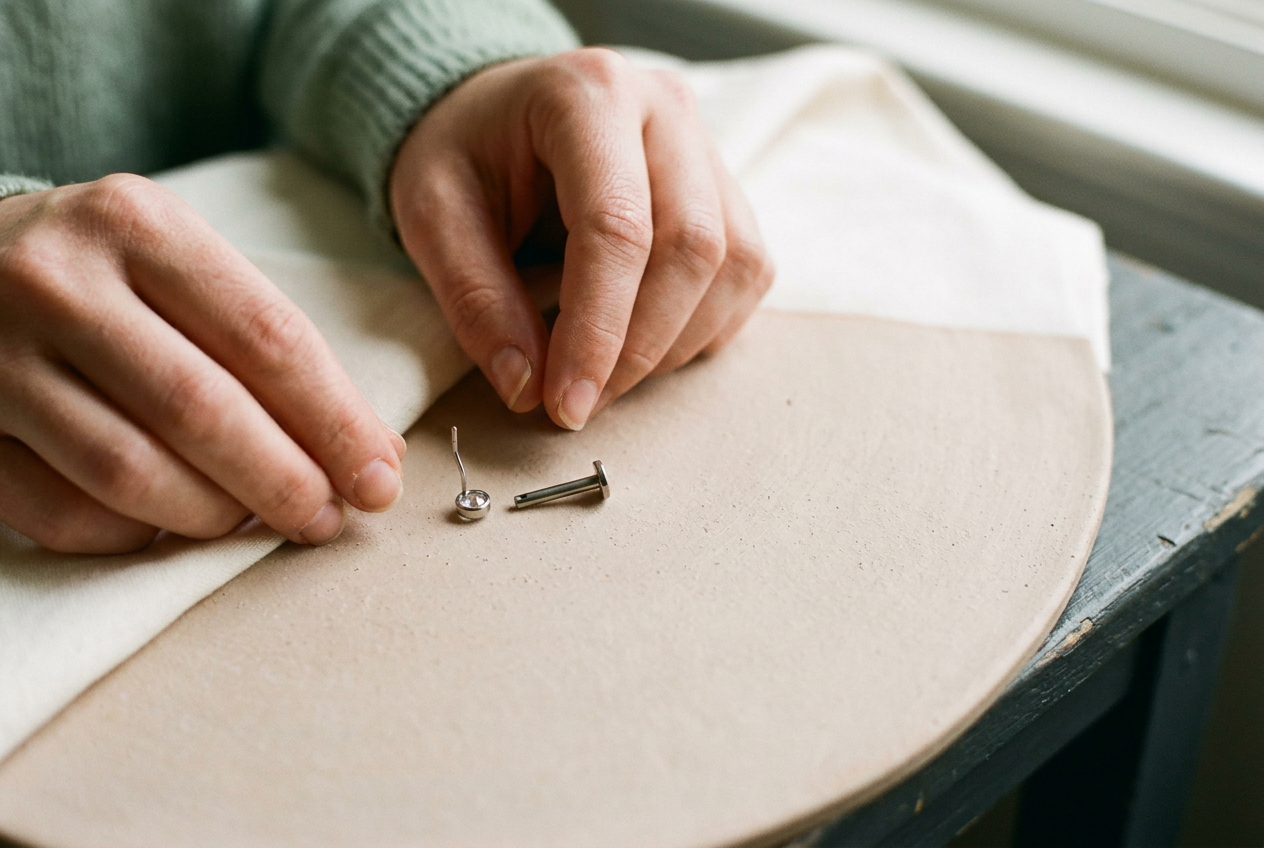
The cleaner alternative was a flat back stud in the third hole, meaning its post ends in a disc that sits flush behind the ear. This preserved the 6 mm hoop’s comfortable fit and removed the repeated metal-on-metal contact. An oval or elongated hoop could also work, provided it offers enough interior height for the lobe while using less width beside its neighbor.
That is the central tradeoff in a close stack: the smallest visually available hoop may be too tight for the tissue, while the comfortable diameter may be too broad for the neighboring jewelry. Every piercing does not need to hold a hoop merely because the stack was planned as a row of rings.
Thin bodies buy space, with limits
Reducing body thickness can recover clearance without changing inner diameter. Moving from a 1.5 mm body to a 1 mm body removes 1 mm from the total outer width, which can be enough to stop intermittent contact. The finer ring will look less substantial, and very thin designs may distort more readily when pulled or repeatedly opened.
Check how the closure is built. On a small clicker, a stiff hinge and tiny catch become harder to operate as the diameter shrinks, especially in an upper lobe piercing that cannot be seen directly. A seamless-looking fit is not worth several minutes of pinching the ear every time the jewelry is changed.
Material matters after the dimensions work. Solid 14k or 18k gold offers a durable precious-metal option at a higher cost, while well-finished implant-grade titanium is usually the more economical way to test an unfamiliar diameter. Gold plating over base metal may wear at the hinge and contact points, and it is a poor trial purchase for anyone whose skin reacts to the metal underneath.
Because pierced-jewelry returns are often limited, test the geometry before paying for a full solid-gold stack. An inexpensive sizing ring or a titanium hoop can confirm whether 7 mm clears the first lobe, whether the hinge closes comfortably, and whether the ring remains separate from its neighbor through a normal day.
Check the stack in motion
A mirror check catches overlap at rest. It misses the movements that make close hoops rub. Turn the head, tuck hair behind the ear, hold a phone in the usual position, and press the lobe lightly toward the side of the head. Listen for clicking and watch whether one hoop pushes the other out of plane.
Remove the jewelry after several hours and inspect the lower edge of each piercing. A temporary light impression can occur with close-fitting jewelry, but persistent soreness, a pronounced groove, or a hoop that resists rotation indicates pressure rather than a neat fit. Do not force a smaller diameter to preserve the graduated look.
The revised reference stack ends with a 7 mm first hoop, the original 6 mm second hoop, and a small flat back stud in the third hole. The rejected 8 mm ring still fits the ear. It belongs in a single-hoop day, where its comfortable drop does not have to share 9.5 mm of space with another circle.
Questions people ask
How much space should sit between two small hoops?
Start with at least half a millimeter of visible clearance while the ear is still, then test movement. A full millimeter is more forgiving. Hoops that only avoid contact in one head position are likely to rub when hair, a phone, or the lobe’s natural movement shifts them.
Is inner diameter the same measurement retailers call hoop size?
Sometimes, but listings are inconsistent. Confirm whether the stated number measures the open interior or the full outside width, and look for body thickness as well. An 8 mm inner diameter hoop with a substantial body can occupy considerably more space than a fine ring carrying the same size label.
Can I size down if neighboring hoops touch?
Only if the smaller inner diameter still clears the lobe without pressure. Measure the piercing-to-edge drop first. If sizing down would leave no allowance for tissue thickness or movement, choose a thinner body, an oval hoop, or a stud in one of the neighboring holes.
Should
I measure a fresh lobe piercing for close hoops?
Wait until the piercing has healed and a qualified piercer confirms that changing jewelry is appropriate. Fresh piercings can swell and should not be compressed for a close visual fit. The spacing map remains useful later, but initial jewelry needs room for healing rather than the smallest possible silhouette.
One update a day
Today's fashion update, in your inbox
One fashion update each morning — no hype, no filler, just pieces worth wearing.