Polka Dots Are Back, but the Dot Size Decides the Job
Small dots can behave like texture, medium dots earn repeat wear, and oversized dots make the garment an event. Contrast and spacing decide which effect you get.
Women's · November 16, 2026 · 7 min read
The change is broader than a single spotted dress. Recent runway coverage and retail assortments show dots turning up at sharply different scales, which means two garments filed under the same trend can have little in common once they reach a wardrobe. A fine black-and-white dot can sit under a jacket like a textured neutral. A circle spread across half a skirt panel dictates the outfit.
For women's wardrobes, the focus here, scale also changes how a print interacts with bust darts, waist seams and button plackets. That makes polka dots less straightforward than stripes, where shoppers often know to check whether the lines match. With dots, the interruption is quieter, yet it can make an otherwise polished garment look poorly planned.
The dress that explains the return
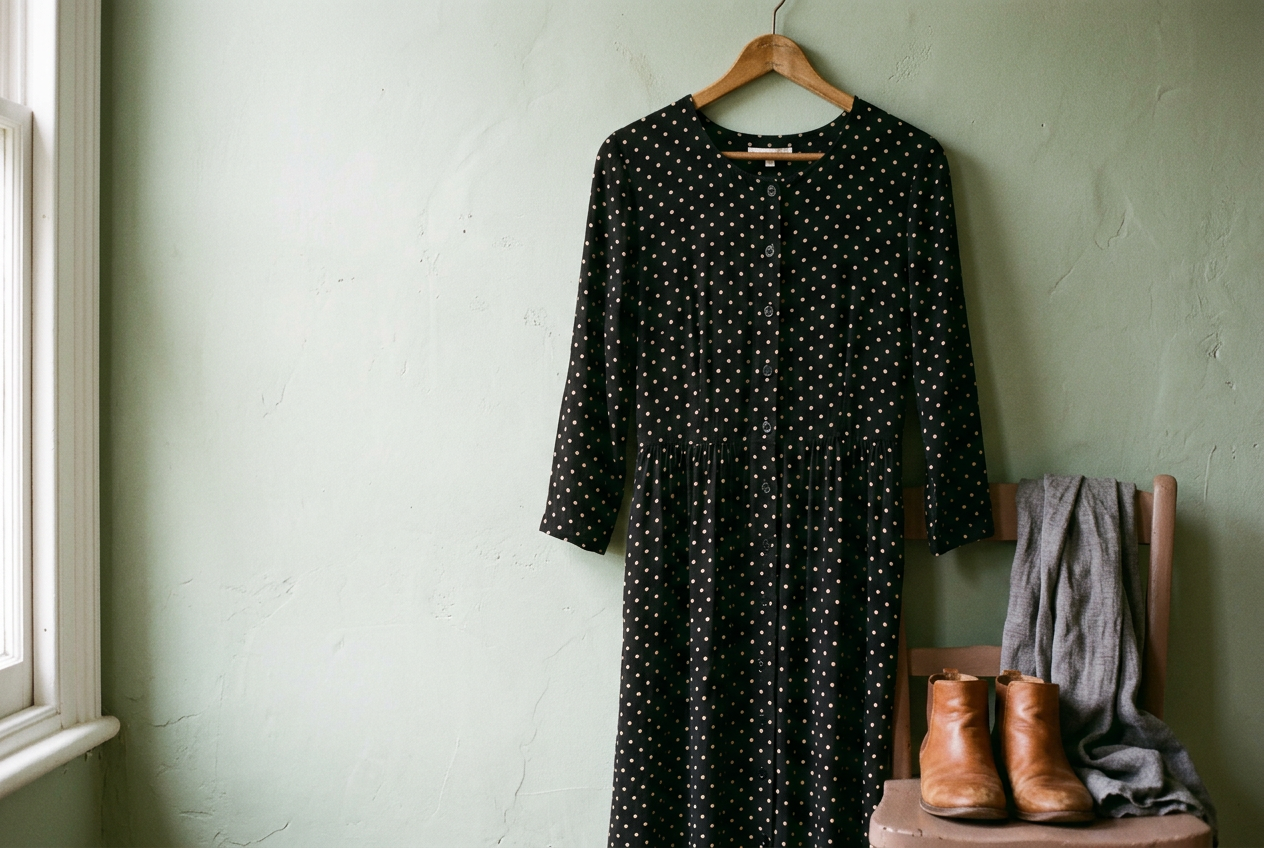
My reference point is an older black viscose midi dress with cream dots about three-quarters of an inch across, a center-front button placket and a set-in waist. I wore it across one week with a black cardigan and leather flats, then with a cropped jacket. The same dress worked in both combinations because its dots were large enough to register from across a room, but small enough that no single circle became the focal point.
The spacing mattered just as much. The repeat, meaning the interval at which a pattern arrangement begins again, left about one dot's width of black ground between neighboring circles. That prevented the cream from taking over. Black buttons also disappeared into the base color, so the placket did not add another vertical interruption.
Viscose gives the dress a fluid hang and lets the skirt move without holding a stiff bell shape, though it also demands attention to the care label because the fiber can weaken when wet and may shrink if washed or dried too aggressively. After a gentle wash and air-dry, the main nuisance was wrinkling at the waist rather than damage to the print. A crisp cotton poplin version would hold the dots more rigidly, while silk crepe would soften their edges through its lightly pebbled surface.
That medium-dot dress is the useful center of the trend. Everything else can be judged by how far it moves away from that balance.
Small dots can stop behaving like dots
A small dot, roughly pinhead to pea sized, often reads as texture at conversational distance. This makes it useful on a blouse that needs to work beneath tailoring, particularly when the ground and motif are close in value, such as navy with cream rather than black with optic white. Under a dark blazer, the print adds movement without competing with lapels, buttons or jewelry.
High contrast changes the result. Tiny white dots packed tightly onto black can create a flickering effect, especially on polyester georgette or another sheer fabric layered over an opaque lining. More dots fit into every inch, and each fold exposes another cluster. The garment may look restrained in a product image, then much busier while walking.
Construction deserves a close look. On a fitted top, small dots make pulling between buttons easier to see because stretched areas open the gaps between motifs. If the fabric contains elastane, try the top seated as well as standing; if it does not, check whether the bust needs a larger size followed by alteration at the waist. The print cannot conceal strain lines.
Small dots are versatile when contrast is moderate and the ground remains visible. With sharp contrast and dense spacing, they become a micro-trend in their own right, closer to an optical surface than a quiet classic.
Medium dots do the ordinary wardrobe work
Medium dots, around the size of a fingernail or modest coin, are the safest choice for a dress expected to survive several seasons of styling. They remain legible in photographs and at a distance, yet they rarely overwhelm a midi-length skirt. The reference dress falls here, and its usefulness comes from the relationship between circle and gap rather than from the diameter alone.
Look for enough open ground that the eye can separate one dot from the next. When neighboring dots nearly touch, a medium-scale pattern gains the intensity of a smaller, densely repeated one. When the spaces grow much wider, each circle becomes more conspicuous and the print starts to feel illustrative.
A medium dot also tolerates layering. The cardigan covered part of my viscose dress without leaving a few oddly large fragments visible at the neckline and hem. On a top, the same scale can sit with solid trousers or denim without requiring the rest of the outfit to echo its colors. This is the version to buy when polka dots need to perform the job of a floral blouse rather than the job of a party piece.
Oversized dots belong to the cut
Once a dot is wider than a palm, placement becomes part of the garment's construction. A circle can be split by a side seam, cropped at the neckline or centered awkwardly over the bust. None of those outcomes is automatically wrong. They do make the piece feel more directional, and poor placement is harder to dismiss as normal variation.
Dresses give oversized dots enough area to establish a rhythm, particularly on a full skirt with few seams. A close-fitting knit dress is less forgiving because the circles stretch across the body and can turn oval where the fabric is under tension. Printed woven cloth keeps the motif stable, though darts will still remove wedges from individual circles.
Tops offer less uninterrupted space. An oversized-dot blouse can work beneath a solid suit when only a section appears, but worn alone it becomes the outfit's main graphic element. Check the exact garment rather than relying on a sample image if print placement varies from piece to piece. The circle landing on the item delivered may differ from the photographed one.
Accessories are a lower-commitment test. A scarf changes character as it is folded because oversized circles break into curved fragments, while small dots remain recognizable. A compact bag preserves more of the graphic effect, provided handles, pockets and hardware do not chop the pattern into unrelated pieces. If the attraction is specifically the enormous scale, an accessory may deliver enough of it without asking an entire dress to remain current.
Contrast and spacing outrank color
Black and white produce the clearest version of the trend, but color alone does not determine intensity. Chocolate with ivory can look nearly as emphatic when the edges are crisp. Red with pink may feel calmer if the values are close, even though the combination sounds louder on paper.
Fabric finish shifts contrast too. Matte viscose absorbs more light than satin, which can flash pale highlights across both the ground and the dots. A sheer layer blurs the motif where it folds over itself. Cotton poplin keeps every edge clean, a strength on a well-cut shirt and a liability when the print is already oversized.
When shopping online, enlarge the fabric image and compare the gap with the dot's diameter. A gap near the width of the dot usually gives each circle room without making it look isolated. Then inspect front and back views for placement at seams. Product photography can tell you more here than trend language, which tends to call every version bold or timeless and leaves the useful distinctions untouched.
Spend according to the print's likely job
A budget synthetic top is a reasonable way to test oversized dots, provided the fabric is not so thin that the pale areas reveal the underwear beneath. Check for static, a common annoyance with lightweight polyester, and inspect whether the print turns white when the cloth stretches. There is little reason to pay an investment price for a scale you expect to wear only while the micro-trend feels fresh.
Medium dots justify better fabric and construction. On the reference dress, the useful details are the lined bodice, stable waist seam and buttons that merge with the ground. Those features matter more than a prestige label because they keep the print uninterrupted and the fit secure. Mid-priced viscose or cotton can do this well if the seams lie flat and the care instructions suit your routine.
Silk earns its higher price only when the shape and scale already fit a real wardrobe gap. A silk polka-dot blouse still needs professional cleaning or cautious hand care, depending on its label, and that maintenance cost can turn an apparently versatile print into an occasional garment. Medium scale lowers the style risk. It does not remove the care burden.
The practical dividing line
Buy medium dots with visible ground if the piece must work repeatedly with existing jackets and shoes. Choose small dots for a blouse only after checking contrast and density, since both can make a supposedly discreet print unexpectedly active. Treat oversized dots as a silhouette decision: the cut, seams and exact placement must be good enough to justify the attention.
The older viscose dress remains the benchmark because no single dot asks to be admired. Its circles support the dress instead of taking over its job.
Questions people ask
What size polka dot is most versatile?
A medium dot around fingernail or modest coin size is generally the most adaptable, especially when the open ground between circles is close to the dot's width. It stays visible under a jacket without turning the entire garment into a graphic statement, and it works across dresses and tops more easily than an oversized motif.
Do small polka dots make a garment look busier?
They can. Tiny dots in strong black-and-white contrast, packed with narrow gaps, create more visual activity than larger dots with generous spacing. For a quieter top, look for lower contrast, a matte surface and enough ground color to separate the motifs when the fabric gathers or folds.
Are oversized polka dots worth buying?
They are worth testing when the garment's cut is clean and the print placement looks intentional at the bust, neckline and seams. For a short-lived trend purchase, a scarf or small bag carries less wardrobe risk. An oversized-dot dress needs enough wear occasions to justify becoming the clear focus every time.
What fabric works best for a polka-dot dress?
Viscose offers fluid movement but may wrinkle and needs cautious washing. Cotton poplin gives crisp circles and more structure, while silk crepe softens contrast at a higher purchase and care cost. Match the fabric to the silhouette first: a full skirt can use structure, whereas a bias or gathered dress usually benefits from drape.
One update a day
Today's fashion update, in your inbox
One fashion update each morning — no hype, no filler, just pieces worth wearing.