Peep-Toe Shoes Are Back, but the Opening Decides the Fit
The returning peep-toe looks restrained, yet a narrow opening can squeeze while a wide one lets the foot slide. The useful update is the pair that exposes the toes without forcing them forward.
Women's · September 4, 2026 · 7 min read
The peep-toe has returned to retail in a quieter form than the platform pumps many people remember. Current versions tend to sit on low or mid-height heels, with elongated toes and an opening that reveals one or two toes rather than the full front of the foot. Fashion coverage has noticed the shift, while searches across high-street and designer retail pages now turn up pumps, slingbacks and mules built around that small cutout.
A small cutout does not make this an easy shoe.
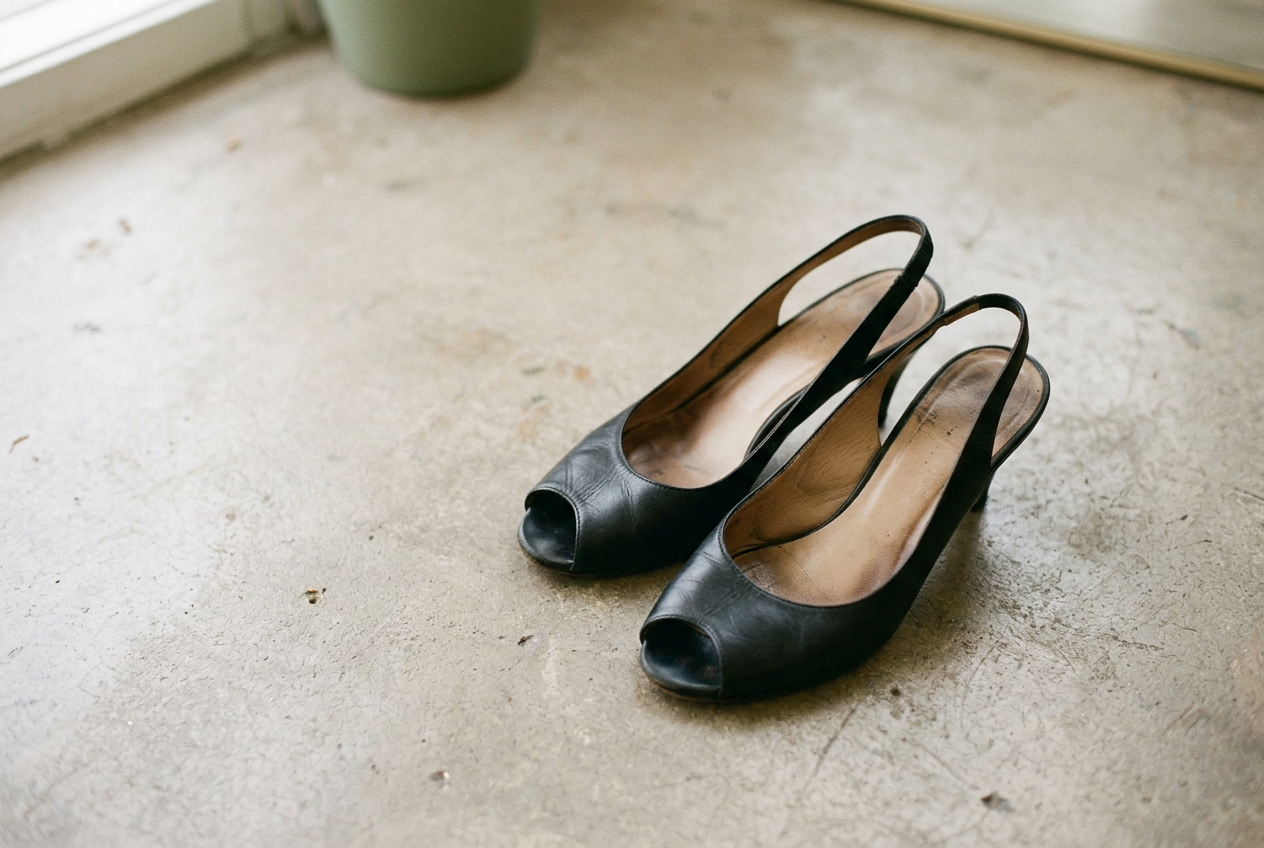
For the practical test, I returned to a black leather peep-toe slingback already in my wardrobe. It has a roughly 2.5-inch heel, a leather lining, an almond-shaped front and an opening about as wide as my two middle toes. I wore it during four outings across one working week, including desk-heavy days and a longer walk between appointments.
The shoe is not new, which removed break-in as an excuse when the fit began to fail.
This is women’s coverage because that is where the current retail push is concentrated, though the mechanics apply to any peep-toe construction. The central problem is straightforward: the shoe must leave enough space at the opening without allowing the foot to travel toward it.
The opening is an edge, not empty space
A peep-toe opening looks decorative on a product page. Under body weight, it becomes a load-bearing edge.
The front section covering the toes is the toe box, and its shape determines which part of the foot meets that edge. On my test pair, the almond toe narrows just before the opening, so the leather presses across the sides of the second and third toes even though the shoe feels roomy at the heel. After about half an hour, a shallow red line appears where the upper ends. Nothing is pinched hard enough to stop the day, but the pressure does not disappear.
Opening size changes the problem rather than solving it. A very narrow slit can press against a toenail or expose only the tip of one toe, which often looks accidental once the foot moves. A broad opening releases more of the forefoot, but it also gives the toes room to spread through the cutout, especially when the heel lifts the body forward.
The most forgiving version followed the natural curve across my toes rather than cutting straight across them. That distinction is hard to see in a front-facing product image. A top-down photograph is more useful because it shows whether the opening sits widest near the second toe, where many feet extend furthest, or centers rigidly over the big toe.
Material matters here. Soft leather can yield around the opening, although an unbound raw edge may stretch unevenly with wear. Patent leather and stiff synthetic uppers hold a sharper silhouette but are less willing to accommodate a toe that lands partly under the edge. Woven or mesh uppers reduce some pressure, yet the cutout can still have a reinforced border that feels firmer than the surrounding material.
My black pair is lined leather, and that lining keeps the opening smooth. It also creates a thicker edge. By the third outing, the leather had warmed and flexed, but the pressure line stayed in the same place, which confirmed that the issue came from geometry rather than new-shoe stiffness.
Foot slide changes how much toe appears
The peep-toe photographed on an unworn shoe is not the peep-toe seen after ten minutes of walking.
Heel height creates pitch, meaning the downward angle from heel to toe. As the pitch increases, the foot tends to move forward unless the shoe holds it at the instep or heel. My slingback’s front looked restrained when I first put it on, with two toenails partly visible. After walking several blocks, the second toe sat much farther through the opening and the big toe rotated toward one side.
The slingback strap did not prevent this. Tightening it pulled my heel toward the rear at first, but it also made the strap dig in while the forefoot continued to creep forward inside the shoe. A secure strap can stop the shoe from dropping off; it cannot correct a toe box that is too tapered or an insole that is too slick.
Smooth leather linings are comfortable against bare skin, though they can become slippery as the foot warms. Light padding under the ball of the foot helped my test pair feel softer, but cushioning alone did not control movement. A thin, grippy forefoot insert reduced the slide during the final outing, at the cost of taking up a little interior depth. That tradeoff works only if the upper is not already pressing down on the toes.
Sizing up is unreliable. Extra length may delay contact with the opening while standing, then increase movement once the heel lifts and the foot travels through the added space. Sizing down can hold the foot back, but it often does so by squeezing the widest part of the forefoot. Neither adjustment fixes an opening placed against the wrong toe.
A lower heel is the safer starting point. Flats still allow movement, particularly in open-backed mules, but they do not direct as much body weight toward the cutout. Block heels can feel stable underfoot without changing the internal pitch, so heel shape should not be mistaken for a fit guarantee.
The fitting-room test needs movement
Standing in front of a mirror tells you whether the shoe looks current. It says little about whether the opening will remain where you put it.
Wear both shoes and walk indoors long enough for your feet to warm. Then stop on a slight incline if the store allows it, or rise onto the balls of your feet several times. Watch which toes move forward and whether the opening’s edge leaves an immediate mark. Pressure that starts during an indoor fitting rarely improves over a full day, particularly in patent leather or coated synthetic material.
Check the shoe from above. One or two toes appearing evenly usually reads intentional; a single toenail caught under the edge signals that the opening and toe shape disagree with your foot. The shoe should also release cleanly when you take a step. If the opening grips a toe and then snaps back into place, walking will keep repeating that friction.
My test pair passed the heel check and failed at the front. The slingback stayed on, the sole bent in the expected place and the heel felt manageable, yet the second toe kept taking the pressure. A closed-toe slingback with a squarer front was the better alternative for the longer appointment day because it distributed contact across more of the upper and did not expose changes in toe position.
Online shoppers need more than the labeled size. Look for top, side and on-foot images, then inspect the return terms before wearing the pair outside. If a retailer shows only a straight-on product shot, the most consequential part of the fit remains hidden. Reviews that mention toes pushing through, sliding or a tight front edge are more useful than general statements about comfort.
The trend is wearable, selectively
The peep-toe’s new appeal comes from restraint. Under straight-leg trousers, a small opening interrupts the solid front of a pump without turning the outfit into full sandal territory. With a midi skirt, a low slingback version looks less formal than a closed pump while retaining more structure than a barely there sandal.
That middle position also limits its usefulness. The shoe exposes enough foot to feel seasonally specific, but not enough to offer the ventilation of a sandal. It requires more attention to toenails than a closed shoe, while the edge can create pressure precisely where an open sandal would leave space.
Prices now stretch from high-street dress-shoe territory to designer versions costing well into the luxury range. I would not pay the premium solely for the returning silhouette. Better leather, a shaped insole and a secure heel counter, meaning the part that cups the back of the foot, can justify spending more; a narrow opening on a steeply pitched last cannot. A last is the foot-shaped form around which a shoe is built, and its proportions set the fit before cushioning enters the discussion.
The test pair stayed in rotation, but only for shorter days. It looks right with full-length trousers, where the small flash of toe is visible during a step, and the softened leather makes it wearable for a few hours. The recurring line across my second toe rules it out for a day built around walking.
That leaves the return unresolved in a useful way. The peep-toe is not inherently uncomfortable, and it is not an automatic replacement for a closed pump. The version worth buying has a low-to-moderate pitch, an opening curved around your actual toe line and enough hold through the middle of the foot that the toes do not become the brake.
Questions people ask
How should peep-toe shoes fit at the front?
The opening should reveal the toes without catching a nail or pressing a hard line across the skin. Walk until your feet warm, then check again from above. If more toe appears as you move, the foot is sliding forward and the shoe may become less comfortable over a longer day.
Should I size up in peep-toe shoes?
Not by default. A larger size can add space at the opening, but it may also let the foot travel farther forward. Start with your usual size, assess width and toe-box shape, then compare another size only if the heel remains secure and the forefoot is not being held by pressure.
Are peep-toe shoes comfortable for walking?
They can handle moderate walking when the heel is low, the insole has some grip and the opening follows the toe line. A steep heel or slick lining increases forward slide. If the edge leaves a mark during an indoor test, choose a closed slingback or a more open sandal instead.
Which peep-toe shape is easiest to wear?
A softly curved opening on a rounded or gently almond-shaped toe is often more adaptable than a narrow slit in a sharply tapered front. The best shape still depends on which of your toes is longest, so judge the alignment on your foot rather than the symmetry of the unworn shoe.
One update a day
Today's fashion update, in your inbox
One fashion update each morning — no hype, no filler, just pieces worth wearing.