Peep-Toe Shoes Are Back, but the Opening Decides the Fit
The new peep toe is narrower and more covered than an open-toe sandal. That small opening can work, but only if the shoe controls forward slide.
Women's · August 27, 2026 · 8 min read
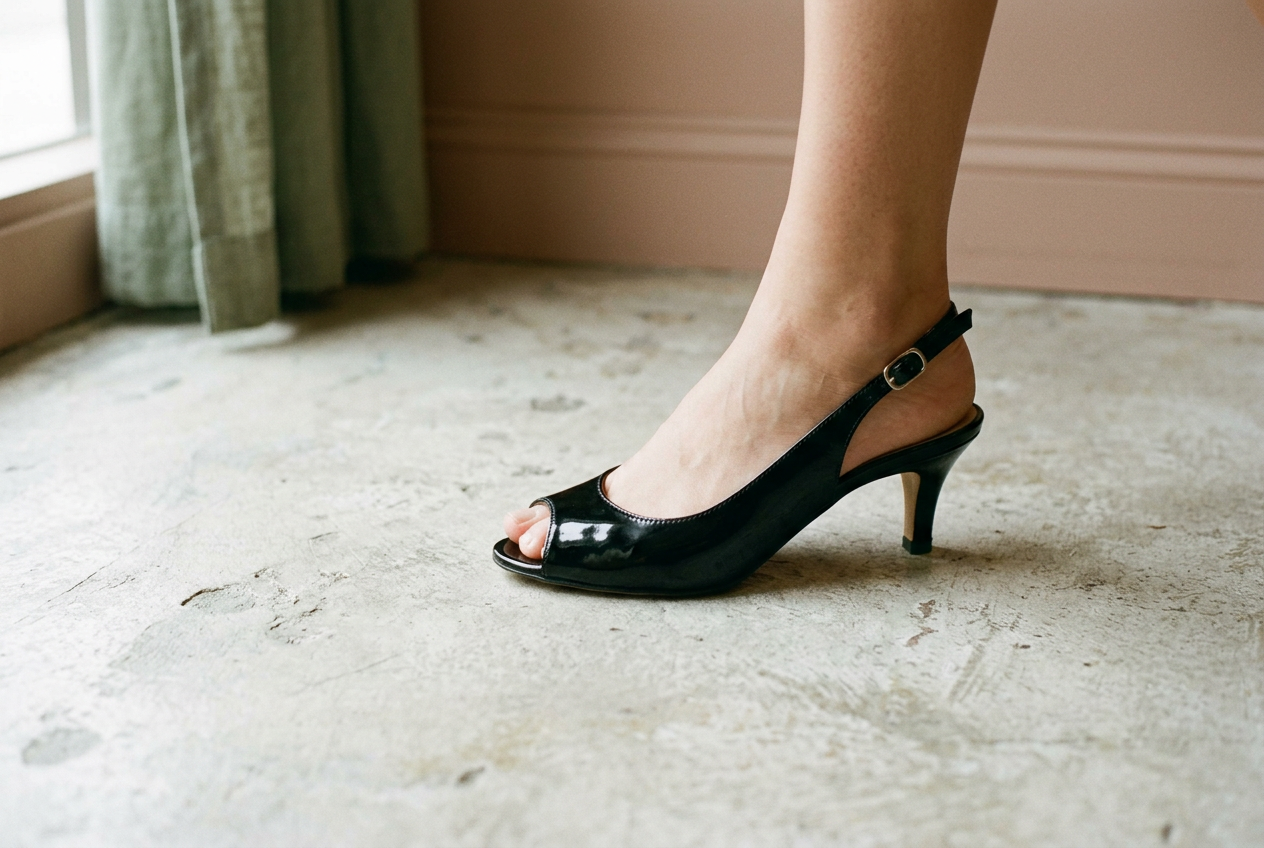
The useful reference for this revival is Toteme’s black patent-leather peep-toe slingback, a covered pump with a low narrow heel and a compact opening at the front. It looks closer to a conventional slingback than a sandal. That distinction is the attraction: the toe reveal interrupts an otherwise restrained shoe, so it can sit under full-length trousers or a clean midi skirt without bringing the visual weight of a strappy sandal.
It also concentrates the fit problem into a very small area. A broad open toe lets the forefoot spread, while a closed pump contains it. The new peep toe attempts both at once, exposing one or two toe tips while asking the surrounding upper to hold the foot in place. If that upper is too loose, the toes move forward.
If it is too tight, the edge of the opening becomes a pressure line.
This is women’s footwear coverage, and women’s sizing matters here because many fashion pumps narrow quickly toward the front even when the labeled size is correct. The underlying mechanics apply more widely, but the current retail revival is concentrated in women’s slingbacks, mules and heeled pumps.
The opening is part of the fit, not decoration
A peep toe should expose the ends of the toes, not the joints behind them. On the Toteme slingback, the small centered opening keeps most of the forefoot covered, which gives the shoe a polished outline but leaves little room for error: the longest toe needs to land behind the front edge without being pushed through it.
Opening shape matters as much as opening size. A shallow oval tends to frame the first and second toes, while a straight horizontal cut can cross several toes at different points. The latter may look graphic on a product page, yet it can press on the top of a longer second toe or catch the nail edge as the foot bends. An asymmetric opening can suit a foot whose big toe is clearly longest, provided the cut follows that slope rather than opposing it.
The edge needs inspection. Patent leather, leather coated to create a hard glossy surface, holds a crisp silhouette but gives less readily around an opening than soft nappa leather. A folded or smoothly bound edge usually feels kinder than a thin raw cut. Press a finger along the inside perimeter.
Any ridge that feels distinct to a fingertip will become more obvious once body weight and heel pitch move the foot toward it.
A very wide opening is not an automatic fix. It reduces contact at the toe tips, but it also removes material that would otherwise contain the forefoot, allowing the toes to spread or project beyond the sole. At that point the shoe behaves more like an open-toe mule, with different styling and less protection on crowded sidewalks.
Toe length decides what the shoe reveals
Peep-toe fit should follow the longest toe, which is not always the big toe. A person with a longer second toe may find that a centered aperture exposes that toe alone, even though the shoe looks balanced when empty. Sizing up can move the opening forward, but it can also loosen the heel and increase sliding, so extra length is useful only when the rest of the shoe remains secure.
The last, meaning the foot-shaped form around which a shoe is built, determines where the shoe begins to narrow. Two pairs with similar openings can fit differently because one keeps its full width farther toward the front. Look at the outsole from below or trace the side walls with your fingers. If they taper sharply before reaching the opening, a broad forefoot will be compressed even when no toe touches the edge.
This is where the Toteme reference pair becomes instructive. Its covered front makes the peep toe look discreet, but that same coverage means the wearer cannot treat it like a forgiving sandal. The correct size should leave the toes lying flat, with only the tips visible. A toe that curls under, lifts away from the insole or reaches for the sole is compensating for a mismatch elsewhere.
Forward slide creates the gripping problem
Heel pitch, the angle that raises the heel above the forefoot, sends weight toward the ball of the foot. A modest heel can still create slide when the lining is slick, the forefoot is too wide or the slingback strap holds only the heel rather than stabilizing the whole shoe. Patent uppers can amplify the effect because the firm surface does not settle around the foot quickly.
Toe gripping often starts quietly. The wearer curls the toes to keep a mule attached, or presses them down to stop a slingback from moving at every step. That effort may keep the shoe on during a fitting-room lap, but it is a poor basis for a full day. The toes should remain long and relatively relaxed while the upper and rear construction control the shoe.
A slingback strap helps only when its position and tension are right. If it sits too low, it can slip beneath the curve of the heel. If tightened aggressively, it may pull the foot backward while the heel pitch continues to push it forward, creating pressure at both ends. Elastic inserts offer some movement, although soft elastic can lose authority faster than an adjustable buckle.
The more reliable construction combines a lower pitch with close contact over the instep or along the sides of the foot. A higher-cut vamp, the part of the upper covering the top of the forefoot, can limit forward travel without squeezing the toe opening. This is why a covered peep-toe slingback may work better than a barely there peep-toe mule, even if the mule appears softer.
Adhesive forefoot pads are a limited correction. A thin suede-textured pad can add friction in a slightly roomy shoe, but a thick gel insert takes up vertical space and may press the toes harder against the opening. It cannot correct an opening that lands directly on a nail or a last that narrows before the foot does.
Material changes the break-in calculation
Soft leather can ease around the forefoot after wear, though the opening may also stretch and reveal more toe than it did in the store. Patent leather changes less and can crease near the flex point without becoming meaningfully wider. Synthetic coated uppers tend to offer the least predictable give, particularly when the edge around the aperture is heat-sealed or left firm.
A leather lining helps with moisture and usually feels smoother against the skin, but very polished leather can encourage sliding. A lightly textured forefoot lining is more useful than plush padding in the wrong place. Cushioning beneath the ball of the foot reduces impact; it does not stop the foot moving forward unless the shape and upper already fit.
Price does not settle this. Designer peep toes may use better leather and cleaner edge finishing, yet the cost can reach several times that of a decent leather pump, and an elegant narrow last remains narrow. At the mid-market level, inspect the opening and lining rather than paying for the silhouette alone. A stiff synthetic edge is not worth breaking in when a conventional slingback offers the same outfit function.
The fitting-room test needs movement
Try peep-toe shoes later in the day if possible, when feet are less likely to be at their smallest. Stand before judging the reveal. Weight changes toe position, and a neat opening while seated can become a protruding toe once the heel takes load.
Walk for several minutes on the store’s hard surface, then stop abruptly and notice where the foot lands. The longest toe should not strike the front edge. The heel should remain aligned with the back of the sole, and the slingback should stay up without being cinched. Pay attention to whether you have begun curling the toes; that habit is easier to detect after movement than during the first few steps.
Do not buy a painful patent pair on the assumption that it will stretch. For an online order, compare the internal shape with a pump that already fits, keep protective films intact and test only on a clean indoor floor within the retailer’s return rules. Half sizes can refine length, but a different last is the better answer when the opening and toe pattern disagree.
The revival may outlast its least practical versions
What is rising is the small, deliberate toe reveal attached to a covered shoe. It replaces some of the broad square-toe exposure that has dominated warm-weather footwear, while keeping enough structure to work beyond high summer. The most wearable versions have a restrained opening, a low heel and a slingback or enclosed heel that does real holding work.
The fragile part of the micro-trend is the extreme aperture: tiny holes that frame one toe, sharply cut patent edges and high-heeled mules with no instep security. These photograph clearly because the update is obvious, but they ask the wearer to manage the shoe with every step. For the price of a designer pump, that is not a compelling trade.
The Toteme slingback lands somewhere more interesting. Its compact opening makes the trend legible without turning the shoe into a sandal, yet its patent upper and tapered front demand an exact match between foot and last. It is a useful reference, not a universal recommendation.
Questions people ask
Should peep-toe shoes feel tight at the opening?
No. The upper may feel close around the forefoot, but the opening should not leave a sharp line, press against a nail or force a toe to curl. Firm patent leather deserves particular caution because it is less likely than soft leather to ease around the cut edge.
How much toe should show in a peep-toe shoe?
Usually the tips of one or two toes, depending on the opening and your toe pattern. The toe joints should stay covered, and no toe should project beyond the sole. Judge the amount while standing, then again after walking, because forward slide can change the reveal.
Can an insole stop feet sliding forward in heels?
A thin, textured forefoot pad can add friction when the shoe is only slightly roomy. Thick gel pads may raise the foot and push the toes into the opening, while full insoles can crowd a shallow pump. If the toes still grip after a short walk, the shoe’s pitch or last is the larger problem.
Are peep-toe slingbacks easier to wear than peep-toe mules?
Often, provided the slingback stays on without overtightening. The rear strap gives the shoe another point of control, reducing the need to hold it with the toes. A mule can work when the vamp fits closely and the heel is low, but a slick lining and loose upper make forward slide difficult to avoid.
One update a day
Today's fashion update, in your inbox
One fashion update each morning — no hype, no filler, just pieces worth wearing.