Matching Sets Rarely Fit Twice. Choose the Hard Piece First.
A set’s shared size label does not make its pieces equally forgiving. Fit the shoulders, trouser rise, or skirt seat first, then alter the simpler half.
November 4, 2026 · 7 min read
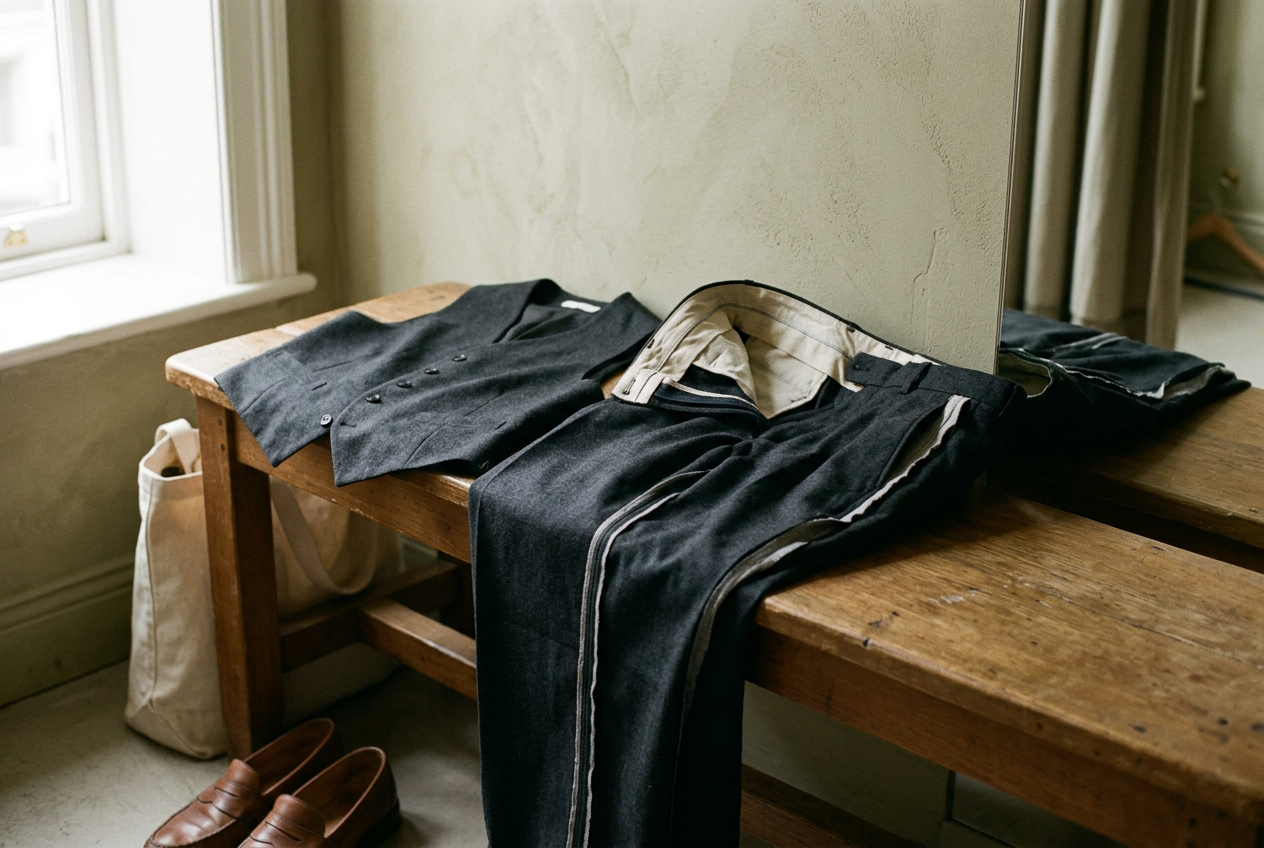
The fitting-room case behind this guide is a charcoal linen-viscose set: a half-lined, single-breasted vest with matching high-rise trousers, sold together in one size. The woven fabric contains no elastane, the waistband is fixed, and the vest has enough structure that its shoulder line cannot be treated like a soft tank top.
In the smaller size, the vest sits cleanly while the trousers pull across the seat. One size up releases the trousers, but the vest shoulder extends past the body and the armhole gapes. That is the central matching-set problem in useful detail. Neither size fits both pieces, and each compromise carries a different alteration bill.
This is unisex fit advice. The size labels and shaping conventions may change across departments, but shoulders, rise, and seat still determine whether a woven garment hangs correctly.
One label is doing two jobs
A matching set usually repeats fabric and color, not proportions. A person who needs more room through the hips may have a narrower upper body; someone with broad shoulders may need little extra space at the waist. Grading, meaning the way a pattern expands or contracts between sizes, applies a brand’s chosen proportions to every size rather than responding to an individual body.
Sets sold as separates make that mismatch easy to solve. Take one size in the vest and another in the trousers, then confirm that the dye lot and fabric surface look the same under daylight. Black, navy, cream, and garment-dyed linen can vary enough that two pieces labeled with the same color name do not always read as a set.
A set sold only as one unit requires a harsher decision. The correct size is the one that fits the harder piece, not the one that makes the outfit look most finished during a two-minute mirror check.
Start where alterations become reconstruction
On tailored tops, begin at the shoulder. The shoulder seam should finish close to the edge of the shoulder unless the garment was designed with a deliberate drop. If a fitted vest collapses near the armhole, stands away from the upper chest, or extends beyond the shoulder, sizing down may work better than asking a tailor to rebuild that area.
Shoulder alterations are difficult because the neckline, lining, armhole, and sometimes a collar all meet nearby. The armscye, meaning the garment’s armhole opening, may also need reshaping once the shoulder moves. A tailor can do the work, but it can cost more than the set justifies and may alter the vest’s balance.
For trousers, prioritize rise and seat before waistband fit. Rise is the distance from the crotch seam to the top of the waistband; when it is too short, the trousers may pull upward, form tight horizontal creases, or feel restrictive while sitting. The seat is the fullest area across the back of the pants. Diagonal drag lines, pocket flare, and a crotch seam that shifts forward all suggest that this area needs more room.
The larger trousers in the charcoal set win for that reason. Their waistband has modest excess, but the rise stays in place and the linen-viscose falls from the seat without gripping. Taking in a waistband is a contained alteration. Adding meaningful room to a short rise is usually impossible because manufacturers rarely leave enough fabric inside the seam.
A fitted skirt follows the same logic. Choose the size that lets the skirt fall from the fullest hip and seat without twisting, hiking, or opening a back vent under strain. A loose waist can often be reduced. A tight seat cannot be fixed unless the seams contain generous reserves.
Test the hard piece in motion
Standing still hides fit problems. Sit in the trousers for several minutes, walk, climb a step if the fitting area allows it, and bend enough to see whether the waistband cuts into the body or the back rise pulls down. Linen-viscose may relax slightly with wear, but it will not gain the durable stretch of a fabric made with elastane.
For the vest, reach forward and lift each arm. A close fit is acceptable; pressure at the back armhole, a neckline that lifts away from the chest, or buttons that take the strain is not. Wear the underlayer you expect to use, since a substantial T-shirt occupies more space than a fine ribbed tank.
Then leave the set on for ten minutes. The extra fitting time is more useful than repeatedly switching sizes, because heat and movement reveal a waistband that rolls, a lining that catches, or a trouser crease that keeps drifting toward the inner leg.
Give the tailor the easier half
The safest alterations remove length or modest excess without changing the garment’s architecture. Trouser hems are usually straightforward, provided the leg shape does not taper sharply near the ankle. A skirt hem can also be simple, although pleats, curved edges, and border prints add labor.
Taking in the waist of trousers or a skirt is often reasonable when the hips already fit. The tailor may work through the center-back seam or waistband, depending on construction, but pockets and belt loops can limit how much the waist can shrink before the proportions look wrong. Ask to see the garment pinned rather than relying on a promised number.
On the charcoal vest, small changes at the side seams are more plausible than moving the shoulders. Seam allowance is the strip of fabric inside a stitched seam; enough allowance gives a tailor room to adjust width while preserving the outer shape. A half-lined vest takes more labor than an unlined one because the lining must be opened and closed, yet that remains a cleaner job than rebuilding the armhole.
Shirt-style tops are often the forgiving member of a set. A roomy body can be worn open, tucked, or tied without alteration, while a long sleeve may be rolled. Shortening sleeves becomes less attractive when the cuff has working buttonholes, since moving those details requires more work and can leave poor spacing.
Know when the set is not worth rescuing
If one size fits the trousers but leaves the vest shoulder more than a minor adjustment away, skip the set unless the pieces work independently. The same applies when a correct vest forces the pants into a rise that pinches or a seat that shines under tension. Buying for color harmony does not make structural alterations economical.
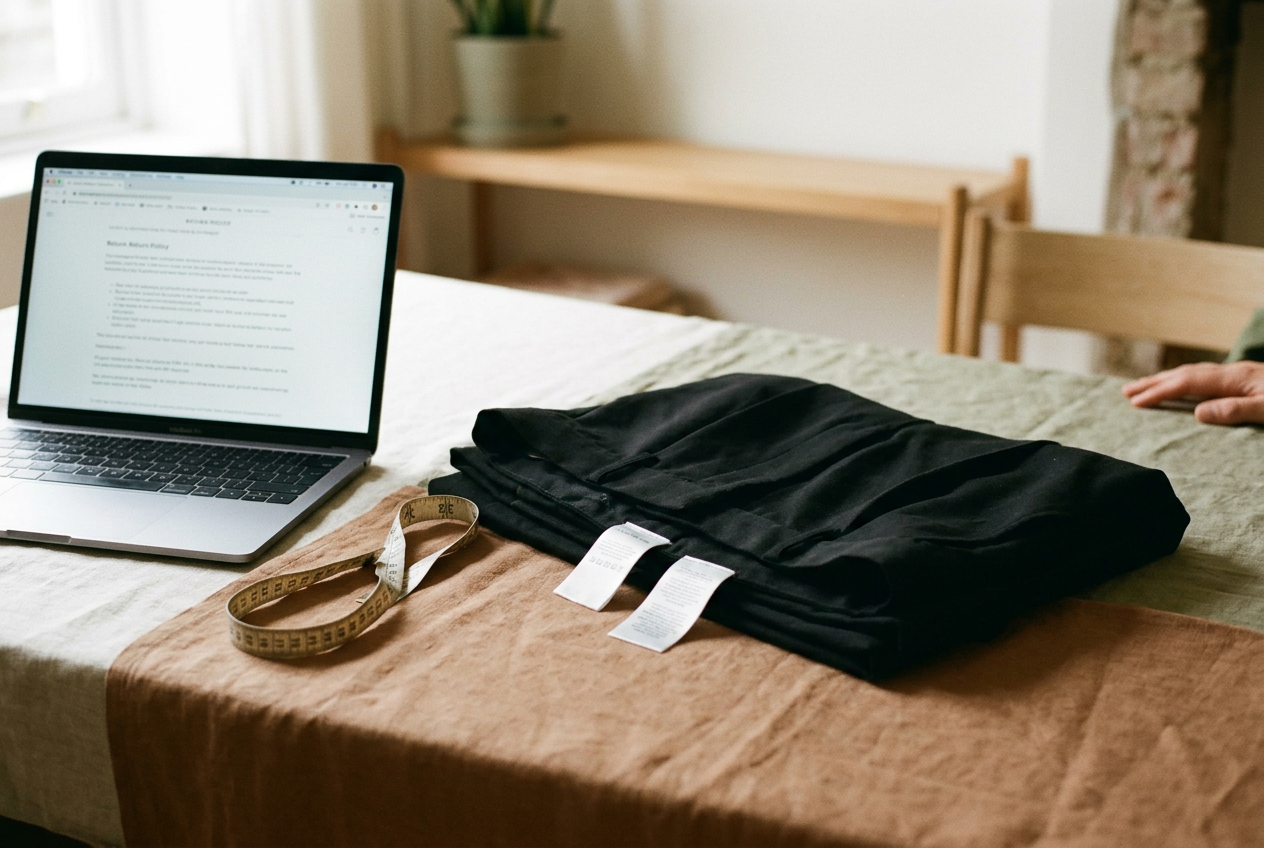
Before paying, inspect the inside seams and photograph the care label and size tag. Check the return policy before removing anything, especially when the set is sold as one unit; some retailers require both pieces back together, even if only one has been tried beyond the fitting room.
Buying two sets in different sizes and keeping one piece from each is rarely a sensible workaround unless the retailer explicitly allows individual-piece returns or the unmatched halves already have a clear use. Otherwise, the apparent fit solution creates another pair of garments to sell, alter, or store.
A better alternative is to look for the same outfit formula rather than the exact set. Pair charcoal trousers with a tonally close vest in another fabric, or use the set’s shirt with a skirt already in the wardrobe. Slight texture contrast looks deliberate more often than two almost-matching blacks that disagree in daylight.
Fabric decides how exact the fit must be
The charcoal set’s linen-viscose blend has fluidity, but no recovery from stretch. A close trouser seat may loosen during a day and then tighten again after washing, while strained seams remain visible throughout. That makes buying too small a poor bet.
A woven cotton poplin shirt offers more styling tolerance because it can blouse over a waistband or stay open as a light layer. Satin is less forgiving: needle marks, puckered seams, and slight pulling catch the light. Plaids and stripes raise the stakes further because taking in one area can interrupt the pattern match.
Knitted sets behave differently. Stretch can accommodate proportion differences, though a ribbed skirt stretched across the hips may become sheer or lose its intended line. Fit the piece at the point where the knit is under the greatest tension, then check whether the other half can be styled looser without looking accidental.
Use one fitting-room order
Try the structurally demanding piece first, wearing the shoes and underlayer planned for the outfit. Confirm the shoulder on a vest or jacket, or settle the rise and seat on pants and fitted skirts. Move in it. Only then assess the easier piece and pinch the excess where an alteration might go.
Turn both garments inside out. Visible seam allowance, an accessible hem, and uncomplicated lining make changes more realistic; narrow overlocked seams and fused construction leave fewer options. If the salesperson or retailer cannot separate the sizes, choose according to the hard piece and decide whether the easy alteration is still worth the total cost.
For the charcoal set, that means the larger trousers, a reduced waistband, and accepting that the vest may need side-seam shaping. If its shoulders remain too wide, the set goes back.
Questions people ask
Should
I size a matching set for the top or the bottom?
Size for whichever piece has the least correctable problem. A structured vest with poor shoulders may take priority over loose elastic-waist pants, while tailored trousers with a short rise should take priority over a shirt that can be tucked, worn open, or taken in through simple seams.
Can a tailor fix pants that fit the waist but pull at the seat?
Sometimes, but only if the back and side seams contain enough spare fabric. Letting out the seat by a small amount may work; correcting a short rise or substantial tightness usually does not. Size up for clean movement through the seat, then ask about reducing the waistband.
Is it better to buy matching separates in different sizes?
Yes, when the retailer sells them individually. Fit each garment on its own merits, then compare color and texture in natural light before removing tags. Separates also make returns and future replacement easier because one worn-out piece does not force you to replace the entire set.
Which matching-set alterations are usually simplest?
Plain hems, modest waistband reductions, and small changes through accessible side seams tend to carry the lowest risk. Shoulder reconstruction, major rise changes, and alterations through complex linings or matched patterns require more labor. Inspect the inside construction before assuming an apparently loose area will be easy to fix.
One update a day
Today's fashion update, in your inbox
One fashion update each morning — no hype, no filler, just pieces worth wearing.