Long Shorts Can Crowd a Petite Frame. Check the Hem First.
Knee-near shorts offer the ease of a skirt with more structure, but small changes in length can upset the line. A cotton-twill fitting test shows when to alter and when to walk away.
Women's · September 17, 2026 · 8 min read
Long, knee-near shorts have moved beyond the occasional Bermuda on a summer rail. Current assortments place tailored versions beside midi skirts: pressed cotton twill, fluid suiting, pleated linen blends, denim and softer pull-on shapes, often styled with the same compact tops and polished shoes a skirt might previously have carried.
The practical appeal is clear. A long short permits a wider stride, usually has useful pockets and does not require the same attention on a windy platform. Yet it also divides the body in more places than a skirt does, with a waistband, a visible crotch and a horizontal hem all interrupting the line. That makes proportion unusually sensitive on a shorter frame.
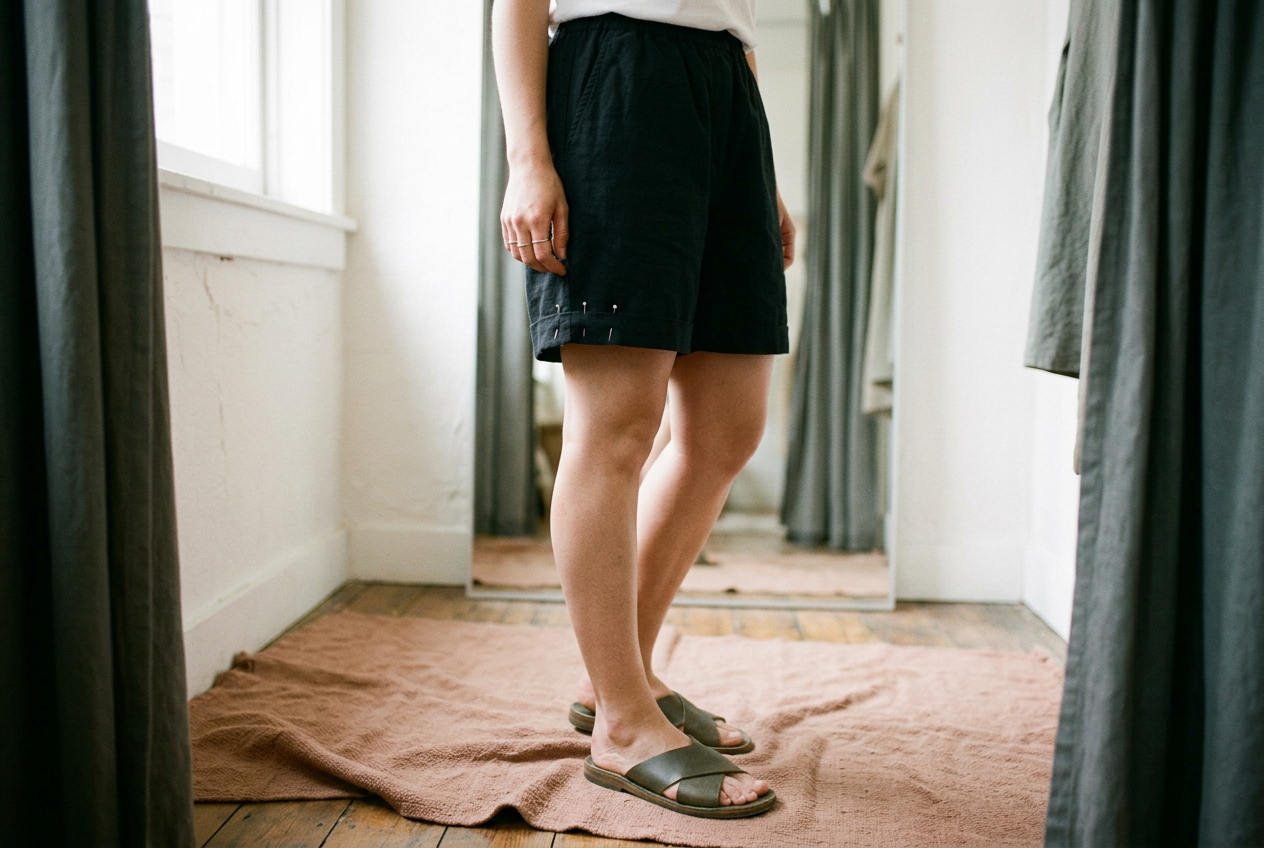
For the fitting-room test, I used one specific shape as the reference: a women's high-rise black cotton-twill short with front pleats, a pressed crease, an unlined interior and a leg that widened slightly toward a hem touching the upper edge of the kneecap. The twill was crisp enough to hold its outline rather than falling around the leg. This is women's coverage, and the fit observations refer to women's petite proportions and grading.
That test pair looked intentional at its original length. Once pinned shorter, it did not improve in a straight line.
The inseam is only the starting measurement
The inseam, meaning the seam running from the crotch to the hem along the inner leg, tells you roughly where a short will finish. It does not reveal where the waistband will sit or how much fabric will surround the thigh, which is why shopping by inseam alone produces erratic results.
On the test pair, the original hem met the narrow transition into the knee. The long vertical crease remained visible, and the slight flare created space around the leg instead of gripping it. That air mattered: the silhouette read as a deliberate alternative to a skirt rather than an extended version of a standard summer short.
Pinned about an inch higher, the pair still held together. The crease remained long enough to direct the eye downward, while the hem stayed below the fullest part of the thigh. Pinned higher again, the opening began to land on a broader point of the leg. More skin was visible, but the result looked heavier because the wide hem now made a stronger horizontal bar.
This is the first useful alteration rule. Shorter does not always mean more lengthening. A petite wearer gains more from placing the hem at a comparatively narrow part of the leg than from exposing another inch while retaining a broad, stiff opening.
Rise controls how much torso is left
Rise is the distance from the crotch seam to the top of the waistband. On a long short, it determines where the long leg shape begins, so it can change the apparent balance as much as the inseam does.
The high rise on the black test pair helped while the shirt was tucked in. It placed the waist clearly above the hip and gave the pressed front enough uninterrupted length to counter the knee-level hem. With a loose shirt ending below the waistband, that advantage disappeared; the visible short became a broad block from lower hip to knee, and the torso looked compressed.
A high rise can still be too high. If the waistband approaches the lower ribs, wrinkles form below it when sitting, the front pleats push open and the crotch may hang lower than intended. Repeated sitting in the test pair made this easy to spot: the firm twill recovered its crease, but the pleats stayed slightly open until the fabric was smoothed by hand. That is not a problem a shorter hem will solve.
Petite shoppers should therefore check the seated fit before considering alterations. If the waistband presses upward, the front pools or the crotch drops when standing again, try a petite cut or a shorter rise. Taking fabric from the bottom preserves the same overlong upper section.
Hem width decides whether shortening works
Hem width is the distance across the leg opening at the bottom of the short. A generous opening can be useful because it releases the thigh and gives a long short some of a skirt's movement, but its position changes when the garment is shortened.
The reference pair widened gradually below the hip. Removing a modest amount from the bottom placed the new hem at a slightly narrower part of the pattern, so the pinned edge needed gentle reshaping to mimic the original opening. A tailor can usually manage that on a plain, unlined leg. A deep cuff, side tab, contrast topstitching or shaped vent adds work and may need to be rebuilt rather than folded under.
There is also a point at which the intended cut disappears. On this pair, moving the hem well above the kneecap removed much of the long crease and left the pleats occupying a disproportionate share of the remaining leg. The garment still fit, but it had become an ordinary wide tailored short. Paying for that alteration would make little sense unless that was the silhouette wanted from the start.
Pin both legs before buying, then walk, sit and view the side profile. Folding only one leg encourages comparison by exposed skin rather than by the complete shape. Keep the folded fabric inside, since rolling it outward creates a false cuff and adds weight exactly where the finished hem would not have it.
Fabric changes the visual weight
Crisp cotton twill makes a knee-near short easy to assess because it shows the pattern clearly. It also makes every proportion more emphatic. The black test pair stood away from the thigh, held its wide opening and preserved the pressed crease through walking; those qualities produced a clean line, though they also made the hem harder to ignore.
A fluid wool blend or soft viscose suiting can fall closer to the body, reducing the box effect, but very light cloth may collapse between the legs and resemble a divided skirt only while standing still. Linen brings welcome movement and heat comfort, then softens at the crease and gathers behind the knees after sitting. Denim is the least forgiving option when it is both wide and rigid, since shortening moves a substantial band of fabric toward the fuller thigh.
Material also changes the tailoring decision. A basic machine-finished hem is the least complicated alteration. Recreating a cuff, preserving a vent or moving decorative stitching requires more labor, while lined suiting must be shortened inside and out. At mass-retail prices, extensive work can turn an experimental trend purchase into poor value.
Contemporary tailoring may justify the cost if the rise, seat and waistband already fit without compromise.
Shoes can restore space, not correct the cut
Shoe pairing affects the gap between the hem and the floor. A low vamp, the front edge of a shoe where it crosses the foot, leaves more of the instep visible and keeps that space open. With the black test pair, a close-fitting flat sandal made the knee-level hem feel lighter without pretending the short was narrower than it was.
A streamlined loafer also worked when the top of the foot remained visible. Add a thick sock and a heavy sole, and the leg acquired another strong horizontal break below an already emphatic hem. A substantial sneaker was wearable, but it shifted the outfit toward a deliberately compact, oversized proportion; it did not offer the easy length often promised by generic petite styling advice.
A heel is optional. The useful feature is visual openness rather than height, so a flat with a slender upper can do more than a platform sandal with broad straps. Shoes cannot rescue a low crotch, a pinching waistband or pleats that spread across the abdomen. They can only change how much breathing room surrounds a sound fit.
The fitting-room decision
Start with the waistband at its natural position, not pulled higher to manufacture leg length. Tuck or lift the top so the rise is visible, and check whether the side seam falls straight. Then fold the hem inward in small stages while keeping it near the knee. The alteration remains promising if the crease still reads as a long vertical line, the opening clears the thigh and the pleats have enough length to settle.
Skip the pair if it needs several corrections at once. Shortening plus waistband work plus tapering is no longer a minor petite adjustment; it is an attempt to redraft a garment whose proportions were graded for another body. A long short with a cleaner front, a narrower opening or a true petite rise will be a better starting point, even if its fabric looks less exciting on the hanger.
The black cotton-twill pair passed with the smaller pinned adjustment and a low, open shoe. It failed once the hem moved far enough upward to erase the knee-near tension that made the garment current. That boundary will vary by leg, but the test is stable: preserve the relationship between rise, crease and hem, rather than chasing the shortest possible length.
Questions people ask
Where should long shorts end on a petite frame?
A useful starting point is close to the knee, where the leg begins to narrow, rather than across the fullest part of the thigh or calf. The exact point depends on rise and hem width. Pin both legs, walk and sit before deciding, because a hem that looks balanced while standing can ride into a broader area in motion.
Can a tailor shorten
Bermuda shorts without changing the shape?
A modest plain hem is often feasible, especially on an unlined leg without cuffs or vents. Larger reductions may remove the taper or flare built into the pattern, leaving an opening that looks too wide for the new length. Ask the tailor whether the side seams need reshaping, not just whether the hem can be turned up.
Do petite shoppers need petite-specific long shorts?
Not always. A regular-size pair can work when the waistband sits comfortably, the crotch remains close without pulling and the pleats lie flat after sitting. Petite sizing becomes more useful when the rise is excessive, since trimming the hem cannot remove surplus fabric between the waistband and crotch.
Which shoes work best with knee-length shorts?
Shoes with a low vamp or a relatively open upper leave space below the hem, which can lighten a wide, structured short. Flat sandals and streamlined loafers are reliable options. Chunky sneakers can work when a compact, oversized look is intentional, but changing shoes will not correct a dropped crotch or an overwide leg.
One update a day
Today's fashion update, in your inbox
One fashion update each morning — no hype, no filler, just pieces worth wearing.