Fisherman Sandals Got Slimmer. Their Protection Did Too.
Narrow leather straps and low-profile soles make the fisherman sandal easier to dress up. They also remove some of the coverage, adjustability, and underfoot protection that made the shape useful.
Women's · September 19, 2026 · 8 min read
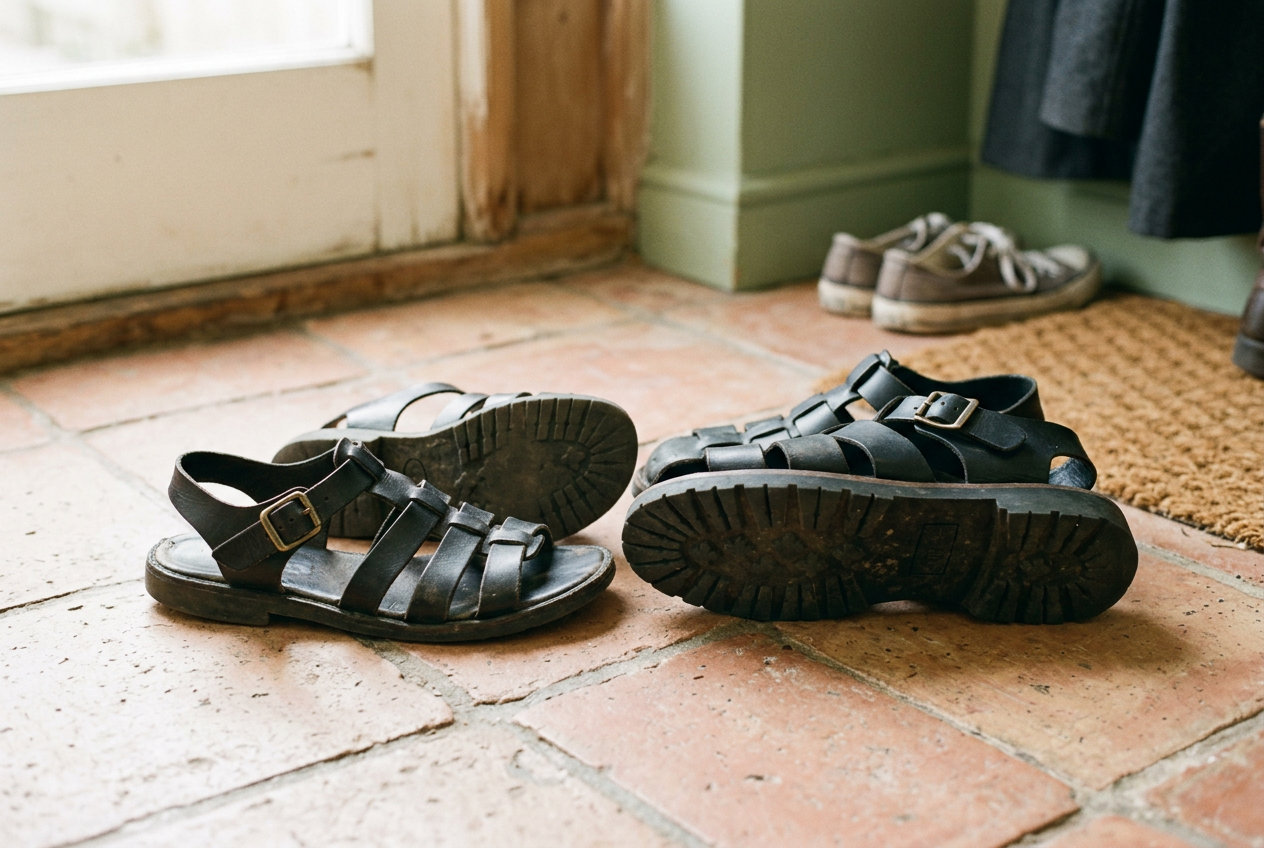
The useful detail in Everlane’s Day Fisherman Sandal is the gap between its slim leather straps. The shoe still has the familiar closed cage, buckle fastening, and covered toe associated with a fisherman sandal, yet the narrow bands expose more of the foot and sit on a low-profile sole. It looks closer to a neat leather flat than outdoor equipment.
That one construction change explains much of the current movement. Across women’s sandal assortments, the fisherman outline remains recognizable, but its heavier elements are being edited out: broad straps become fine ones, deep rubber soles lose height, and rounded protective toes are tightened into cleaner shapes. The result works with tailored pants and light dresses without bringing the visual weight of a hiking sandal.
It also does less.
The cage is becoming decoration
A traditional fisherman sandal covers the front of the foot with interlaced leather strips connected to a central strap. That upper once distributed pressure across relatively broad pieces of leather, while the spaces between them allowed air and water to escape. A thick outsole, meaning the bottom layer that meets the ground, separated the foot from stones, hot pavement, and uneven paths.
The newer version preserves that visual grid but reduces its substance. On the Day Fisherman Sandal, the slim straps make the pattern look precise and airy. They do not cover as much skin, and each one has less surface area over which to spread pressure. If a strap lands across a prominent toe joint, it may feel sharper than a wide band made from leather of similar firmness.
This matters most during the first week, when an unlined or minimally padded leather upper has not yet softened around the foot. Broad straps can feel stiff, but they usually create larger contact areas. Fine straps leave narrower pressure lines, particularly when feet swell in heat. Leather may relax with wear; the position of the strap will not change.
The refined cage offers some protection from incidental contact, such as a chair leg or the edge of a curb, but it should not be confused with the coverage of a substantial closed shoe. More of the toes and forefoot sit beside open spaces, while a tapered front can bring the toes closer to the leather framework. The polished appearance is real. The protective gain over an ordinary strappy sandal is modest.
One buckle cannot solve every fit problem
Fisherman sandals can look adjustable because they contain many separate straps. Most of those straps are fixed.
On the Everlane example, adjustment comes from the ankle buckle rather than from the forefoot cage. Tightening it can hold the heel more securely, but it cannot create extra room across the toes or move a strap away from a bunion. This is the central fit quirk of the refined shape: it visually resembles an adaptable woven shoe while behaving more like a closed leather flat with ventilation.
Women shopping this silhouette should judge the widest part of the foot before the ankle fit. The foot should sit inside the sole without spreading over its edge, and the outermost toes should not press through the side openings while standing. A little heel movement can often be corrected at the buckle. Forefoot compression usually cannot.
Look closely at where the central lengthwise strip meets the cross straps, too. That strip forms part of the vamp, the section of the upper covering the top of the foot, and can press on a high instep even when the sandal is wide enough at the ball. A longer buckle strap does not add height to the cage.
This makes returns more important than usual. Try both shoes late in the day, when feet are likely to be fuller, and walk on a hard indoor surface long enough to notice whether one narrow band takes most of the load. Keeping a pair because the leather will stretch is a poor bet when the problem is strap placement rather than general snugness.
The thinner sole changes the job
A low sole is part of the appeal. It lets the fisherman sandal sit quietly beneath a fluid trouser hem, and it avoids the bulky lift that made earlier versions read as deliberately practical. The same reduction brings the foot closer to the ground.
Thin does not automatically mean uncomfortable. A well-shaped footbed, the surface directly beneath the foot, can provide cushioning without much visible depth, while a flexible rubber bottom can feel easier than a rigid leather sole. Product photographs rarely show enough to establish either quality, however. A slight padded rim is not evidence of arch support, and a sole that bends readily in the hand may still transmit every paving joint after an hour.
The Day Fisherman Sandal’s streamlined profile is best read as city-flat territory rather than as a substitute for a substantial walking sandal. It suits a commute with seated stretches, lunch, or an evening when the outfit needs a covered-looking toe without a closed shoe. For a day built around museums, standing, or rough sidewalks, a deeper sole and a wider upper have a clearer purpose.
Tread deserves attention as well. Many refined fisherman sandals use a thin rubber layer, which is generally more forgiving than bare leather on smooth floors, but shallow tread loses the ground-gripping advantage associated with rugged versions. The cage may suggest seaside utility. A fine leather upper and lightly patterned sole do not make a wet-weather shoe.
Water can darken leather, stiffen it as it dries, and weaken adhesive over repeated soakings. Anyone wanting a sandal for beach access, sudden rain, or garden use should look at washable synthetic webbing or molded material instead. That alternative will not give the same polished finish, but it states its purpose honestly.
The style gain is specific
The narrow fisherman sandal earns its place when an open sandal feels too bare and a loafer feels too closed. Black or dark brown leather can carry the line of a slim trouser, while tan leather softens white denim and cotton skirts. The covered framework also gives a little visual structure beneath loose linen, which can overwhelm a minimal two-strap sandal.
The Everlane pair illustrates why thinning the silhouette works. Its close-set leather grid supplies detail without creating a heavy block at the foot, so it can sit beneath ankle-length pants without shortening the leg as abruptly as a thick black platform might. A visible strip of ankle helps. Very long pants can catch on the cage or hide the feature being paid for.
The shape is less convincing when styled as technical footwear. Pairing a delicate leather cage with performance socks or trail clothing asks it to imply support and weather resistance it does not have. A substantial fisherman sandal can bridge that gap because the tread, broad straps, and volume support the reference. The refined one belongs with ordinary city clothes.
There is also a useful distinction between slim and flimsy. Narrow straps should have clean, secure attachment points where they enter the sole, and the edge finish should feel smooth against bare skin. A sole can be visually thin while retaining a rubber bottom and some internal cushioning. If the straps feel papery, the buckle holes distort before wear, or the sole twists with almost no resistance, refinement has become cost cutting.
Price should follow construction, not the trend label
Fisherman sandals now appear from mass-market retailers through luxury labels, and the outline alone gives little guidance on value. At the lower end, synthetic uppers or thin coated leather may deliver the look for occasional wear. Mid-market pairs often cost roughly what a decent leather flat or sneaker does. Luxury versions can rise far beyond that without adding adjustability or protection.
Check what the upper, lining, and outsole are made from rather than stopping at the phrase leather sandal. A leather upper with a synthetic lining may feel different against heat-swollen skin from a fully leather-lined cage. A replaceable buckle is useful. So is a sole with enough material for a shoe repairer to work on, although many very thin bonded constructions are not designed for straightforward resoling.
The Day Fisherman Sandal makes sense as a reference because its design is coherent: the narrow straps, tidy buckle, and restrained sole all aim at the same dressed-up result. Paying more for an even finer version does not restore the functions removed from the silhouette. If the required shoe must handle long walks, broad feet, or uncertain weather, the better investment may be the less fashionable chunky pair.
That does not make the refined version a bad purchase. It makes it a different category of shoe, despite carrying the old name.
The quick decision is about use
Choose narrow straps and a thin sole if the sandal needs to work like a ventilated leather flat, the forefoot cage sits comfortably without relying on future stretch, and most wear will happen on predictable city surfaces. It should look polished from above and still have a rubber contact layer underneath.
Choose the bulkier form if coverage is meant to do practical work. Wider straps distribute contact, a roomier toe shape tolerates more foot movement, and a deeper sole reduces how much pavement texture reaches the foot. Models with adjustable forefoot straps are rarer, but they are worth seeking for feet that change volume in heat.
Skip both if the real requirement is immersion in water, strong arch support, or the security of a closed toe. A water sandal, supportive walking sandal, or breathable sneaker will answer those needs more directly than a leather cage, however sturdy it looks.
Questions people ask
Are refined fisherman sandals good for wide feet?
They can be, but the outline is misleading. Check that the foot stays within the sole and that no toe pushes through a side opening. A buckle usually adjusts only the ankle, so a fixed narrow cage that pinches across the forefoot is unlikely to become wide enough through normal wear.
Do thin-soled fisherman sandals work for all-day walking?
Some have enough cushioning for moderate city use, but sole thickness, tread, and footbed shape matter more than the fisherman label. If pavement texture is obvious during an indoor try-on, it will become more noticeable over a full day. A deeper rubber sole is the safer choice for sustained walking.
Can leather fisherman sandals get wet?
Brief splashes may be manageable if the leather is allowed to dry away from direct heat, but most refined leather pairs are not water sandals. Repeated soaking can mark or stiffen the upper and stress glued construction. Choose washable synthetic webbing or molded material when regular water exposure is part of the plan.
Should fisherman sandals fit tightly at first?
They should feel secure, not compressed. Leather may soften and give slightly, but a narrow strap sitting directly on a toe joint or a central strip pressing into a high instep is a placement problem. Test the pair late in the day and reject any fit that depends on major stretching.
One update a day
Today's fashion update, in your inbox
One fashion update each morning — no hype, no filler, just pieces worth wearing.