
Dark Sunglasses Do Not Tell You How Much UV They Block
A dark tint can still be the wrong lens for the road, your phone or open water. Read the category, UV and polarization labels as separate specifications.
September 23, 2026 · 8 min read
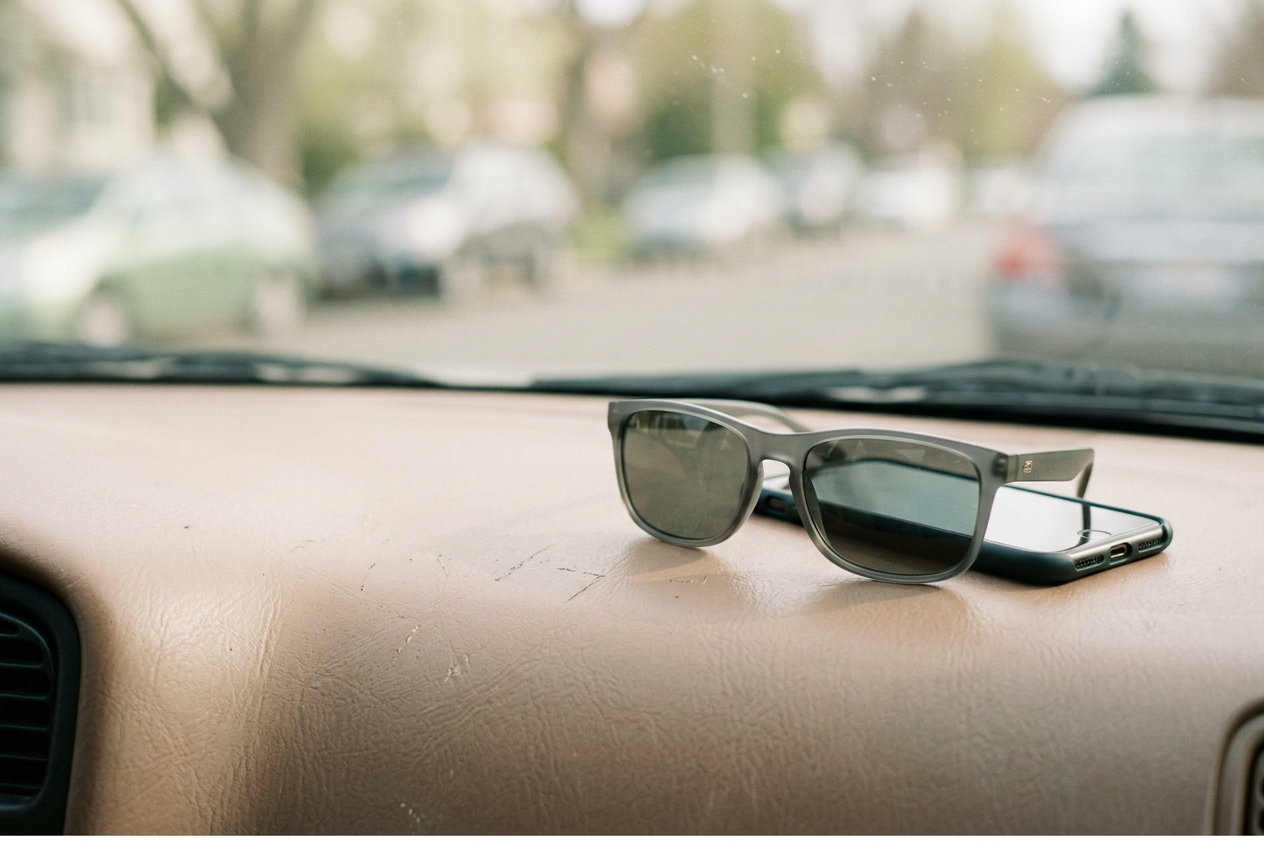
Start with one concrete reference pair: full-rim sunglasses with gray, category 3 polarized lenses and a UV400 claim. The lens looks dark from the outside. The frame blocks some light at the sides. Worn from a sunny road to a waterfront, this pair handles hard glare well, but it can make a dashboard display fade and may feel too dark when clouds roll in.
That single pair exposes the problem with shopping by lens color. Four specifications are doing different jobs, and the darkest-looking one is not necessarily the safest or most useful. This is unisex advice because lens performance does not change across wardrobes, though frame width, bridge fit and cheek contact still determine whether stray light reaches the eye.
Darkness and UV protection are separate
Lens category, the 0-to-4 scale printed on many product cards or lens descriptions, indicates how much visible light a lens transmits. It does not grade ultraviolet protection. A pale lens can carry a full UV claim, while a dark fashion lens should not be assumed to block UV unless the maker states that it does.
UV400, a label indicating protection against ultraviolet wavelengths up to 400 nanometers, is the specification to seek alongside wording such as 100 percent UVA and UVB protection. Buy from a retailer or maker that identifies the protection clearly. The claim can come from the lens material, an applied treatment or both; the tint is only what your eyes perceive in visible light.
Visible light transmission, or VLT, is the percentage of visible light that passes through a lens. On the commonly used category scale, category 0 transmits roughly 80 to 100 percent, category 1 about 43 to 80 percent, category 2 about 18 to 43 percent, category 3 about 8 to 18 percent and category 4 about 3 to 8 percent. Product labeling and regional standards can differ, so use the manufacturer’s stated category rather than judging a lens against a white wall.
Categories 0 and 1 cover clear, decorative or lightly tinted lenses. Category 2 suits moderate sunshine and often adapts better to mixed city light. Category 3 is the familiar dark sun lens for strong daylight. Category 4 is specialized for exceptional brightness and is labeled unsuitable for driving.
Our category 3 reference pair therefore answers only one question: it cuts a large amount of visible light. Its separate UV400 label addresses ultraviolet protection, while its polarization handles reflected glare.
For driving, inspect the dashboard first
A fixed category 2 lens is the flexible driving choice when a route moves through tree cover, overcast patches or short tunnels. Category 3 works in strong daytime sun, particularly on open roads, but the comfort margin narrows as conditions dim. Sunglasses should come off when there is no longer enough light to read the road clearly.
Polarization, a filter that reduces glare reflected from flat surfaces, can take the white flash off wet pavement and car hoods. The tradeoff sits inside the vehicle. Some liquid-crystal displays, head-up displays and phone screens look dim, rainbowed or nearly black through polarized lenses, especially when the screen and lens filters meet at an unfavorable angle.
Test this while parked. Put on the glasses, look at the instrument panel and rotate your head slightly. Check the navigation screen in both portrait and landscape orientation. The exact result depends on the display, its protective cover and the lens orientation, so a polarized pair that behaves well in one car may frustrate you in another.
This is where the gray category 3 polarized reference pair can fail. It controls road glare, yet a faint fuel gauge or disappearing head-up display is too high a price for that comfort. A nonpolarized category 2 or 3 lens is the practical alternative if the car’s displays become difficult to read.
Tint color matters less than category, but it still changes the view. Gray keeps colors relatively neutral. Brown or copper can increase perceived contrast while warming the scene. Green shifts color less aggressively than many fashion tints.
Strong blue, red or novelty colors deserve caution when quick recognition of traffic lights and signs matters.
For walking, category 2 is often enough
Street light changes block by block. A dark category 3 lens can feel excellent on an exposed avenue, then become cumbersome under scaffolding, dense trees or a station canopy. Category 2 gives up some comfort at noon but asks for fewer on-and-off adjustments across an ordinary day.
A gradient lens, meaning a lens that is darker at the top and lighter toward the bottom, solves a specific version of this problem. The upper area shades open sky while the lower section leaves a phone, café menu or bag contents easier to see. Behind the wheel, that lighter lower zone can also improve the view of conventional dashboard controls.
A gradient is still a fixed tint. It does not react to light, and its UV protection must still be stated separately. The fade may be visible from the outside, which can suit an aviator or oversized frame, but the fashion effect should not obscure the mechanical tradeoff: more visible light enters through the lower lens.
Photochromic lenses, which change tint in response to light, are another option for a day moving repeatedly between indoors and outdoors. Many do not darken as much inside a car because the windshield filters much of the ultraviolet light that activates them, although products designed to react to visible light can behave differently. Check the maker’s driving guidance rather than treating all photochromic lenses as interchangeable.
Bright water calls for polarization and coverage
Water changes the priority. Reflected glare arrives as a hard horizontal sheet, and polarization removes much of that distracting brightness in a way that a dark nonpolarized lens cannot. For a beach walk, ferry deck or day near open water, a polarized category 3 lens with a clear UV claim is the useful default.
The reference pair earns its place here. Gray keeps the view restrained, category 3 controls strong visible light and polarization reduces glare coming off the surface. Yet its full-rim construction matters almost as much as the lens label. A narrow fashion frame can leave bright light entering above, below and beside the lenses, while a larger lens or modest wrap gives better coverage without requiring a darker tint.
Polarization does not add UV protection by itself. Nor does it eliminate every reflection. Light can still bounce from metal, glass or textured water at angles the filter does not suppress, and reflections on a phone may change rather than disappear. A backside anti-reflective treatment can reduce light reflected from the inner lens surface, which is useful when the sun sits behind the wearer, but that coating is another separate specification.
Category 4 lenses belong to specialized, extremely bright environments. They are not the stronger all-purpose version of category 3, because they become a liability if the day includes driving or a rapid move into shade. For most people traveling to water by car, carrying a category 3 polarized pair is less complicated than managing a category 4 lens that cannot be worn for the journey.
The label worth paying for
UV protection does not require a luxury frame. Higher prices may cover optical refinement, polarization, durable coatings, complex prescriptions or frame construction, but a logo cannot replace a stated UV claim. Conversely, polarization is an upgrade worth considering for water and glare-heavy driving, while a city walker who mainly checks a phone may prefer a nonpolarized category 2 gradient.
Read the product description in a fixed order: UV claim first, lens category second, then polarization and tint format. Check the return policy before buying if dashboard screens are part of the use case, because that compatibility is difficult to settle from an online image.
The gray category 3 polarized pair remains a strong specialist rather than a universal answer. Keep it for open-road sun and bright water. Choose the lighter or nonpolarized alternative when changing light and screen visibility shape more of the day.
Questions people ask
Are polarized sunglasses always better for driving?
No. Polarization can reduce glare from wet roads and car surfaces, but it may dim instrument panels, head-up displays or navigation screens. Test the glasses in a parked car and turn your head slightly. If essential information fades, choose a nonpolarized lens with an appropriate daytime category instead.
Is category 3 too dark for everyday walking?
Category 3 suits strong daylight, especially on exposed streets or near water. It can feel too dark under trees, transit canopies and heavy cloud. A category 2 lens is often easier for a mixed-light day, while a gradient keeps the upper view shaded and leaves the lower view brighter.
Do gradient sunglasses have less UV protection at the bottom?
The visible tint is lighter at the bottom, but that appearance does not tell you how UV protection is distributed. Look for a UV400 or 100 percent UVA and UVB claim covering the lens. Treat the gradient as a visible-light feature, not as evidence for or against UV protection.
Why does a phone screen look black through polarized sunglasses?
Polarized lenses and some screen filters can block each other when their orientations align, making the display look dark or black. Rotating the phone or your head may restore the image, though results vary by display and screen protector. If frequent phone use matters, test before committing to the pair.
One update a day
Today's fashion update, in your inbox
One fashion update each morning — no hype, no filler, just pieces worth wearing.