Beach Haze Rinses Off. Scratched Lens Coatings Do Not.
Salt crystals and sunscreen make coated sunglasses look cloudy. The safe fix starts with fresh water, not the corner of a beach towel.
September 21, 2026 · 8 min read
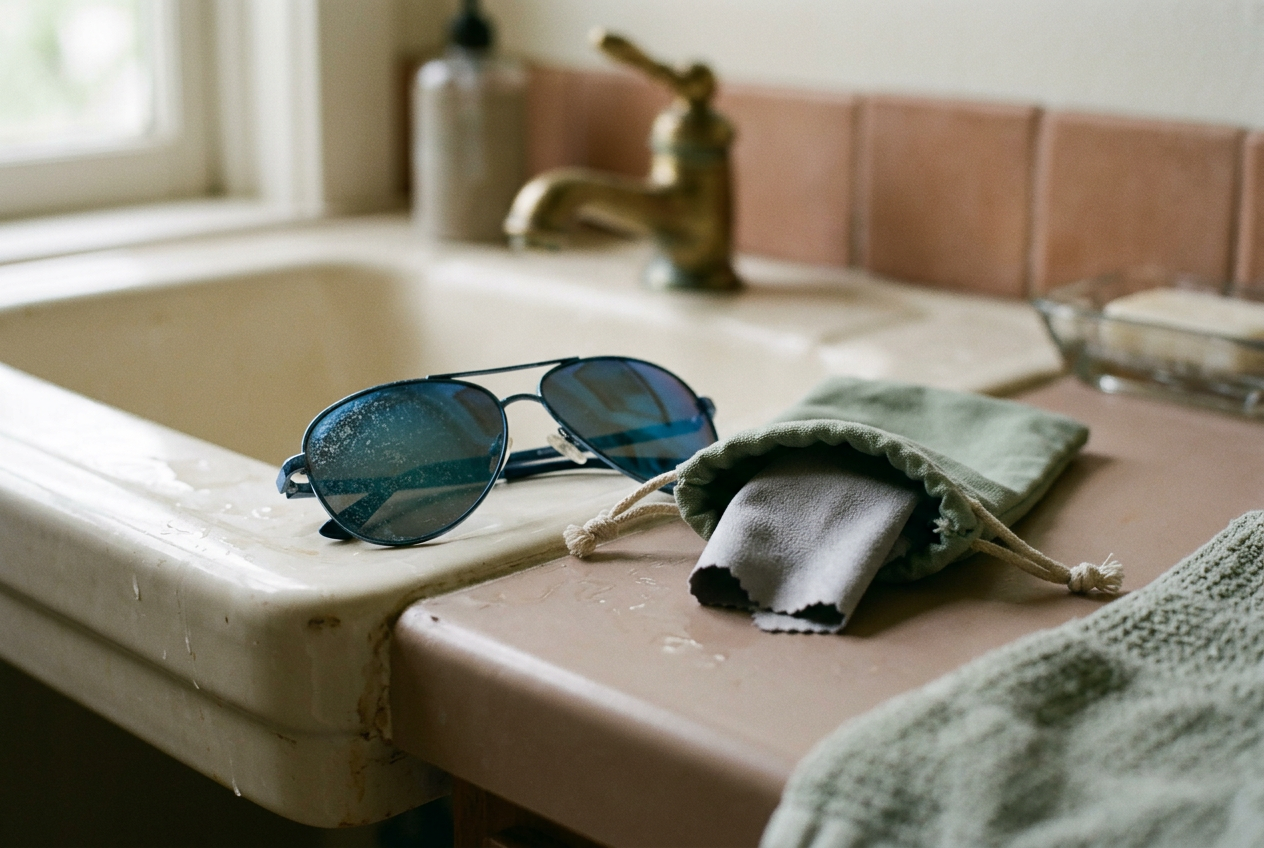
The blue mirror on a pair of Maui Jim sunglasses with Blue Hawaii lenses looked dull after a beach wear test. Fine salt had dried across the front. An oily thumbprint, transferred after applying sunscreen, sat near the bridge. The temptation was to polish both away with the clean-looking edge of a cotton cover-up.
That is the moment when removable haze can become permanent damage.
A mirrored coating, meaning the reflective layer on the front of a lens, shows fine scratches readily because each mark interrupts an even field of color. An anti-reflective coating sits on the back of many premium sunglass lenses to reduce distracting reflections from behind the wearer. It can be marked too, particularly when a sandy cloth is folded through the frame and rubbed against both surfaces.
This is unisex care advice. Lens coatings respond to salt, oil and friction in the same way regardless of the wardrobe around them.
The problem is the dry wipe
Saltwater does not dry into a soft film. It leaves crystals, and a lens that appears only misty may have hard particles sitting on top of sunscreen residue. Pressing a shirt, paper napkin or terry beach towel against that surface drags the particles across it.
Sunscreen changes the feel of the job. The oil-rich smear looks as though it needs vigorous buffing, while its tacky surface holds sand and lint that would otherwise fall away. Mineral sunscreen can leave an especially visible pale cast, but a clear chemical formula can produce the same greasy drag. Neither should be polished off dry.
For the hands-on check, I let the Blue Hawaii pair remain hazy until it could be cleaned under running water. I did not test a dry wipe, since deliberately grinding salt into a coated lens would measure the damage caused by bad care rather than the effectiveness of good care. Under angled light, the dried layer looked uneven and slightly iridescent; after rinsing and washing, that effect disappeared without hard rubbing.
Maui Jim describes Blue Hawaii as a blue mirror treatment over a neutral gray lens base, while its lens system also includes a backside anti-reflective treatment and water- and oil-resistant coatings. Those features make daily wear more comfortable. They do not make the surface immune to abrasion.
Rinse before the cloth comes out
Start by washing sunscreen from your hands. Pay attention to the pads of the fingers, since those are about to touch the frame and may touch the lens during washing.
Hold the open sunglasses under a gentle stream of cool or lukewarm fresh water. Rinse the front and back of each lens, then the bridge, hinges and the inner edges where the lenses meet the frame. Do not begin with a microfiber cloth, even a good one. Water should carry away loose salt and sand before anything makes contact.
Avoid hot water. Sunglass frames combine materials that can respond differently to heat, and there is no cleaning benefit here that justifies stressing adhesives, inserts or coatings. A hard faucet blast is unnecessary as well; a steady, low-pressure stream reaches the creases without knocking the glasses into the sink.
If fresh running water is unavailable, pour bottled water over both sides rather than dipping the glasses into a shared cup or rinsing them in the ocean. A quick seawater swish leaves more salt behind. Put the wet pair in a clean case only as a last resort, because trapped grit and a damp lining create another rubbing surface.
Use mild soap for the sunscreen film
Water removes loose salt but may leave an oily veil. Add a small amount of mild liquid dish soap without lotion, abrasives or citrus solvent to wet fingertips, then spread it lightly over both lens surfaces. The soap should reduce the oil enough that the fingers glide. If the lens still feels gritty, stop and rinse again.
Brand instructions differ in wording, which matters when a lens has a proprietary coating. Maui Jim's public care guidance allows mild liquid dish soap and warm water. Ray-Ban directs owners toward water, mild neutral detergent and a soft cloth, while Oakley emphasizes its Microclear bag and purpose-made cleaning kit and warns against unsuitable chemicals. The useful overlap is narrow: remove particles with water, avoid household solvents and use a clean material approved for optical lenses.
Do not substitute hand sanitizer, acetone, window cleaner or an unverified lens wipe. Alcohol is safe for some optical products and discouraged for others, so the manufacturer's instructions should settle that choice. Soap and fresh water are the lower-risk beach routine when the brand permits them.
Rinse until the soap is gone, including along the lens rim. Residue collected under a brow bar or around a thick acetate frame can work back onto the lens while the glasses dry.
Dry without polishing grit back in
Shake off excess water over the sink. Then use a freshly washed microfiber lens cloth, laying it against the lens and lifting moisture with light contact before making a gentle finishing pass. If the cloth has lived loose in a beach bag, it is not clean. Fine sand caught in microfiber can be difficult to see and easy to drag.
A soft cotton shirt is an alternative only when it is clean, smooth and free of salt or sunscreen. At the beach, those conditions rarely hold. Paper towels and facial tissues can shed fibers, and some paper products are rough enough to leave fine marks after repeated use. Terry towels are worse because their loops collect grit.
The drying cloth needs care too. Wash it without fabric softener, which can leave a coating-like film, and store it in a closed pouch once dry. Replace it if it remains greasy after washing or has picked up debris that will not rinse free. A branded cloth is not protective once it is dirty.
On the Blue Hawaii pair, one wash lifted the sunscreen thumbprint and restored the even blue reflection. No extended buffing was needed. That result is the practical dividing line: contamination changes or disappears as oil and salt are removed; coating damage stays fixed in the same place.
Tell haze from damage before cleaning again
Examine a clean, dry lens under diffuse daylight, first from the front and then from the back. Tilt it rather than staring through it at a bright lamp. A leftover fingerprint usually has a soft edge and may shift when touched by a clean damp cloth. Dried soap tends to form streaks or collect around the frame.
A scratch holds its position and becomes more visible at certain angles. On a mirror, it may appear as a bright silver line or a break in the colored reflection. Damage to a backside anti-reflective layer can look like a persistent cloudy patch, fine branching lines or an area with a different reflected color. Peeling near an edge, pinprick voids and a mottled patch that survives proper washing also point toward coating failure rather than beach residue.
Do not keep scrubbing a fixed mark. More pressure will not restore a missing coating, and abrasive polishing compounds can remove additional material while changing the lens optics. The lens substrate, which is the glass or plastic body beneath the treatments, may still be intact, but a damaged surface treatment generally requires a replacement lens rather than a stronger cleaner.
A useful test is one more controlled wash with brand-approved soap and a known-clean cloth. If the shape remains identical after the lens dries, photograph it against a plain background and contact the manufacturer or an optical shop about replacement options. Coating coverage and replaceable-lens policies vary, so buying a repair kit before checking the model is not worth the money.
Make the beach routine smaller
The lowest-effort kit is fresh water, a clean optical cloth in a sealed pouch and a rigid case. Keep the cloth separate from the glasses until the lenses have been rinsed. At home, wash the pair properly instead of letting the day's sunscreen sit around the nose pads, hinges and lens edges.
Do not rest mirrored sunglasses lens-down on a towel, even when the fabric feels soft. Fold the temples and set the frame upside down, or put it in the case. The outer mirror on the test pair was the most visually unforgiving surface; one fine line would have been far easier to notice there than on a plain gray lens.
Questions people ask
Can
I use a beach towel to dry sunglasses after rinsing them?
It is a poor choice because terry loops can hold sand, salt and sunscreen even when the towel looks clean. Let excess water run off, then blot and lightly wipe the lenses with a clean microfiber optical cloth that has been stored in a closed pouch.
Why do my sunglasses still look cloudy after washing?
Soap residue or sunscreen trapped near the frame may need another thorough rinse. If a clean, dry lens retains the same cloudy shape, branching lines or altered reflective color under angled daylight, the mark may be coating damage that further cleaning cannot reverse.
Are premoistened lens wipes safe for mirrored sunglasses?
Only use them when the sunglass manufacturer approves the wipe's ingredients for that lens. Coating chemistry varies, and an unlabeled wipe may contain alcohol or another solvent. Fresh water and manufacturer-approved mild soap are easier to verify after salt and sunscreen exposure.
Should
I replace a lens with one small coating scratch?
A small mark outside the main viewing area may be tolerable if it does not affect vision, but cleaning will not erase it. Seek a replacement lens if the damage sits in your sight line, creates distracting glare or appears to be spreading from the edge.
One update a day
Today's fashion update, in your inbox
One fashion update each morning — no hype, no filler, just pieces worth wearing.