Three Thin Chains Are the Limit Before Layering Turns to Knots
A seven-day wear test found that spacing and link shape matter more than adding another necklace. Three chains stayed manageable. The fourth turned dressing into detangling.
Women's · August 10, 2026 · 7 min read
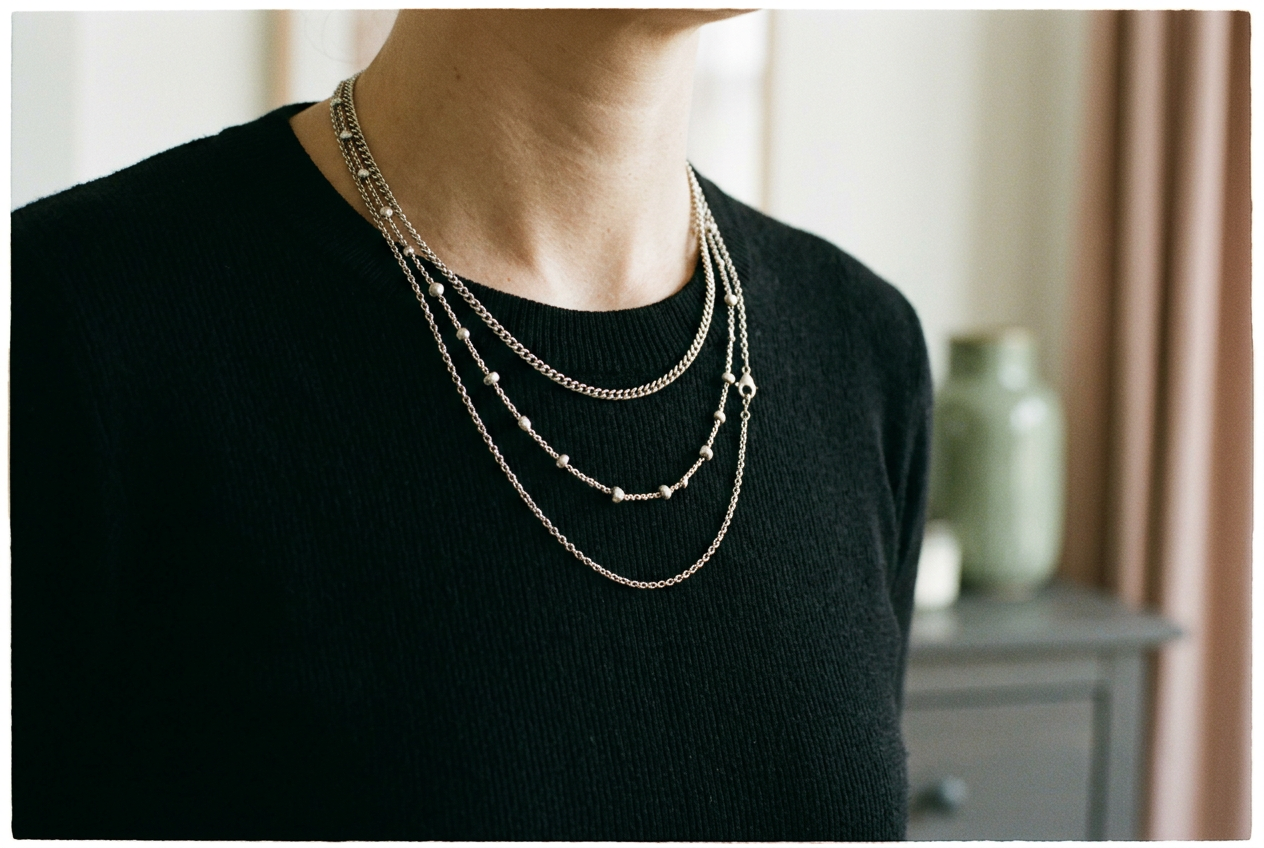
The trouble began at the back of the neck. A 16-inch sterling silver cable chain had crossed under an 18-inch curb chain, while the 20-inch pendant chain wound around both clasps. From the front, the layers still looked deliberate. At the nape, they had become one tight strand.
That three-necklace set became the anchor for a seven-day wear test: a 1-millimeter cable chain at 16 inches, a 1.3-millimeter curb chain at 18 inches and a 1.1-millimeter cable chain with a small pendant at 20 inches. A cable chain has uniform oval links set at right angles; a curb chain uses flattened, interlocking links that sit closer to the skin.
All three were sterling silver with conventional individual clasps.
This is women's everyday jewelry coverage, though the chain mechanics are not gender-specific. The styling scale is: fine chains worn close to the collarbone, under coats and over ordinary knitwear, rather than substantial chains that stay apart through their own weight.
The test answer was plain. Two chains were easy. Three needed a method. Four were not worth the morning maintenance.
Two-inch spacing does most of the work
Thin chains need enough vertical distance to move without constantly occupying the same line. In the test set, the 16-, 18- and 20-inch lengths produced visible steps across an open neckline, and that separation survived desk work and a moderate walk without much correction.
One-inch gaps looked more densely styled, but they disappeared as soon as the chains shifted toward the same collarbone. Once two fine links touch repeatedly, friction lets one chain travel around the other; the clasps then provide bulky points for the winding chain to catch. The front may separate again. The knot remains behind the neck.
Necklace length is not identical on every body. A 16-inch chain can sit at the base of one neck and higher on another, while a pendant changes the apparent drop even if the chain measurement stays fixed. Judge the gap while wearing the necklaces, not while laying them in straight lines on a table. The useful target is about two inches of visible vertical space between the chains at the center of the chest.
The 20-inch pendant chain was especially helpful because its small weight kept the lowest layer facing forward. A very heavy pendant would introduce another problem: it can pull a fine chain into a narrow V and drag the shorter necklaces toward it. For this stack, a light pendant with a smooth bail, meaning the loop that connects the pendant to its chain, supplied enough stability without taking control of the arrangement.
Link shape matters more than matching perfectly
Three nearly identical cable chains made a coherent stack from the front, but they also nested together. Their links were close in size, their surfaces met in the same way and none of the chains resisted winding around its neighbor.
Replacing the middle cable chain with the 1.3-millimeter curb chain improved the stack. Its flatter profile sat against the skin while the rounder cable chains moved above and below it, so the necklaces still crossed during wear but separated with a finger rather than tightening into a rope. That middle chain became the quiet divider.
The visual difference was slight. This did not read as mixed-metal styling or an intentional clash of necklace types. It was enough variation to change the mechanics.
A snake chain, which has tightly connected links that create a smooth tube, can also resist wrapping because its surface is less open. It brings a different tradeoff. Fine snake chains can kink, and a sharp bend may remain visible rather than relaxing when the necklace is straightened. For a daily stack that gets pushed under sweater collars, the curb chain was more forgiving.
Metal does not solve poor spacing. Solid gold and sterling silver have different price points and maintenance needs, while plated chains can show wear where necklaces rub together, but any two fine chains can twist if their lengths and link structures are nearly identical. Paying more may improve the clasp, finish or durability. It does not repeal movement.
The fourth chain changed the calculation
The fourth necklace was a 22-inch, 0.9-millimeter cable chain. On paper, it followed the same two-inch spacing rule. In wear, it added another clasp at the nape and another moving line across the chest, which gave the 20-inch chain two neighbors to wrap around rather than one.
The failure was not dramatic. That made it more annoying. The four chains could look fine through breakfast, then tighten while a coat was pulled off or a shoulder bag strap moved across the body. Detangling took only a few minutes, but those minutes arrived while getting dressed, when a necklace stack should be finishing an outfit rather than delaying it.
After several wears, the thinnest chain also showed why repeated tangling is more than a cosmetic nuisance. Pulling at a knot places pressure on small links and jump rings, the narrow metal rings that connect a chain to its clasp. A fine chain may survive the habit until one connection opens. The safer move is to stop pulling, lay the necklaces on a hard surface and loosen the knot with two pin tips or fine tweezers.
Four chains can work for a short event when the neckline stays open and outerwear is minimal. It was a poor everyday arrangement. The practical ceiling remained three, with the understanding that even those three had to be chosen as a set rather than collected at random.
A separator helps, but it has its own fit quirk
A necklace separator is a single bar or clasp unit with several attachment points, designed to keep individual necklaces aligned. It addresses the messiest part of layering by replacing several loose clasps with one organized closure.
For three chains worn repeatedly, a separator can earn its place. Attach the shortest necklace to the top position and the longest to the bottom, checking that the chains hang without crossing before closing the unit. The bar reduces winding at the nape and lets the full stack go on in one motion.
It does not freeze the necklaces in place. The front sections can still cross, particularly when the chains have similar links, and the separator itself can rotate toward the shoulder if one pendant is much heavier than the others. A larger metal fitting may also be visible with a wide or low back neckline. The cheapest versions can have rough attachment loops, which defeat the point if a fine chain catches on them.
I would skip the extra hardware for two necklaces. Their individual clasps are quick enough, and the separator adds weight where none is needed. For the tested three-chain set, it was useful on high-friction days involving a coat, a scarf or repeated changing. The open-neckline days did not require it.
The fastest morning order is longest first
Put on the 20-inch pendant chain first. Center the pendant, rotate its clasp to the back and add the 18-inch curb chain above it. The 16-inch cable chain goes on last, when the lower two are already hanging straight.
This order keeps short chains from blocking the longer clasps. It also reveals a crossed chain before the full stack is closed. If the lowest necklace has already looped over the middle one, remove it and start again; threading a pendant through the gap can create a twist that looks corrected at the front while remaining crossed at the back.
Clasp every necklace before storage. An open chain end can pass through another necklace and form a knot inside the jewelry box, which means the morning starts with damage control. Store each chain in its own shallow compartment or small pouch, with a little chain left outside the pouch closure so the necklace cannot gather into a tight heap.
The seven-day set behaved best when it was treated as one styling unit but stored as three separate pieces. That distinction matters. Keeping the necklaces together on one hook saves seconds at night and can cost several minutes the next morning.
Clothing can undo a well-built stack
Bare skin gave the three-chain set its cleanest wear. A smooth cotton crewneck was manageable, though the shortest chain sometimes slipped beneath the collar. Brushed knits created more drag, and loose fibers caught around the pendant bail and chain links.
Outerwear was the largest disruption. A coat collar pushed the 16-inch chain upward, while removing the coat pulled the longer chains sideways. On those days, putting the necklaces on after the coat was the better move when possible. If the jewelry had to go on first, the separator reduced the clasp knot at the back even though the chains still needed straightening at the front.
Scarves and three fine chains asked too much of the same small area. I would choose the scarf or the full necklace stack, not both. A single pendant under a scarf is less likely to catch and easier to check before leaving.
Buy the missing length, not another near-duplicate
Before buying a layering set, measure the necklaces already in the jewelry box from end to end with the clasp closed. If two favorites are both around the same length, an extender may be enough; an extender is a short section of chain that adds adjustable length at the clasp.
Choose one that matches the chain's metal and does not outweigh the necklace. A bulky extender can drag the clasp forward, particularly on a fine 16-inch chain. It may still be a better purchase than another necklace, because it creates the two-inch interval the existing stack lacks.
For a new three-piece stack, prioritize secure clasps and smooth connecting rings over a perfectly matched set. A lobster clasp, a spring-loaded fastener shaped like a small claw, is easier to grip than a tiny spring-ring clasp and often feels less fiddly during a rushed morning. Check that the clasp closes fully and that no gap is visible in the rings beside it.
The useful formula is narrow: three chains, roughly two inches apart, with a flatter middle link and a light pendant on the longest layer. The tested 16-, 18- and 20-inch set met that formula. Adding the 22-inch chain supplied more jewelry, but no better outfit.
Questions people ask
How many thin necklaces can I layer without tangling?
Two are low maintenance. Three can work daily when the lengths are separated by about two inches and the middle chain has a different link shape. Four add enough moving chain and clasp hardware that routine dressing becomes less predictable, especially under coats or knitwear.
Do necklace separators prevent every tangle?
No. A separator organizes the clasps and limits winding at the nape, but the chains can still cross at the front. It works best when the necklaces have distinct lengths and similar overall weight; one heavy pendant may rotate the whole fitting toward the shoulder.
Should the heaviest necklace go on the bottom?
Usually, but keep the pendant light relative to the chain. A modest weight stabilizes the longest layer, while a heavy pendant pulls the chain into a deep V and can draw the shorter necklaces toward it. The bottom chain should anchor the stack without dragging it.
Can I sleep in layered thin chains?
It is better to remove them. Fine chains can wind together as the neck and shoulders move against bedding, and pulling apart a tight overnight knot can strain links or connecting rings. Clasp each necklace and store it separately before bed.
One update a day
Today's fashion update, in your inbox
One fashion update each morning — no hype, no filler, just pieces worth wearing.