
Polka Dots Are Getting Bigger, and They Date Faster
Dot scale changes more than mood. Pin dots can work like a neutral, while oversized spots make the season and the garment much easier to place.
Women's · October 19, 2026 · 7 min read
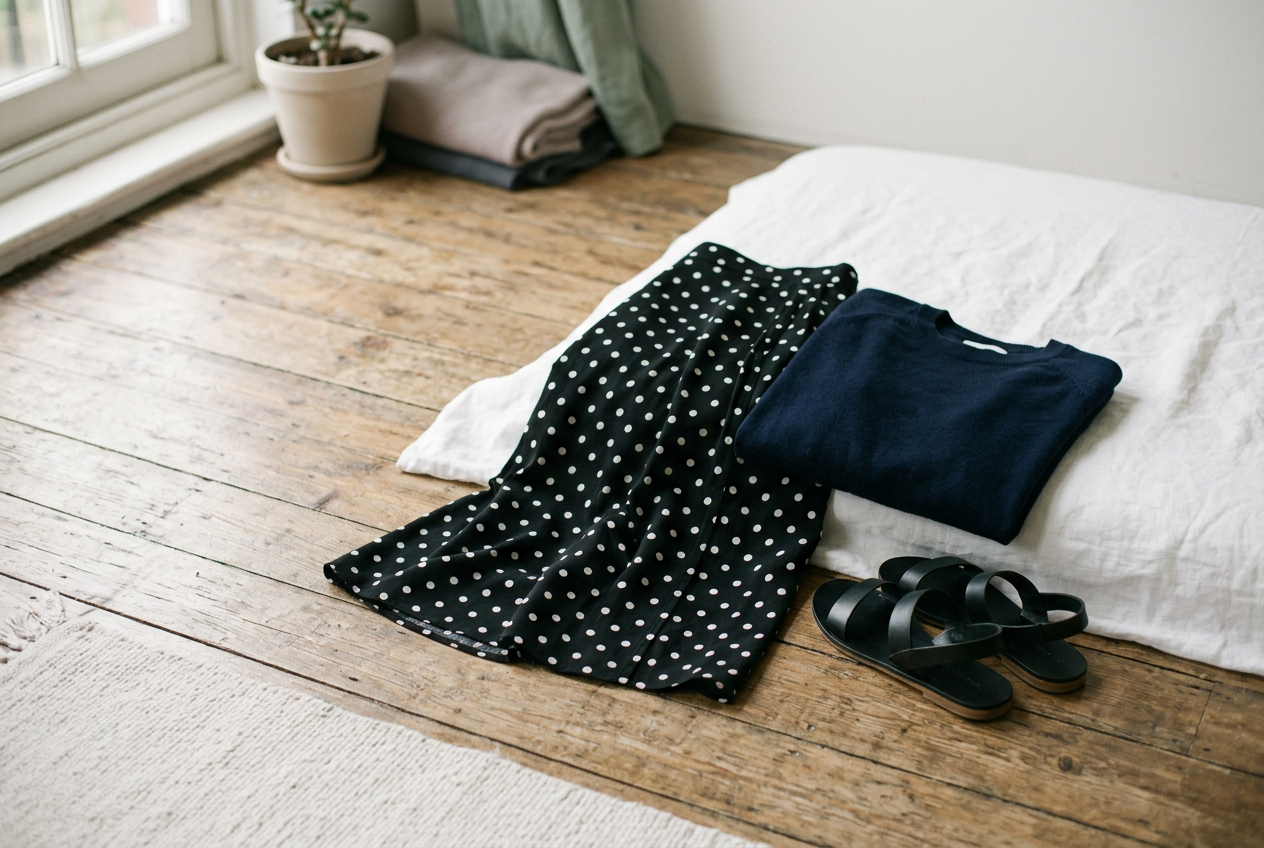
The change is visible across women's dresses, skirts and blouses: the tidy polka dot has expanded into larger circles, loose ovals and spots that run off an edge. Mango, Zara, Rixo, Reformation and Ganni approach the print differently, but current retail pages collectively make more room for dots that cannot be mistaken for background texture.
Scale decides how much work the print does. It also affects seam placement, outfit repetition and resale photographs, where a large spot is immediately legible but a pin dot can disappear. The useful distinction is not printed versus plain. It is whether the eye reads texture, pattern or image.
The skirt that sets the scale
Use one garment as the control: a black viscose midi skirt with white dots roughly the width of a thumbnail, evenly spaced, cut on the bias and finished with a side zipper. A bias cut, meaning the fabric is cut diagonally across the grain, lets woven cloth fall closer to the body and move more freely around the hips.
This is women's coverage, and fit matters here because the print stretches differently over a curved hip than it does on a straight-hanging shirt. On the control skirt, the dots remain recognizable from across a room, yet they are small enough that a navy crewneck and black flat sandals can quiet them. The skirt leads, but it does not take over.
Viscose adds another variable. Its fluid drape keeps evenly spaced dots from looking rigid, though the cloth can crease at the lap and may grow slightly while damp. A similar print on crisp cotton reads more graphic; on polyester satin, reflected light raises the contrast and makes each white circle look sharper. Dot size cannot be judged apart from surface.
Pin dots disappear at conversation distance
A pin dot is a very small repeated dot that reads almost like grain from several feet away. In navy and cream, charcoal and pale gray, or brown and muted white, it can perform much like a fine stripe: the garment carries pattern, but jackets, shoes and jewelry do not have to answer it.
That makes pin dots the least date-sensitive version. A pin-dot silk blouse can sit under a suit, while a fine-dot cotton poplin shirt works with denim without requiring a deliberately retro outfit. Low contrast extends that usefulness. Black fabric with brilliant white pin dots remains busier than navy with softened cream, particularly in photographs, where a dense repeat can produce moiré, the rippling visual interference that appears when a camera sensor struggles with tiny patterns.
Construction still shows. On low-cost garments, very small dots can blur where the fabric folds into a narrow hem, and poor printing may leave the base color visible when seams pull. Check the side seam and zipper area rather than the center front. If the dots distort there before the garment is worn, they will not improve after a wash.
Pin dots have one weakness in resale. They are often hard to see in a listing thumbnail, so the cut, fiber and brand must make the case. That does not make them a poor secondhand buy. It means a seller's first photograph may understate them, which can favor a patient shopper willing to enlarge images and read the composition label.
Mid-size dots carry the most associations
The evenly spaced mid-size dot, represented by the control skirt, is the familiar polka dot. It is neither texture nor abstract image. It can read polished, playful or knowingly vintage depending on the garment around it, which is useful but makes the surrounding details unusually important.
A bias-cut midi skirt with a plain waistband keeps the print mobile. Put the same dots on a fit-and-flare dress with a small collar, covered buttons and a gathered sleeve, and the period reference becomes much stronger. The dots did not change. The combination of scale and silhouette did.
This middle size is often the best single purchase for someone who enjoys visible print but still wants outfit range. The control skirt can take a loose white T-shirt in summer, then move under a longer knit when the weather cools. A belt is less helpful: it divides an already emphatic repeat and can push the outfit toward deliberate nostalgia.
Spacing deserves attention. Even gaps create order and make a mid-size dot easier to combine with simple clothes. Crowded circles generate more visual movement, while widely spaced dots expose more ground color and draw attention to each individual mark. On a fitted garment, check whether spacing opens across the bust or hips.
A woven piece that pulls enough to turn circles into ovals is too tight, regardless of what the size label says.
Oversized spots own the silhouette
An oversized spot cannot function as a neutral because the eye registers placement before repetition. Once circles grow toward palm size, or become irregular enough to resemble painted marks, a dress is no longer merely polka-dotted. Its front panel may contain a handful of distinct shapes, each of which affects the composition.
This is where current assortments feel newest, particularly on column dresses, full skirts and matching sets. The scale suits clean cuts because large marks already supply movement. Added ruffles, bows or complicated seaming leave less visual space, although a fluid fabric can soften the effect when spots break around folds rather than sitting flat and circular.
Placement is the practical risk. A large white spot cut in half at the center-front seam looks accidental unless the repeat is clearly irregular throughout, and two circles landing symmetrically on the bust can create an unwanted focal point. Product photographs may show a sample with better placement than the garment delivered because pieces cut from different areas of printed cloth will vary.
Oversized spots are also the easiest to date. Their scale records a strong fashion decision, especially when paired with another high-signal feature such as a bubble hem or extreme sleeve. That does not make them a bad purchase. It makes cost per wear less predictable, so the premium contemporary version is difficult to justify unless the cut and fabric would remain appealing after the print loses momentum.
Retail and resale reward different dots
Retail photography favors the large spot. It reads on a phone screen, separates one dress from a page of black dresses and conveys the print before the shopper opens the product page. Pin dots need close-ups. Mid-size dots sit between those demands, which helps explain why they persist even as editorial attention moves toward larger scale.
Resale reverses part of that logic. On The RealReal, Vestiaire Collective, eBay and Depop, oversized prints can be easy to recognize, but recognition does not ensure demand. Asking prices are not completed sale prices, and a conspicuous print narrows the pool of shoppers who can imagine wearing it repeatedly. Search terms also matter: sellers may describe irregular spots as abstract, graphic or dalmatian rather than polka dot.
The control skirt has an advantage here. Its thumbnail-size dots are visible in a listing, while its black ground and uncomplicated midi cut give a buyer several familiar styling routes. Fiber remains decisive. A viscose skirt may drape better than a stiff synthetic one, but the listing should disclose pulls, shine at the seat and any hem distortion caused by hanging it while wet.
For secondhand shopping, compare the pattern at the side seams and inspect the largest uninterrupted section of fabric. A print that looks balanced only because the seller folded away an awkward spot will be harder to style once the whole garment is visible.
The buying test is distance, then detail
Start by viewing the garment from several feet away. If the dots merge into texture, treat it as a near-neutral and focus spending on fiber, fit and construction. If each dot stays distinct, the print is part of every outfit. If individual spots dominate the outline, buy only when that graphic effect is the reason you want the piece.
Then move close. On the control skirt, the useful checks are whether the dots remain round over the hip, whether the side seam breaks the repeat cleanly and whether the viscose recovers after being lightly crumpled in the hand. A skirt that fails those checks is not rescued by having the most versatile dot size.
Pin dots are the safer investment band, especially in silk, cotton or fine wool. Mid-size dots make sense at mass-market through premium contemporary prices when the cut is plain and wearable. For oversized irregular spots, secondhand is the more convincing experiment until repeated wear proves that the print belongs in the wardrobe rather than in one summer photograph.
Questions people ask
Which polka-dot size is easiest to wear?
Pin dots are easiest when the contrast is low because they recede into texture and combine with more shoes, jackets and accessories. Evenly spaced mid-size dots are still versatile, but they remain visible across a room and can look retro when paired with gathered sleeves, small collars or fit-and-flare shapes.
Do large polka dots make a garment look dated?
They can date a garment faster because scale is a conspicuous trend decision. Irregular spots may age better than perfectly repeated giant circles if they read as an abstract print, but placement and silhouette still matter. A simple column dress has more staying power than the same print combined with several directional details.
What should
I check when buying polka dots secondhand?
Enlarge the photographs and inspect side seams, zipper areas and the placement of large spots across the bust or hips. Read the fiber label, then look for pulls, surface shine and a stretched hem. On viscose, distortion may indicate that the garment was hung or handled while wet.
One update a day
Today's fashion update, in your inbox
One fashion update each morning — no hype, no filler, just pieces worth wearing.