Mesh Ballet Flats Stay Cooler. Your Toes Pay for It.
A full day in open mesh confirmed some airflow, plus a less charming delivery of pavement grit. The deciding issues were the toe seam and flimsy side support.
Women's · August 10, 2026 · 8 min read
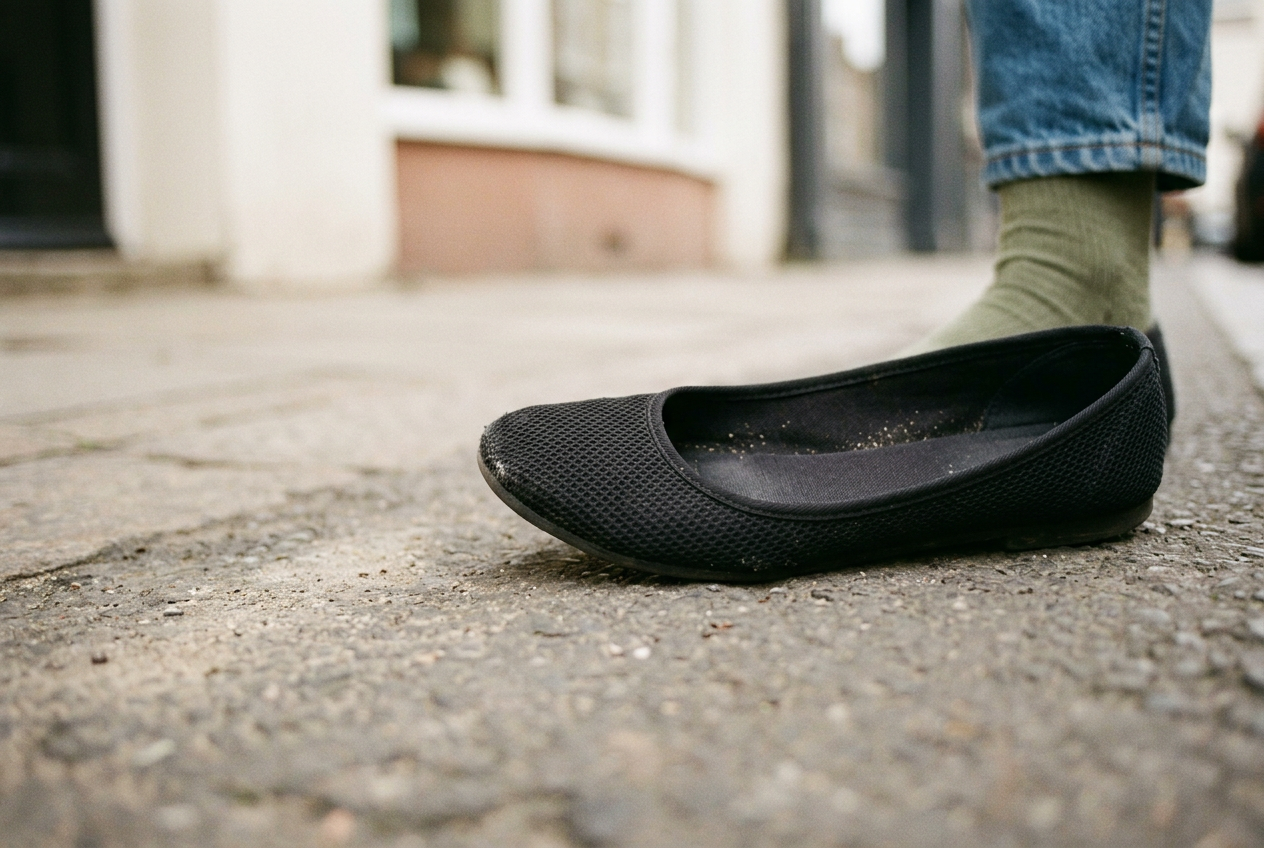
The test pair was a black, round-toe women’s ballet flat with an open synthetic mesh upper, textile edging, a small lined section around the toes and heel, and a thin fixed foam insole. Underneath sat a flexible rubber outsole, meaning the layer that meets the pavement. I wore this one pair through a warm, dry day of walking, public transit, indoor stops and an evening meal, without socks or backup insoles.
That construction matters. Open mesh looks almost absent on the foot, but a shoe still needs enough material to hold its shape, cover internal seams and stop the toes from sitting directly on glue. In this pair, the most ventilated area was the middle of the forefoot. The parts that usually become uncomfortable first, including the toe edge and heel, were also the parts covered by lining or binding.
The result was cooler than a fully lined synthetic ballet flat, though nowhere near sandal territory. It was also grittier, less stable and more demanding about toe shape than the airy photographs of mesh flats tend to suggest.
Airflow worked best while the shoe was moving
During the first walking stretch, air passed through the exposed mesh across the top and sides of the forefoot. The difference was noticeable against a conventional faux-leather flat, particularly where the mesh sat slightly away from the skin rather than stretching tightly across it.
Standing still changed the calculation. On transit and during indoor stops, the fixed foam insole held warmth under the foot, while the lined toe section reduced ventilation exactly where the toes were pressed together. The upper remained cooler than an opaque synthetic one, but the sole of the foot still felt warm because mesh does nothing to ventilate through foam and rubber.
Fit influenced the cooling effect as much as the holes did. When open mesh is pulled taut, it lies directly against the skin and leaves little space for air to move; when the shoe has a fraction more volume, walking flexes the upper and creates a mild pumping effect. That does not justify buying a loose size, because a slipping heel creates a new and more immediate form of misery.
The useful shopping test is to press the upper over the widest part of the foot while standing. If every opening is stretched into a long oval and the mesh pattern marks the skin, the shoe is already relying on the upper to provide width it does not possess. It may feel ventilated during a brief fitting, yet the tension will increase pressure at the edge of the toe lining over a longer day.
City grit did not respect the styling concept
Open mesh admits fine dust. That sounds obvious, but the amount becomes clearer when bare toes, dark fabric and a full day outside are combined. By midafternoon, a light film had settled around the edges of the insole and inside the mesh near the ball of the foot. Larger debris stayed out; fine pavement dust did not.
The black upper disguised the outside dirt well. Inside, the pale residue collected where the mesh joined the sole, a narrow channel that was awkward to reach without bending the upper back. Shaking the shoe removed loose particles, while a soft dry brush handled most of what remained. A damp cloth worked on the rubber edge, though soaking the shoe would have risked weakening the glued construction and distorting the textile binding.
Anyone planning to wear mesh flats on dusty commutes should check the care label before buying and inspect whether the insole lifts out. A removable insole would make this problem easier to manage. The fixed one in the test pair turned cleaning into close work with a brush, which is more intimacy than pavement residue deserves.
Sheer socks or foot liners can keep grit off the skin, but they change the appearance and may show through the open weave. A tonal liner is the least disruptive option. Bright white under black mesh reads as an intentional styling choice, whether or not the wearer intended to make one.
The toe seam was the real limit
The toe box, meaning the interior space around the toes, looked rounded and forgiving from above. It was less generous inside. A narrow strip of lining reinforced the front edge, and the seam where that lining ended sat across the tops of the smaller toes.
For the first part of the day, the seam registered as mild pressure. As the foot warmed and expanded, it became the clearest point of discomfort, leaving a temporary indentation where the lining met the mesh. The flexible upper did not solve this because the seam itself had less stretch than the surrounding material. Soft-looking shoes can still contain a firm internal border.
This is the fit quirk to test in a store. Stand rather than sitting, spread the toes, then bend the foot as it would bend during a step. If a seam crosses a toe joint or the top of a toenail, extra wear is unlikely to turn it into a better location. Mesh may relax, but stitching and lined edges usually change less.
The round shape also narrowed sooner than its outline suggested. Buyers with a longer second toe, a broad forefoot or toes that sit high should look for a square or almond-shaped mesh flat with visible depth at the front. Going up a full size can create heel slip without moving the seam far enough forward, so width and toe shape matter more than the size number alone.
Side support was mostly visual
The test pair had limited lateral support, the side-to-side resistance that keeps the foot centered over the sole. On level pavement this felt manageable. During quick turns, sloped sidewalks and the sideways shuffle required in a crowded space, the foot shifted over the edge of the narrow outsole before the mesh pulled it back.
A conventional ballet flat is rarely a stability shoe, but a denser woven upper or leather side panel can provide more resistance than open netting. This pair depended on the textile edge around the opening to hold the heel and sides. That edge stayed in place, yet the mesh below it bowed outward under load.
Look at the sole from underneath before buying. If it is markedly narrower than the footbed through the middle and forefoot, the flexible upper will have little platform to work with. A slightly wider outsole, a firmer heel counter, which is the reinforced section cupping the heel, and a strap across the instep would each make a mesh flat more secure without turning it into athletic footwear.
Arch support was minimal. The foam softened the first contact with pavement but flattened under body weight, so the shoe still felt thin by late afternoon. Anyone who already relies on structured insoles should skip fixed-footbed versions unless there is enough internal depth to accommodate an insert without forcing the toes into the upper.
Repeated flexing changed the upper
At the end of the day, the mesh had developed a visible flex line behind the toe lining. It was not a sharp crease, as it would be on coated material, but the openings looked slightly compressed where the shoe bent under the ball of the foot. The inner side also showed mild waviness after repeatedly bowing outward.
Black helped. On a pale color, trapped dust and uneven mesh openings would probably draw more attention, while a very fine net could be more vulnerable to pulls from rough pavement, bag hardware or a careless toenail. The tested upper did not tear, though its tidy new-shoe tension had softened by evening.
Before purchasing, bend both shoes at the natural flex point, the place where the sole folds beneath the ball of the foot. The upper should collapse without a reinforced seam digging downward. Check the display pair for distorted holes or loose threads there, since it has already endured more handling than a boxed pair and can reveal how the material responds.
The buying decision comes down to construction
Mesh ballet flats make sense for warm, dry days when a closed toe is useful and the walking demand is moderate. They offer more air than opaque synthetic flats, and less protection than almost any conventional upper. The test pair worked best during continuous, straightforward walking; heat returned during stationary periods, and side movement exposed the limits of the narrow sole.
At lower high-street prices, that tradeoff can be reasonable if the internal seams sit clear of the toes. At designer prices, open mesh alone is not enough to justify the premium. Look for softer binding, a shaped or removable insole, a wider outsole and reinforcement placed away from toe joints. Those details affect the day more than a logo attached to netting.
For long walking days, the better alternative is a woven flat with a denser upper and a supportive sole, or a ventilated sneaker if the outfit allows it. For dinner, office wear and short city routes, mesh keeps the closed-flat silhouette while reducing some heat. It does not turn a thin ballet flat into climate control.
Questions people ask
Are mesh ballet flats cooler than regular ballet flats?
They are cooler across the exposed upper while the foot is moving, especially compared with fully lined synthetic material. The improvement is limited by the toe lining, heel reinforcement and foam insole, all of which still hold warmth. Expect a modest reduction in heat rather than sandal-level ventilation.
Should mesh ballet flats fit tightly?
No. The mesh can look forgiving while concentrating pressure at less flexible seams and binding. A secure heel is useful, but the forefoot should not stretch the openings into long shapes or leave the mesh pattern on the skin. Choose a wider or differently shaped toe box rather than relying on the upper to expand.
Can mesh ballet flats handle a full day of walking?
A supportive pair may manage it, but the tested flat became uncomfortable at the toe seam and felt thin underfoot by late afternoon. For a full day, prioritize outsole width, internal seam placement and enough depth for an insole. Open mesh by itself does not improve cushioning or stability.
How do you keep mesh flats clean in a city?
Let dry dirt fall out first, then use a soft brush inside and outside, concentrating on the join between the mesh and sole. Wipe the rubber edge with a damp cloth and follow the shoe’s care label before using water on the upper. For regular dusty routes, a removable insole is the practical choice.
One update a day
Today's fashion update, in your inbox
One fashion update each morning — no hype, no filler, just pieces worth wearing.