Studded Flats and Belts Can Survive, but Check the Back
The stud itself tells you little. Turn over a belt or look inside a flat to find the attachment method, then check whether flexing, friction, or a thin base will loosen it.
August 10, 2026 · 8 min read
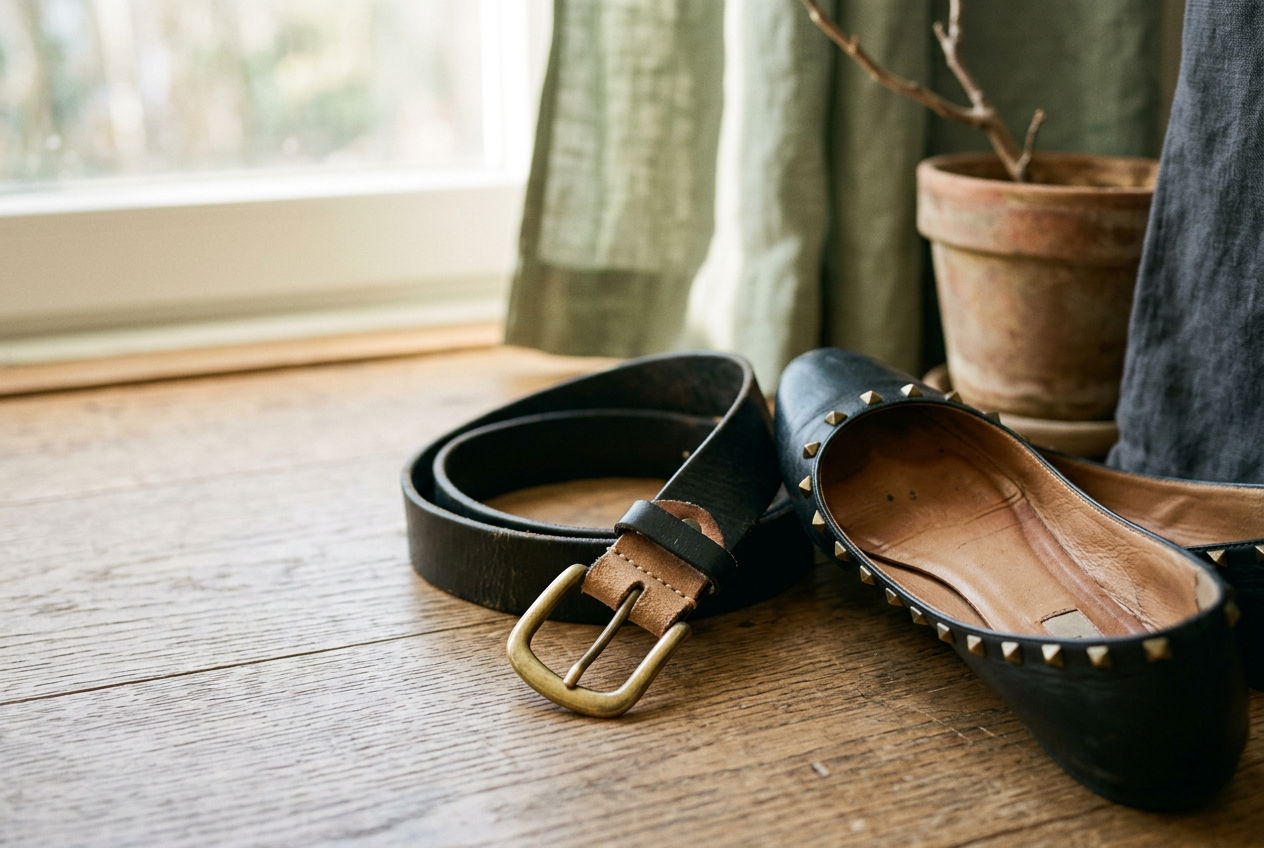
Studs have moved back onto pointed flats, slim belts, ballet shapes, and broad waist belts, often as small silver domes rather than the heavier hardware associated with older punk references. The visual shift is easy to spot. The useful distinction is underneath.
Take one common secondhand candidate: an unbranded black leather belt with two rows of nickel-colored dome studs. The underside is unlined, so each stud reveals two narrow metal legs folded against the leather. One dome beside the most-used buckle hole rocks when pressed, and its legs have started to lift. That belt is the reference case for this inspection because it shows both the advantage and the weakness of prong-set hardware.
The stud can be tightened, but the punctured leather around it has already taken some strain.
The construction advice here is unisex. Stud placement changes with shoe shape and belt width, but the tests apply across wardrobes and size ranges.
Start with the attachment, not the shine
A prong-set stud has narrow legs that pierce the base material and fold flat on the reverse. This is common on belts because the maker can set many studs without using a separate post for each one. It also appears on flats, especially when the upper has a lining that hides the metal legs from the foot.
Prongs give a stud a mechanical hold, meaning the attachment passes through the material instead of relying only on adhesive. That is generally encouraging. The catch is that every prong creates a small hole, and repeated bending can enlarge it, particularly in thin split leather, soft synthetic uppers, or polyurethane-coated material that has begun to crack.
Return to the black belt. Most of its prongs sit flat and point away from the belt edges. The loose stud near the buckle hole is different: that section curves sharply whenever the belt is fastened, while the neighboring hole concentrates pulling force in the same patch of leather. A secure attachment has been placed in an unforgiving location.
Run a fingertip over the reverse rather than scraping it with a nail. A raised tip can catch a knit top, scrape skin, or work itself farther open. On a lined belt, press each dome lightly from the front and compare its movement with the others. One rotating or rocking stud deserves attention even if the lining prevents a direct view.
Rivets hold well until the base gives way
A riveted stud uses a post passed through the material and compressed into a cap. The finished hardware usually presents a round back rather than two folded legs, although a lining may cover it. Rivets tend to resist casual pulling better than small prongs, which makes them sensible for a substantial leather belt or a stud positioned away from the main flex line of a shoe.
The base still matters. A tightly set rivet can behave like a rigid button in a soft upper, so the surrounding material bends while the circle beneath the hardware does not. Look for a pale stress ring, an enlarged hole, or a fine split radiating from the post. On coated synthetic leather, the surface film may lift before the rivet itself moves.
Placement inside a flat also affects comfort. A rivet back under a thin lining can press against the toes or the side of the foot, and that pressure may not register during a brief try-on if the shoe is worn without the socks or hosiery intended for regular use. Press inside the upper with a thumb. Any hard bump that is easy to locate by hand is unlikely to disappear during a commute.
Riveted hardware is the stronger option when the upper or belt is thick enough to support it. It is not an automatic mark of quality, and a heavy cluster can make a soft ballet flat collapse or twist when lifted by the heel.
Glue is hardest to judge before it fails
A glued stud has a flat back fixed to the surface with adhesive. There is no puncture, which preserves a delicate textile or thin synthetic base, and the reverse should remain smooth. Gluing also allows small domes and angular pieces to sit close together without filling the inside of a shoe with metal backs.
Inspection is less reassuring. A cleanly glued stud reveals almost nothing about the adhesive beneath it, while a poor one may remain attached in the store and release after moisture, warmth, or repeated flexing reaches the bond. The first warnings are often a visible glue halo, a stud sitting at a different angle from its neighbors, or a narrow shadow under one edge.
Do not pry at the hardware on a new or secondhand item. Instead, flex the material gently over the curve of your hand and watch the edges. On a flat, concentrate on the vamp, meaning the upper section that crosses the front of the foot, because it creases during each step. A glued stud centered on that crease has a harder job than one placed on a firmer toe cap or near the side of the upper.
Glue can be repaired, but the result depends on access and surface condition. Old adhesive must often be removed without stripping a metallic finish or damaging coated leather, and a replacement stud may leave a visible ring. A scattered design tolerates that imperfection better than a precise grid in which one shifted dome interrupts the pattern.
Heat-applied studs belong on calmer surfaces
Heat-applied embellishments, sometimes sold as hot-fix studs, carry a thermoplastic adhesive that melts under controlled heat and bonds as it cools. Many are lightweight metal-look pieces rather than solid metal hardware. They are common in dense motifs because a group can be transferred into place at once.
These pieces can wear reasonably on a flat textile panel. They are less convincing across the folding edge of a ballet flat or around the buckle end of a belt, where the base repeatedly bends into a tight curve. Heat can also soften some adhesives again, while moisture and surface coatings interfere with the original bond.
Look across the design from a low angle. Several pieces lifting along the same line suggest that the underlying material folds there, which matters more than one isolated missing stud. A blank spot with a glossy residue usually points to adhesive attachment; a small puncture or torn opening indicates that mechanical hardware was lost.
Replacing one heat-applied piece is possible if a close match can be found, though matching the finish may be harder than attaching it. Bright silver, darkened silver, and warm nickel separate noticeably once they sit in the same row.
Flats fail where the foot makes them move
The safest studded flat is not necessarily the stiffest. It has enough structure beneath the embellishment to prevent extreme folding, while the rest of the shoe still allows the foot to move. A reinforced toe cap can carry riveted or prong-set hardware well. Dense studs across an unstructured vamp are a less settled proposition.
Bend the shoe only as much as it would bend in a step. The natural crease should not run directly through several rigid studs, and the spaces between them should not open into sharp V-shaped folds. Check the top line for hardware that could catch a trouser hem, then feel inside for exposed backs, rough lining seams, or foam compressed around rivets.
Studs near the widest part of the forefoot can also alter fit. Hardware and backing layers reduce local give, so a flat that feels merely close in the store may not relax like an undecorated leather version. For a wide forefoot or bunion, prioritize studs on the toe tip, heel counter, or another area that does not need to stretch.
A missing stud on a scattered design may be livable. Pressure against the foot is not.
Belts reveal more when they are fastened
Inspect a belt in the curve it will hold around the body, rather than leaving it flat on a table. Hardware beside the favorite buckle hole, around the keeper, and near the point where the tail turns back will experience the most movement. On the reference black belt, the rocking dome becomes more obvious once that section is curved.
Leather should remain firm around each puncture without looking dry or torn. A synthetic belt needs closer scrutiny because a neat surface can hide a textile backing that has stretched around the hardware. If the studs are heavy, hold the belt by one end and note whether the decorated section twists; that torque will return during wear and can distort narrow belt loops.
Secondhand shoppers have one advantage: early failures have already had time to show. Compare the most-flexed area with a quiet section near the middle back. Matching, flat hardware is promising. Missing pieces, replacement studs in a different tone, or several enlarged holes turn a low price into a repair project.
I would still consider the black prong-set belt if its cost reflected that work and the loose dome could be removed without exposing a large tear. At a premium price, I would leave it. A plain, sound leather belt costs less attention, and embellishment is not valuable enough to make recurring snags feel inevitable.
The purchase test takes under two minutes
First identify the reverse: folded legs indicate prongs, round metal backs suggest rivets, and a smooth uninterrupted underside usually points to glue or heat application. Then curve the belt or flex the shoe at its natural working point while watching for movement. Finish by checking the material around the attachment and any lining that sits between hardware and skin.
Consistency matters more than perfection. One slightly dull dome is cosmetic; one mobile dome among firmly seated neighbors is structural information. On new pieces, favor repairable hardware and sensible placement before paying extra for a dense pattern. On secondhand pieces, a well-set rivet or flat prong can be a better buy than pristine-looking glue whose edges have begun to haze.
The embellishment can survive regular wear. The undecided part is whether the current crop has been placed with regular wear in mind.
Questions people ask
Are riveted studs always better than glued studs?
No. Rivets resist pulling well when they pass through substantial leather or a reinforced upper, but they can create pressure points and stress holes in thin material. Glue keeps the reverse smooth and may suit delicate textiles, although it is harder to assess and tends to dislike flexing, heat, and moisture.
How can
I tell whether a missing stud is repairable?
Check what remains. A clean adhesive mark may accept a matching replacement after old residue is addressed, while an intact pair of prong holes can sometimes take new hardware. Torn leather, stretched synthetic backing, or a large rivet hole needs more than a replacement stud and may remain visible.
Where should studs sit on a flat for the best wear?
Studs fare best on a reinforced toe, a structured side panel, or another area that bends only gently. Be more cautious when rigid hardware crosses the vamp crease, presses against the widest part of the forefoot, or sits under a thin lining where its back can be felt.
Is a secondhand studded belt worth buying with one loose stud?
It can be, if the surrounding leather is sound, the attachment is accessible, and the price leaves room for a minor repair. Skip it when several studs move near the buckle holes or the base has torn, because tightening the hardware will not restore material that has already stretched away.
One update a day
Today's fashion update, in your inbox
One fashion update each morning — no hype, no filler, just pieces worth wearing.