Men’s Summer Belts Got Softer. Bags and Jewelry Followed.
The credible shift is toward flexible belts, relaxed bags and lower-profile jewelry. The louder versions photograph well, but the useful ones earn space in a summer wardrobe.
Men's · August 10, 2026 · 7 min read
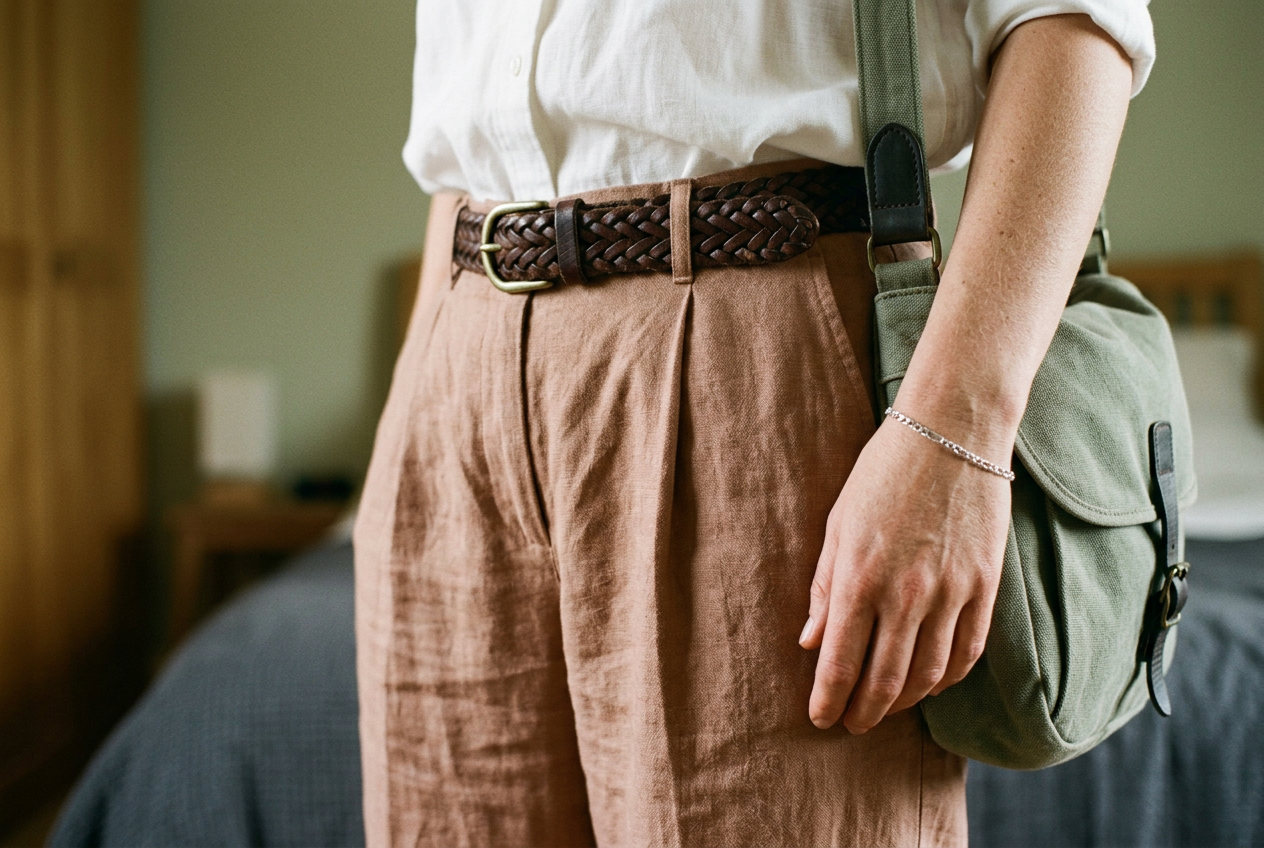
Start with a 30mm dark-brown braided leather belt, worn through the loops of high-rise pleated linen trousers and fastened with a plain brushed buckle. Thirty millimeters is narrow enough to sit quietly against light summer fabric, while the braid introduces texture without relying on a logo or oversized hardware. It is also a useful measure of the wider change in men’s accessories this season.
The important shift is not that men have suddenly discovered belts, bags or jewelry. Retail assortments have moved away from accessories that announce their category from across a room: thick monogrammed straps, rigid crossbody boxes and jewelry whose main feature is weight. In their place are pieces that bend, slouch or sit closer to the body, often in leather, suede, canvas, cord and relatively fine metal.
This is men’s coverage, and the wardrobe point matters. Looser trousers, knitted shirts and roomier tailoring leave more visible space around the waist and neckline than a narrow T-shirt with slim jeans did. Accessories now have to finish that space without making a lightweight outfit feel top-heavy.
The belt is the clearest evidence
A braided belt adjusts in smaller increments than a conventional punched belt because the buckle pin passes through the weave rather than a fixed hole. That makes it unusually useful with summer trousers, which may sit differently across the waist depending on whether the fabric has relaxed, the shirt is tucked or the waistband contains a partial elastic panel.
The fit quirk is the tail. A braided belt should fasten with enough length to pass the first belt loop, but the end should not travel far around the hip. Since there is no central set of holes to guide the eye, an overlong size looks untidy sooner than it would in a plain leather strap. If two sizes both close comfortably, the shorter one is usually cleaner, provided it still reaches that first loop.
Material separates the useful version from the temporary one. Full-grain leather, meaning the dense outer surface of the hide remains intact, develops creases and a darker patina where the strands cross. Bonded leather, made from leather fibers held together with adhesive, can split at those same pressure points. Cotton webbing is cooler, lighter and often cheaper, though it reads more casual and can buckle at the edges after repeated wear.
The 30mm dark-brown belt works because its scale matches the trousers. A wide Western belt with a large buckle can be convincing with denim or a deliberately shaped jacket, but it tends to pull soft linen inward and create a hard horizontal line across the waist. Western hardware is a real fashion signal, yet it remains look-specific. Treat it as a second belt, not evidence that every plain strap is obsolete.
Price should follow construction. At mass-market prices, a tightly woven cotton belt is often a better buy than leather assembled from thin laminated strips. Braided leather becomes more credible around the cost of a decent pair of sneakers, where the strands should feel substantial, the back should not shed fibers and the buckle should turn without grinding against the leather loop. Designer pricing buys finish and branding, but does not solve an overlong tail.
Bags are relaxing at the edges
The bag change is visible in structure. Compact camera bags and rigid phone pouches have not disappeared, but the rising everyday shape is softer: a small shoulder bag that folds against the ribs, or a larger tote that gives under the arm rather than holding a perfect rectangle. East-west bags, meaning bags wider than they are tall, also fit this direction because they spread their contents across the body instead of hanging as a deep block.
Softness has practical costs. An unlined suede bag can release fine fibers onto dark clothing, absorb sunscreen from a hand and lose shape when loaded with a water bottle. A narrow shoulder strap may look elegant on a product page, then press through a knitted polo once keys, sunglasses and a charger are inside. The best version has either a broad strap or enough body in the base to stop the contents gathering into one heavy corner.
For summer, tightly woven canvas remains the less glamorous but more dependable alternative. It tolerates heat, weighs less than substantial leather and usually allows some spot cleaning, although pale canvas shows contact marks quickly. Nylon is stronger for wet days but can make relaxed tailoring feel technical unless the hardware is restrained.
A useful bag should pass a simple packing test before purchase. Put in the objects carried on an ordinary day, close the fastening and wear it over the intended shirt or jacket. If the bag twists toward the heaviest object, the internal layout is wrong for that load. If the strap reaches its final adjustment hole before the bag sits at the upper hip, it lacks enough range for taller bodies or crossbody wear.
The noise is the bag that has been reduced until it holds little beyond a cardholder, yet still carries designer-bag pricing. Tiny proportions can sharpen an outfit, but they rarely replace a pocket. The more durable shift is toward bags that look less formal while remaining large enough to remove weight from trouser pockets.
That distinction returns us to the braided belt. Both pieces work through compliance: the belt adapts to the waist, while the bag adapts to the body. Their value is partly visual, though their staying power comes from making loose summer clothes easier to wear.
Jewelry is moving closer to the skin
Men’s jewelry has become more integrated with the neckline rather than disappearing. The clearest versions are fine pendant chains, short cord necklaces and rings with low profiles, which can remain on through an ordinary day without dictating the rest of the outfit. The heavy Cuban chain, a chain made from interlocking flattened oval links, still has a place, but it is no longer the only shorthand for intentional jewelry.
For an everyday chain, proportion matters more than novelty. A chain around 2 to 4mm wide usually sits under an open shirt without competing with the collar. Length is personal, so measure a chain already owned rather than trusting a model image; neck circumference and shirt opening alter where the same listed length lands. A pendant should clear the collar edge or remain fully inside it.
Hovering directly on that edge makes both pieces look misplaced.
Sterling silver, an alloy containing 92.5 percent silver, darkens with exposure to air and skin products but can be polished. Stainless steel usually changes less and costs less, though it lacks silver’s softer surface and is harder for a jeweler to resize or repair. Solid gold avoids plating wear and suits constant use, but the price rises sharply with weight.
Gold-tone plating is the budget route, provided the wearer accepts that friction at clasps and ring edges may reveal the base metal.
The noisier jewelry story is maximal personalization sold as a ready-made set: several necklaces, mixed beads and multiple rings designed to appear collected over time. Some men will wear that combination well. As a retail proposition, it often asks the buyer to purchase the finished image rather than build a habit. One chain that does not catch chest hair, turn the neck green or collide with every shirt collar is the more meaningful shift.
The useful signal is repetition
Retail signals become credible when the same construction appears at different price levels. Soft woven belts now sit beside formal leather straps; relaxed shoulder bags appear in both luxury leather and high-street fabric; fine necklaces are merchandised as daily wardrobe pieces rather than event accessories. No sales figure is needed to see that the assortment has widened.
Social visibility is less useful on its own. Oversized buckles, miniature bags and dense stacks of charms produce a clear image, which helps them travel, but image clarity says little about repeated wear. The practical test is whether an accessory works with two different trouser rises, more than one shirt collar or the amount carried on a normal afternoon.
That 30mm braided belt clears the test. It fits pleated linen trousers, adds texture to straight chinos and remains unobtrusive under an overshirt, although it will not provide the hard polish of a smooth black strap with a suit. Buying it makes sense for a soft summer wardrobe. Replacing every belt with it does not.
Questions people ask
Are braided leather belts still worth buying?
Yes, if the braid is made from substantial leather strips and the tail fits your belt-loop spacing. They are particularly useful when summer waistbands vary in fit because the buckle can fasten anywhere through the weave. Choose smooth leather instead when the outfit needs a formal, uninterrupted line.
What size summer bag is most useful for men?
Choose around the daily load rather than the trend shape. A bag should hold a phone, wallet, sunglasses and any regular charger without bulging, while the strap should retain adjustment in both directions. If a water bottle makes the bag twist, move to a wider tote or a design with a structured base.
Which metal is best for everyday men’s jewelry?
Sterling silver is a useful middle ground when occasional polishing is acceptable, while stainless steel costs less and resists visible change. Solid gold suits long-term, constant wear if the price is comfortable. With plated jewelry, inspect high-friction areas regularly because the underlying metal usually appears first at clasps, edges and ring undersides.
Should a belt match a bag in summer?
Exact matching is unnecessary. Keep the visual weight related instead: a slim braided brown belt can sit with a soft tan, olive or dark-brown bag because both have muted texture and flexible structure. A glossy rigid bag may need a smoother belt, particularly when the shirt and trousers are already relaxed.
One update a day
Today's fashion update, in your inbox
One fashion update each morning — no hype, no filler, just pieces worth wearing.