Bag Charms Get Heavy Before They Look Finished
Dense charm clusters make an ordinary bag feel personal, but metal rings and swinging weight can leave permanent evidence. A short handling check separates decoration from damage.
August 10, 2026 · 8 min read
The useful version of the bag-charm trend is not the most crowded one. A single mascot or leather fob can alter the mood of a familiar bag without asking much of its construction; a cluster of metal clips, chains, figures and souvenir tags behaves more like extra cargo, except that the cargo swings outside the bag and repeatedly hits the same places.
This is unisex advice. The mechanics do not change with the wardrobe around the bag, though the current styling ranges from toy-like plush figures on compact shoulder bags to carabiners loaded with keys and tags on nylon crossbody styles.
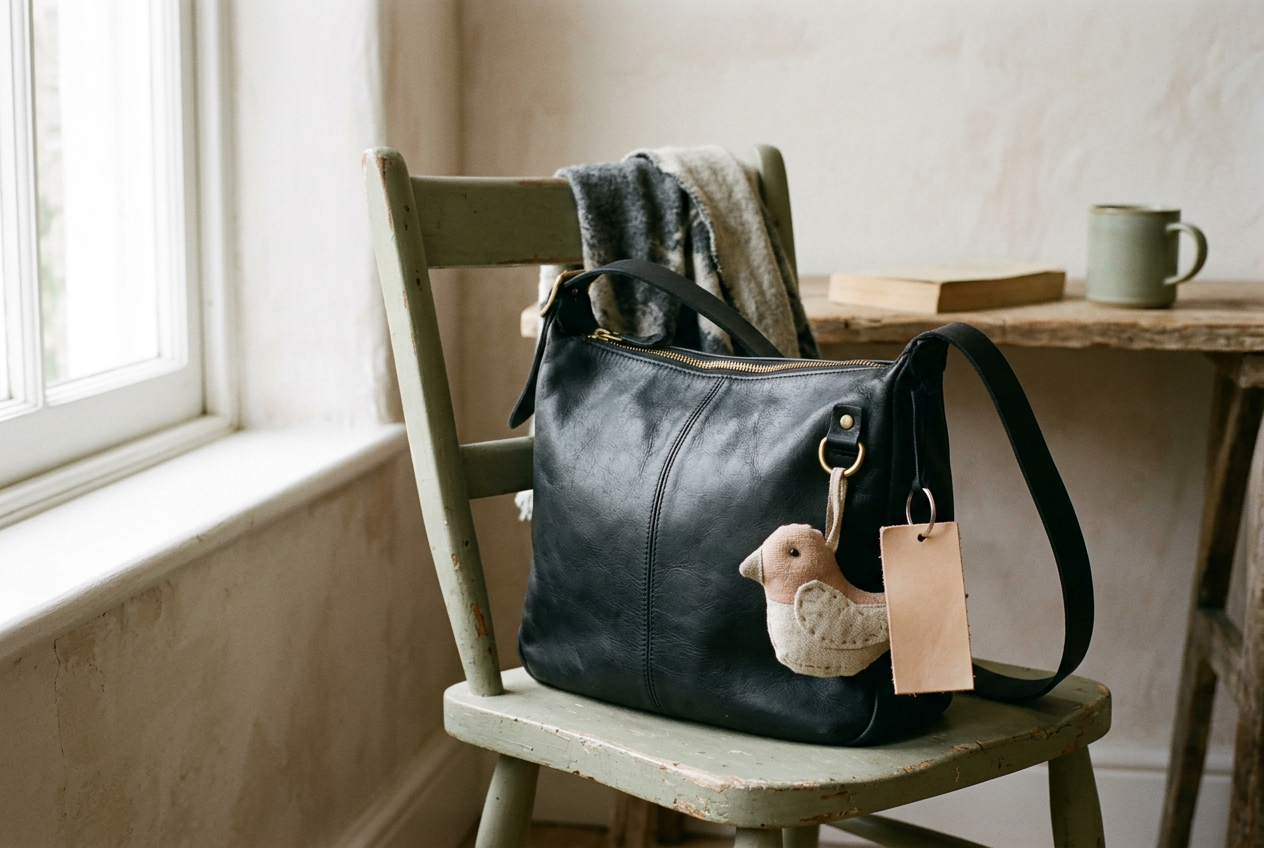
For the hands-on evaluation behind this assessment, the anchor was a small black leather zip-top shoulder bag with two narrow rolled handles and an exterior D-ring, meaning a D-shaped metal point intended for attaching or adjusting hardware. The test cluster combined a fabric mascot on a cord loop, an acrylic tag, a leather fob and a short metal chain. That mix matters: soft pieces added bulk, while the smaller metal parts produced most of the contact and noise.
Weight becomes leverage
A charm cluster can feel light in the hand yet pull noticeably once it hangs several inches below an attachment point. The problem is leverage. A long chain or cord allows the weight to swing through a wider arc, increasing the repeated tug at the ring, handle base or zipper pull even when the charms themselves are modest.
On the black shoulder bag, the fabric mascot accounted for much of the visual volume without making the handle twist. The short chain changed the behavior more. It pulled the cluster away from the bag during walking, then let the acrylic tag strike the leather as the bag returned toward the body. Shortening that connection reduced both movement and sound without removing any charm.
There is no single safe weight for every bag. A substantial canvas tote with webbing stitched down its body can tolerate more than a small leather bag whose rolled handles meet the body through narrow tabs, and a manufacturer’s stated load limit, when one is supplied, should include the charms as well as everything packed inside.
A kitchen scale gives a useful comparison. Weigh the empty bag, then the complete charm cluster. If the decoration begins to feel like a meaningful addition to the bag’s empty weight, treat that as a prompt to remove the densest metal piece or move the cluster onto a stronger bag. The number matters less than the comparison, because a light evening bag and a reinforced commuter tote should not be judged by the same threshold.
Watch the attachment point while lifting the packed bag. A ring that rotates freely is doing what it was designed to do. Leather that puckers around the ring, a handle that rolls outward, or stitching that opens enough to reveal gaps is objecting before it fails.
The contact point tells the story
Smooth leather shows repeated contact quickly. Metal edges can leave pale surface lines, while painted acrylic may transfer color if moisture and friction are involved. Suede and nubuck are more vulnerable because their raised surface can flatten into a darker-looking patch. Coated canvas usually hides light contact better, although hard hardware can still abrade printed corners and trim.
The black bag’s short metal chain was the least successful part of the cluster. When attached to the exterior D-ring, it rested partly against leather and clicked during each step; when moved to one handle, it slid toward the handle base and concentrated the cluster over the edge paint, the protective coating applied to a cut leather edge. Neither position improved the bag.
A cord loop worked better because it held the fabric mascot without presenting a sharp edge to the leather. It still needed inspection. Rough cord, exposed wire inside a flexible loop and crimped metal ends can saw at a handle slowly, especially when the same charm remains attached for weeks.
Zipper pulls are tempting attachment points and usually poor ones. A loaded pull can drag the slider toward one side while the bag is carried, making the opening less secure, and a wide split ring, meaning a coiled metal ring opened by separating its layers, can catch the fabric beside the zipper teeth. On the test bag, the acrylic tag also fell across the zip path whenever the bag was set down. That made opening the bag a two-hand task.
Noise deserves its own decision. A light click in front of a mirror becomes continuous on stairs, public transit or a quiet office floor. Metal touching metal is the main source, so removing one chain can make a larger difference than removing a bulky plush figure.
A five-minute attachment check
Start with the bag packed as it is normally carried. An empty-bag test misses the way a full body changes shape, pulls handles apart and moves a charm closer to corners or zipper teeth.
Clip on the complete cluster and lift the bag by its usual handle or strap. Hold it still for a minute, then walk indoors, sit down and place it beside a chair. Those ordinary changes of position expose different failures: a charm that clears the zipper while standing may become trapped under the bag when seated, while a long fob can hit the floor every time the bag is put down.
Next, open and close every zipper fully. One finger’s clearance between the cluster and the moving zipper path is a practical minimum, not an engineering specification; if the finger cannot pass without pushing charms aside, the arrangement will demand attention each time the bag opens. Move the attachment or shorten the drop.
Run a clean white cloth over the charm surfaces before letting them rest against pale leather. This does not predict every case of dye transfer, particularly in rain or heat, but visible pigment on the cloth is enough reason to avoid direct contact. Check for burrs by passing the edge across scrap fabric rather than skin. Any snag can mark a bag lining, scarf or coat.
Then inspect the attachment from both sides. The clasp should close fully, with no charm cord caught in its gate, and the hardware should be too large to slip through the bag’s ring yet small enough to move without forcing it. If attaching requires prying open a split ring against leather, assemble the charms away from the bag and connect the finished cluster with a smooth clasp.
Finally, photograph the undecorated bag and repeat the inspection after several carries. Look at the handle base, edge paint, zipper tape and the patch of leather beneath the cluster. Early polishing or a faint line is easier to stop than a worn groove.
Resale favors reversible decoration
Bag charms can support resale when they are original accessories sold with the bag, but aftermarket decoration adds uncertainty rather than automatic value. A future buyer may like the styling and still discount scratched leather, stretched handle tabs or discolored hardware. The charm collection and the bag should be treated as separate items unless they were designed and documented as a set.
Reversibility is the useful standard. Keep original straps, detachable tags, dust bags and spare hardware apart from the charm cluster, and do not replace a factory ring with a cheaper connector that may alter the finish. Avoid adhesives, drilled holes and permanent stitching. A low-cost fob is not worth a leather repair or a visible resale deduction.
Photographs help here too. Images taken before decoration can show that a mark was absent, while periodic close-ups make it easier to notice wear before listing the bag. Clean the charms separately. Metal polish, alcohol and household cleaners that suit a trinket may strip coating or color from bag leather.
Expressive, within limits
The charm-covered bag is rising because it offers personalization without buying a new bag, and because an uneven mix can make a polished shape feel less formal. That appeal survives the practical objections. Dense hardware does not need to.
On the black shoulder bag, the strongest arrangement kept the fabric mascot and leather fob on the exterior D-ring, shortened their drop, and removed the metal chain from daily use. The acrylic tag could return for an occasional outfit, provided it stayed clear of the zipper. The result was less elaborate, but the bag opened normally and the leather stopped serving as a percussion surface.
Whether the fuller version lasts as a fashion signal is harder to settle. A removable cluster has little commitment built into it, which is part of the pleasure. The sensible stopping point arrives when the bag’s construction starts adapting to the charms rather than the charms adapting to the bag.
Questions people ask
How heavy should bag charms be?
There is no universal limit because handle construction and bag weight vary. Weigh the empty bag and the complete cluster, include charm weight in any stated load limit, and remove pieces if leather puckers, a handle twists or the attachment ring pulls out of its normal position.
Can bag charms scratch leather?
Yes. Metal edges, acrylic corners and rough cords can polish or score smooth leather through repeated movement, while suede may flatten where a charm rests. Use soft loops, shorten swinging chains and check the contact patch after several carries rather than waiting for a deep mark.
Is it safe to attach charms to a zipper pull?
A very light, short charm may work, but zipper pulls are weaker and less stable than dedicated exterior rings. Skip the attachment if it drags the slider, crosses the zipper path or catches the surrounding fabric. A closed D-ring or reinforced strap loop is usually the better location.
Do bag charms reduce resale value?
Removable charms alone do not necessarily reduce value. Damage associated with them can: scratched leather, stretched tabs, worn edge paint and changed hardware are harder to dismiss. Keep decoration reversible, retain original parts and remove the cluster before storage so it cannot rest against the bag.
One update a day
Today's fashion update, in your inbox
One fashion update each morning — no hype, no filler, just pieces worth wearing.